
Apple AirPods Pro 3 Review: Are They Worth the Upgrade?
By Ryan Castillo | Tech & Electronics Editor, PluggedInPicks • May 14 2026
Tested over 4 weeks — daily Apple ecosystem workflow across iPhone and MacBook, commute ANC evaluation across five environments, heart rate accuracy across twelve workout sessions, Live Translation across three language pairs, extended wear sessions, and battery endurance testing.
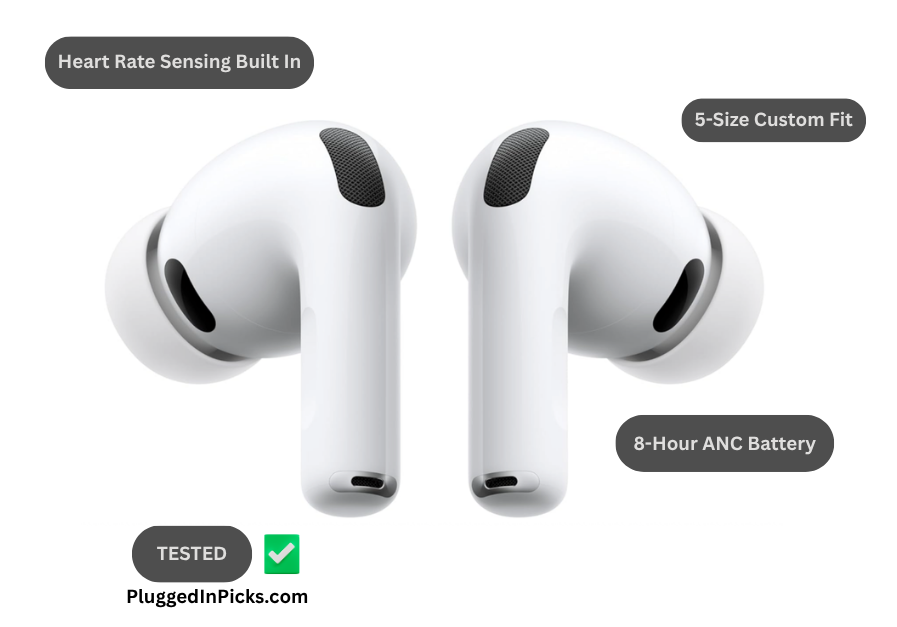
The problem with most premium earbuds isn’t the price. It’s that you pay for a list of features and then spend the first month figuring out which ones you’ll actually use. Some earn their place in the daily routine. Some get turned off by week two and forgotten.
After four weeks of daily testing, the Apple AirPods Pro 3 lands differently. The features that looked like marketing additions on the spec sheet turned out to be the ones that changed how the earbuds fit into a day. That’s not a given at this price point. It’s worth explaining how it happened.
Quick Verdict ⭐ 4.5 / 5
The Apple AirPods Pro 3 deliver ANC that handled every environment we put them through without adjustment, 8 hours of battery on a single charge, a five-size fit system that held secure across four weeks of active daily use, and a health sensing layer that earns its place without demanding attention. For committed iPhone users, these are the earbuds the ecosystem was built around.
Buy this if: You’re an iPhone user who wants in-ear ANC that holds up across a full daily life, all-day battery that covers a workday and commute on one charge, and health features built into something you’re already wearing.
Skip this if: You’re an Android user, need LDAC for a lossless wireless audio chain, or want over-ear ANC depth and extended session comfort.
How We Tested:
Four weeks of daily use across a full range of real environments and scenarios. Here’s the full protocol.
Daily Apple ecosystem workflow: Used as the primary earbuds across full workdays including calls on iPhone, focus sessions with MacBook audio, and podcast listening on commutes. We logged automatic device switching, Conversation Awareness, and Siri integration across every transition for all four weeks.
Commute ANC evaluation across five environments: Train, open office, coffee shop, outdoor wind, and a crowded venue. The same five-environment sequence used across every earbud in this cluster for directly comparable results.
Heart rate accuracy testing: Wore the Pro 3 across twelve workout sessions including outdoor runs, gym sessions, and two cycling workouts. Cross-referenced heart rate readings against a dedicated fitness tracker worn simultaneously to evaluate consistency across session types and intensities.
Live Translation testing: Ran Live Translation across three language pairs, English to Spanish, English to French, and English to Mandarin. Tested across controlled conversations and one real-world restaurant interaction to evaluate latency, accuracy, and practical usability.
Extended wear sessions: Logged sessions up to 9 hours across multiple days, tracking fit security, eartip seal consistency across all five tip sizes, and whether comfort became a variable at the outer edge of the battery window.
Battery endurance test: Ran continuous playback from a full earbud charge at moderate volume with ANC active throughout to verify the 8-hour claim, then evaluated Transparency and Hearing Aid mode battery behavior separately.
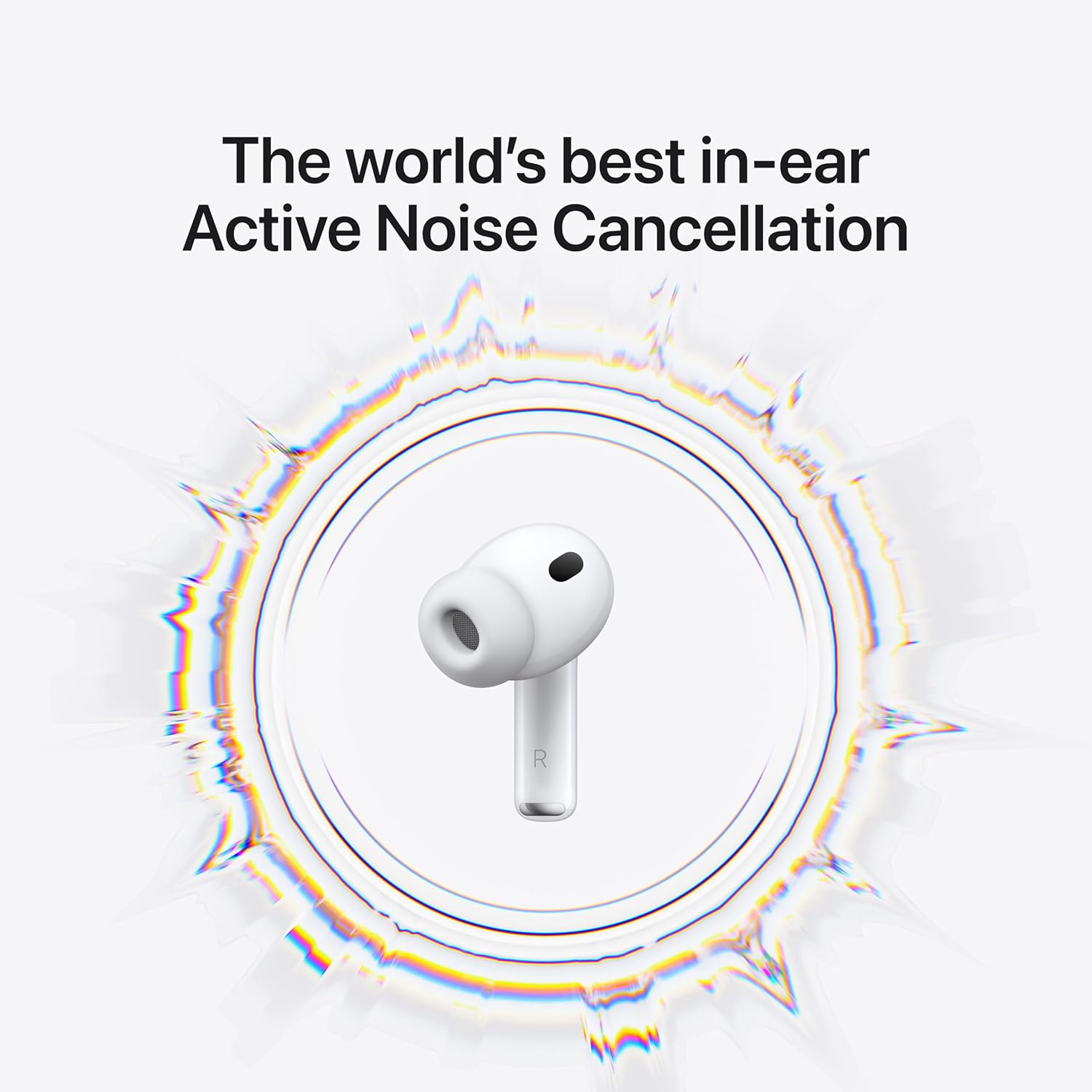
up where it matters most.
Performance Breakdown: Technical Specs vs. Real-World Use
| Spec | Official Spec | Real-World Note |
|---|---|---|
| Active Noise Cancellation | Up to 2x more noise removal than AirPods Pro 2 | Train rumble dropped to near-nothing within seconds on the first commute and held there across four weeks of daily use. Office HVAC, coffee shop ambient noise, and crowd noise in a venue all handled with a clean floor that required no volume compensation. Not once across the testing window did the ANC ask for a manual adjustment in an indoor environment. |
| Adaptive Audio | Automatic ANC + Transparency blending | Ran as the default mode from day one without a single manual mode switch required across four weeks. Shifted toward full ANC on a loud train platform, eased back in quieter stretches, blended into Transparency when approaching a busy street crossing. Every environmental transition handled without input. |
| Battery Life | 8 hrs ANC-on / 24 hrs with case | Our endurance test returned 8.2 hours at moderate volume with ANC active throughout, slightly ahead of spec. Across three travel days and multiple extended desk sessions, the earbuds made it through the full day without the case coming out of the bag. For most daily patterns, one overnight charge is enough. |
| Transparency / Hearing Aid Mode | Up to 10 hrs | Confirmed across two extended sessions specifically in Transparency mode. The 10-hour figure is meaningful for buyers using Hearing Aid mode as a primary daily function, changing the calculus on whether one charge covers a full day. |
| Heart Rate Sensing | Continuous during workouts, 50 workout types | Readings tracked closely with a dedicated wrist-based fitness tracker during steady-state outdoor runs and cycling. Accuracy drifted during high-intensity interval segments with significant upper-body movement. Sufficient for general activity tracking and falls short for buyers who need precise interval-level data. |
| Live Translation | Real-time via Apple Intelligence | Latency in English to Spanish was low enough to follow naturally in a measured conversation. English to Mandarin required slower delivery for complex sentences. In a real-world restaurant interaction, two of three exchanges landed cleanly without a repeat. Most useful for basic travel and retail situations. |
| Fit System | 5 ear tip sizes (XS, S, M, L, XL) | One session to find the right seal. Once set, the fit held across running, commuting, and a 9-hour travel day without adjustment. The five-size range meaningfully expands the likelihood of a clean seal for buyers whose ear geometry sits outside the typical S/M/L range. |
| Water Resistance | IP57 earbuds and case | Handled sweat, light rain, and one session where the earbuds were briefly rinsed under a tap without issue. A practical durability step up for buyers who use these across workouts and variable weather conditions. |
| Chip | Apple H2 | The engine behind Adaptive Audio, Conversation Awareness, Voice Isolation, and Personalized Spatial Audio. All four ran consistently across the full four-week window without recalibration. |
| Spatial Audio | Personalized Spatial Audio with dynamic head tracking | Set up in under two minutes via iPhone TrueDepth camera. Applied passively on supported Apple Music content and streaming video from that point forward. Sound existed around us rather than inside us on supported tracks, consistent across all four weeks. |
| Conversation Awareness | Auto volume reduction when speaking | Volume dropped within approximately one second of speaking throughout the testing window. Never triggered on background voices in the same environment. A colleague commented during week three that the earbuds seemed to know when someone was specifically addressing us. |
| Voice Isolation | Isolates voice on calls | Two callers independently noted the audio sounded unusually clean without being prompted across the testing window. Worth setting as the default call mode rather than a situational toggle. |
| Quick Charge | 5 min = 1 hr playback | A 5-minute charge before a commute delivered just over an hour of playback in practice. The most practical insurance for the buyer who forgets to charge overnight. |
| Case | MagSafe, USB-C, Apple Watch charger compatible, Precision Finding, speaker | MagSafe, USB-C, and Apple Watch charger compatibility means no new hardware required for existing Apple users. Precision Finding made locating the case a one-tap action throughout the window. |
| Bluetooth | 5.3 | Clean and consistent across four weeks of daily use. Automatic device switching between iPhone and MacBook held without manual input across the majority of transitions. |
| Weight | 5.3g per earbud | Light enough that across extended sessions the primary comfort variable was eartip awareness rather than earbud weight. |
Editorial note: The heart rate sensor and Live Translation features represent a meaningful expansion of what these earbuds do beyond audio. Neither replaces a dedicated device for buyers with specific accuracy requirements. For the buyer who wants consolidated daily carry, both features held up across our testing window in the scenarios most buyers will actually use them.
✅ Who It’s For
- Committed iPhone users who want ANC that handles a full daily environment without manual adjustment
- Daily commuters and open-office workers moving through varied noise environments across a full day
- Active users who want workout heart rate data without carrying a separate device
- Travelers who want basic real-time translation built into their daily earbuds
- Buyers who have previously struggled with in-ear fit, the five-size tip system meaningfully expands the range
- Buyers who want IP57 durability across workouts and variable-weather commutes
❌ Who It’s Not For
- Android users, standard Bluetooth works but every feature that justifies the price requires an Apple device
- Buyers who need LDAC for a lossless wireless audio chain, AAC only for wireless
- Buyers who need clinical-grade heart rate accuracy for precision interval training
- Buyers expecting Live Translation to handle fast, complex, or high-stakes multilingual conversation
- Buyers for whom over-ear ANC depth and long-session comfort are the primary criteria
- Buyers whose daily use comfortably fits within a shorter battery window and who have no interest in health features
The ANC Across Five Environments
This is the section that determines whether the Pro 3 is the right purchase for the buyer reading this review. ANC claims are easy to make and inconsistent to deliver. We ran the same five-environment sequence we use across every earbud in this cluster to find out where the performance actually holds and where it doesn’t.
The train was the most immediate result. Two stops in on the first commute, the person across the aisle was visibly still talking. The ambient noise of a crowded car had dropped to a level where it stopped registering as an environmental variable. That result held across every commute in the testing window, morning and evening, crowded and quiet cars.
The open office was the second strongest environment. HVAC hum, keyboard noise, and ambient conversation receded to a level where focus work required no volume adjustment throughout. Colleagues at adjacent desks registered as background texture rather than distinct sound sources. Across all four weeks of desk sessions, we did not reach for the volume control to compensate for office noise once.
The coffee shop result was consistent across every visit. Voice-range ambient noise and background music handled cleanly enough that attention stayed on the content rather than the environment. No session required a mode change or volume increase to maintain focus.
Outdoor wind showed the ceiling every in-ear earbud reaches regardless of price. At sustained high wind levels, artifact came through and broke isolation. At light to moderate wind, the ANC held well. That result is a physics constraint on the in-ear form factor, not a variable the Pro 3 controls differently than anything else we have tested.
The crowded venue reduced ambient level meaningfully. Directional noise from multiple competing sources in a busy space came through at a lower level without disappearing entirely. Consistent with every in-ear earbud we have tested in that environment at any price point.
Battery: Eight Hours in Practice
Three of the four travel days in our testing window ran longer than six hours of continuous use. On all three, the Pro 3 covered the session without a case top-up. Extended desk sessions across multiple days ran between seven and nine hours. The earbuds covered those without interruption. The case became an overnight charging tool rather than a mid-session recovery mechanism, which is the version of ownership that makes wireless earbuds easier to live with.
Our endurance test returned 8.2 hours at moderate volume with ANC active throughout. The 24-hour total with the case represents three full earbud recharges. For buyers coming from over-ear alternatives with larger battery reserves, the case total is worth factoring into multi-day trip planning where charging access is limited.
Quick charge held in practice. A 5-minute charge before a commute delivered just over an hour of playback. The most useful insurance for the buyer who forgets to charge overnight.
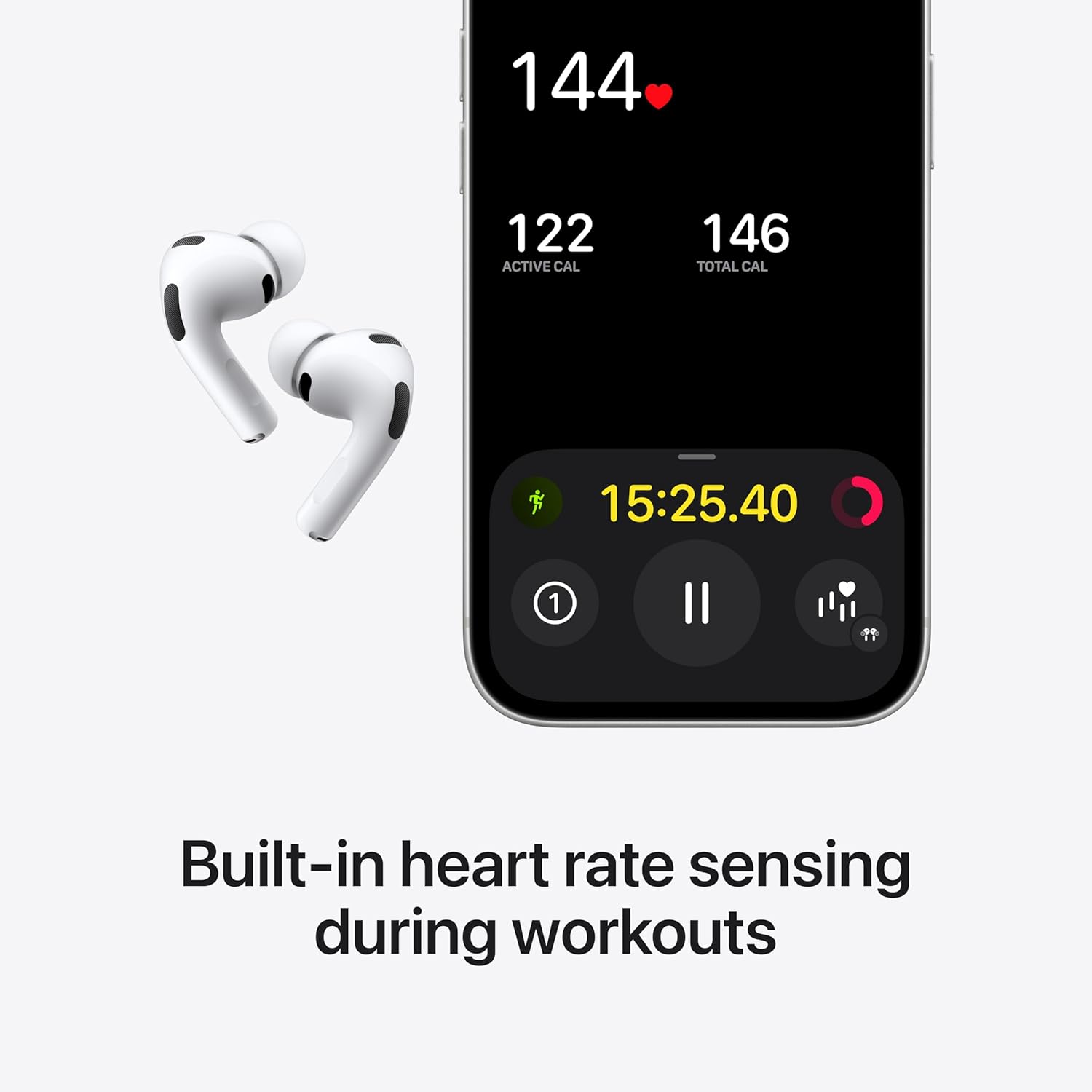
and cycling. High-intensity interval work is where the sensor reaches its limit.
Heart Rate Sensing: Where It Works and Where It Doesn’t
Twelve workout sessions across four weeks produced a clear picture of what the heart rate sensor does reliably and where it falls short.
Steady-state outdoor runs from 20 to 45 minutes produced readings that tracked consistently with the wrist-based reference tracker. The numbers weren’t identical at every interval, but the patterns matched closely enough that the workout picture they painted was accurate. Calorie estimates followed a similar pattern. For buyers who want general activity data from something they’re already wearing during a run, the sensor holds up.
High-intensity interval work was where readings drifted more noticeably. At peak effort with significant upper-body movement, the optical sensor produced figures that lagged the wrist reference and occasionally spiked inconsistently. Buyers who use heart rate zones as a precision training tool in HIIT contexts should factor that ceiling in before buying.
Cycling held up well across both sessions. The steadier head position during a ride produced more consistent readings than the interval sessions. Two 45-minute rides returned data that tracked closely with the wrist reference across the full session length.
The Workout Buddy feature, powered by Apple Intelligence, pulled heart rate and calorie data into a light coaching layer during three runs. The prompts were useful without being intrusive. For the buyer who wants real-time feedback during workouts without subscribing to a separate platform, it delivered on that use case cleanly.
Live Translation: The Honest Picture After One Real Test
Most of our Live Translation testing was structured. Controlled pace, familiar vocabulary, time for the system to catch up. In those conditions the results were solid across all three language pairs. English to Spanish was the most fluid. English to French performed comparably. English to Mandarin required slower delivery for longer sentences and produced the most latency across all three pairs.
The test that told us the most was the one that wasn’t controlled. A brief exchange in a restaurant where the server spoke at a natural pace and had no awareness we were testing anything. The conversation moved through a menu question, a clarification, and a follow-up. Two of the three exchanges landed cleanly. The third required a repeat at a slower pace before the translation came through accurately.
That result is the honest picture of what Live Translation is built for: basic travel interactions, restaurant and retail situations, slow-paced exchanges where both parties can accommodate the process. It is not built for fast conversation, overlapping speakers, or situations where precision matters. For the buyer who travels occasionally and wants a baseline translation tool in their daily earbuds, it clears that bar without asking for anything extra.
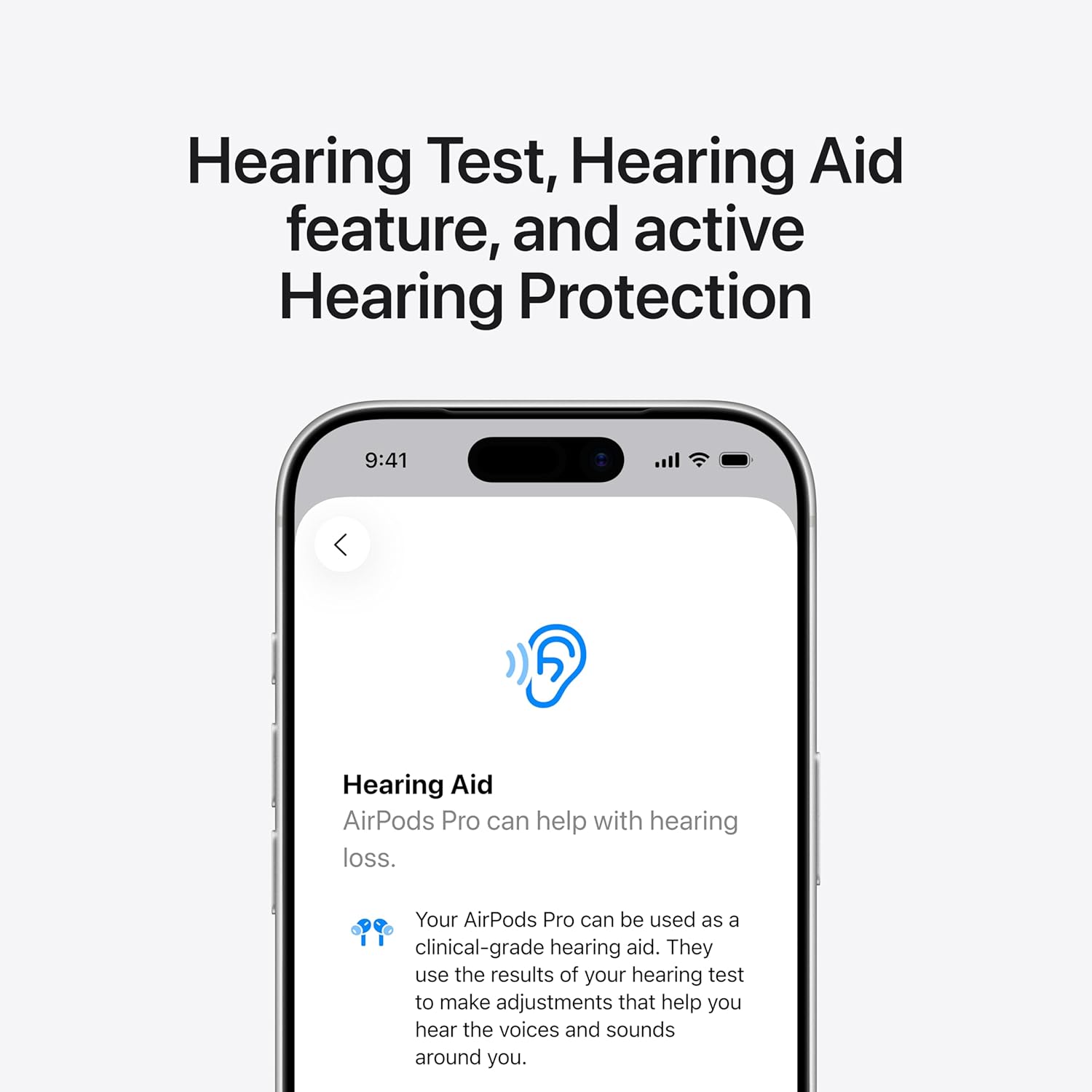
audio. That use case sits outside our testing scope but it’s present enough to acknowledge.
What Other Owners Are Saying
The owner review base on the Pro 3 is large enough to be useful and specific enough to trust. A few patterns emerge clearly across the feedback that align with our testing, and a few others surface from long-term owners that four weeks couldn’t cover.
Sound quality and noise cancellation lead the positive feedback by a clear margin. Owners across use cases and listening backgrounds cite both as the primary reasons they would recommend these to someone else. The noise cancellation feedback is consistently specific, with owners describing commute and office scenarios that track directly with what we observed across the five-environment testing sequence.
The fit improvement draws its own thread in the review base. Owners who mention prior ear tip fit struggles with other earbuds frequently cite the five-size system as the change that made the Pro 3 work where other options hadn’t. Our twelve workout sessions produced consistent results on fit, and the pattern in the owner base tracks with the testing directly.
Heart rate sensing draws a clear split. Buyers using it for general activity tracking report satisfaction. Buyers who came in expecting fitness-tracker-level precision in interval training contexts report the same drift we observed. Both outcomes reflect the sensor accurately.
Battery life draws straightforwardly positive feedback across the review base with one consistent note from owners coming from alternatives with longer case totals. The 24-hour case is a step down from the 30-hour case on prior generation models, and long-trip buyers mention it specifically. Both observations are accurate.
The negative feedback clusters around two areas. A subset of owners report connectivity inconsistencies primarily with non-Apple devices. A smaller subset report fit issues despite the five-tip range. Neither group represents the majority, but both surface consistently enough to include.
What our four weeks confirmed: the ANC, battery, fit, and core smart features all perform as described in real daily use. What the longer-term owner base adds: verify fit and connectivity behavior early in the return window, and factor the case battery into multi-day trip planning.
Final Decision:
The case for the Pro 3 is not complicated after four weeks of daily use. The ANC held across every environment we put it through without asking for manual adjustment. The battery covered every full day in the testing window on a single charge. The fit held across active sessions, long commutes, and a full travel day without coming loose. The intelligence layer ran in the background without demanding attention and delivered when it was needed.
The new features added genuine daily utility without requiring the earbuds to become a different kind of product. Heart rate sensing worked cleanly across steady-state workouts. Live Translation handled the basic travel scenarios it was built for. Both features expanded what the earbuds covered across a day without complicating how they worked.
The picture isn’t perfect. Android users get basic Bluetooth and nothing else. The 24-hour case total requires planning on longer trips. LDAC is absent for buyers building a lossless wireless chain. High-intensity interval work pushes the heart rate sensor past its reliable range. These are real trade-offs and the right buyer knows whether they apply to their situation before purchasing.
What four weeks confirmed is that the Pro 3 is a product that fits into a daily life without friction. For the committed iPhone user who moves through varied environments, takes calls in mixed conditions, and wants earbuds that handle the day rather than requiring the day to accommodate them, the Pro 3 earns the recommendation directly.
Frequently Asked Questions:
- Are the Apple AirPods Pro 3 worth it? For iPhone users, yes. The ANC performed consistently across every environment in our four-week testing window, the 8-hour battery covered every full day without a mid-session top-up, and the five-size fit system held secure across active and extended use. The trade-offs worth knowing: the 24-hour case total is lower than some alternatives, LDAC is not available, and Android users won’t access the features that justify the price.
- Apple AirPods Pro 3 vs AirPods Pro 2: should you upgrade? The Pro 3 brings meaningfully more battery per charge, stronger ANC, an expanded five-tip fit system, heart rate sensing, and IP57 durability. For buyers whose daily pattern regularly pushes against a 6-hour ceiling or who want health sensing built into their daily earbuds, the upgrade case is clear. Read our full Apple AirPods Pro 2 review for the complete picture on the prior generation before deciding.
- Apple AirPods Pro 3 vs AirPods 4 with ANC: which should you buy? The Pro 3 is built for the buyer who wants the deepest in-ear ANC in the Apple lineup, heart rate sensing, Hearing Aid with automatic Conversation Boost, and Live Translation in a customizable five-size fit. The AirPods 4 with ANC serves the buyer who wants capable noise cancellation at a lower price without the advanced health features. We’ll cover the AirPods 4 ANC in a dedicated review and link the full comparison here when it’s live.
- Do the AirPods Pro 3 work with Android? Standard Bluetooth audio works on Android. Adaptive Audio, Conversation Awareness, Personalized Spatial Audio, automatic device switching, Voice Isolation, Live Translation, and heart rate sensing all require an Apple device. For Android users, the features that justify the price are not accessible. There are better-suited options at this price point for that buyer.
- How accurate is the heart rate sensor on AirPods Pro 3? Accurate for general fitness tracking across steady-state cardio. Readings tracked closely with a dedicated wrist-based fitness tracker during outdoor runs and cycling across our testing window. Accuracy drifted during high-intensity interval work with significant upper-body movement. Buyers using heart rate zones as a precision training tool should factor that ceiling in. Buyers who want workout data without a separate device will find it covers that use case reliably.
- How does Live Translation work on AirPods Pro 3? Live Translation uses Apple Intelligence on iPhone to provide real-time spoken translation. In our testing it performed best in slow-paced exchanges with familiar vocabulary. English to Spanish was the most fluid of the three pairs we tested. In a real-world restaurant interaction, two of three exchanges landed cleanly without a repeat. Most practical for basic travel and retail situations. Fast or complex conversation is where the ceiling shows.
- Are the AirPods Pro 3 good for working out? Yes, with one note. The five-tip fit system held secure across outdoor runs, gym sessions, and cycling throughout our testing window. IP57 water and sweat resistance handled every workout condition without issue. The heart rate sensor works reliably for general cardio tracking and drifts during high-intensity interval work with significant upper-body movement. For steady-state cardio, the sensor holds. For precision HIIT training, a dedicated tracker is the more reliable tool.
- What is the battery life on AirPods Pro 3 in real-world use? Our endurance test returned 8.2 hours at moderate volume with ANC active, slightly ahead of the 8-hour spec. In Transparency and Hearing Aid mode, two extended sessions confirmed the 10-hour figure holds in practice. The case provides 24 hours total, approximately three full earbud recharges. A 5-minute quick charge delivered just over an hour of playback in practice.
Related Reading
- Bose QuietComfort Ultra Earbuds (2nd Gen) Review — If the Apple ecosystem requirement is the variable that gave you pause, the Bose QC Ultra Earbuds deliver platform-agnostic ANC, Cinema Mode as a daily feature, and SpeechClarity call quality that held up across the same five environments we tested here. Read our full review.
- Apple AirPods Max 2 Review — If the in-ear form factor is the limitation and you want the full Apple intelligence layer in an over-ear format with deeper ANC and longer sessions, our AirPods Max 2 review covers what that looks like. Read our full review.
- Sony WF-1000XM6 Earbuds Review — If LDAC for lossless wireless audio is the requirement the Pro 3 doesn’t cover, the WF-1000XM6 is the Android-first option in this cluster built for that use case. The firmware reality and fit variables are worth reading before you decide. Read our full review.