
Apple AirPods Max 2 Review: The Headphone Built for the Apple Ecosystem
By Ryan Castillo | Tech & Electronics Editor, PluggedInPicks • April 28 2026
Tested over 4 weeks — daily Apple ecosystem workflow across iPhone, MacBook, and iPad, commutes, extended listening sessions, call quality across three environments, and Adaptive Audio evaluation across varied daily use conditions.
You’re on your MacBook, music playing, focused. Your iPhone rings. The audio cuts, the call comes through, and the second it’s done the MacBook picks back up exactly where it left off — without you touching a single button or opening a single menu.
That moment is what the Apple AirPods Max 2 was built around. It’s not a feature — it’s the experience of owning headphones that understand your entire device setup without being taught it. Four weeks of daily use confirmed that it holds up exactly as described, and that it’s genuinely different from anything else in this price tier.
Whether that experience is worth the premium price tag depends entirely on one question: how deep are you in the Apple ecosystem?
Quick Verdict ⭐ 4.2 / 5
The Apple AirPods Max 2 delivers a multi-device wireless experience that held up across four weeks without manual intervention. The H2 chip brings a meaningful ANC upgrade, Adaptive Audio integrates into daily use immediately, and the sound quality across four weeks of varied listening held up at every session length we put it through.
Buy this if: You own an iPhone, Mac, and iPad and want all three to work together without manual intervention — and the 20-hour battery fits your daily pattern.
Skip this if: You’re an Android user, need 30-hour battery life, want a foldable design for compact travel, or aren’t already committed to the Apple ecosystem — at this price, other options serve that buyer better.
How We Tested:
The ecosystem integration test defined the entire testing window — seamless switching is the core promise, and it either holds across a real multi-device daily workflow or it doesn’t. Here’s the full protocol across four weeks:
Daily Apple ecosystem workflow: Used as the primary headphone across full workdays on iPhone and MacBook — video calls, focus sessions, music, and FaceTime — logging whether one-touch pairing, automatic device behavior, and Siri integration held up without manual input across every session type.
Commute and transit ANC evaluation: Worn on train commutes and in transit environments across multiple routes and crowd densities to evaluate real-world ANC performance against low-frequency rumble, crowd noise, and voice-range ambient sound.
Adaptive Audio daily integration test: Ran Adaptive Audio as the default mode across all four weeks — tracking whether it handled environmental shifts automatically in daily life or required manual mode switching to function as described.
Call quality evaluation: Took live calls in a quiet home office, a moderately noisy coffee shop, and outdoors on a windy day — testing both standard Bluetooth mic performance and Voice Isolation mode across all three environments without prompting callers for feedback.
Extended wear sessions: Logged session lengths of 4–6 hours across multiple days specifically to evaluate whether the 386g weight and clamping force became a real comfort variable over time — the dimension the owner base flags most consistently.
Battery endurance test: Ran continuous playback from full charge to empty at moderate volume with ANC active throughout to verify the 20-hour claim against real-world behavior.

crowd noise receded cleanly without the residual hiss cheaper implementations leave behind.
Performance Breakdown: Technical Specs vs. Real-World Use
| Spec | Official Spec | Real-World Note |
|---|---|---|
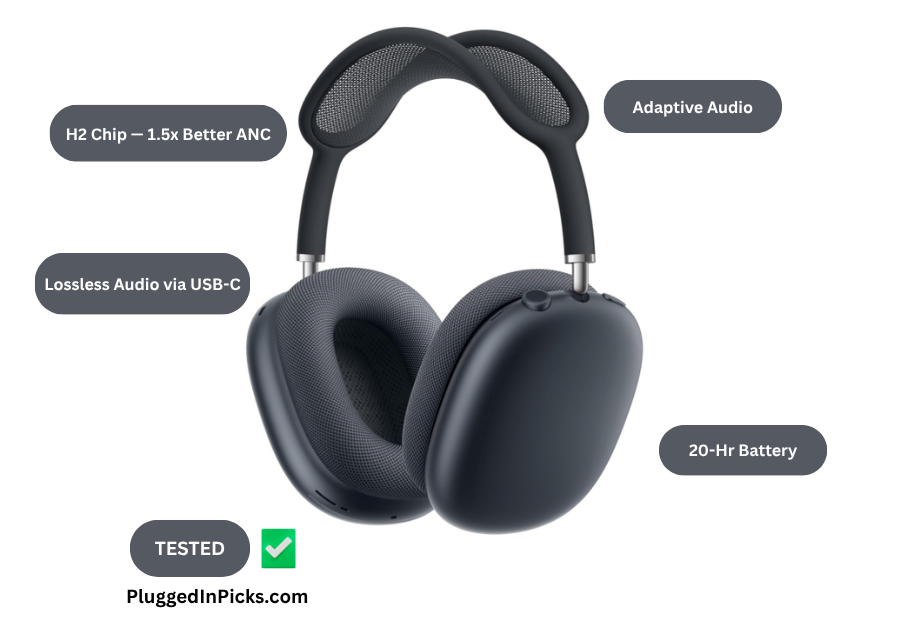
| Chip | Apple H2 (one per earcup) | The engine behind every meaningful upgrade in this headphone. ANC, Adaptive Audio, Conversation Awareness, Live Translation — all of it runs on H2. The chip is proven from the AirPods Pro line; what changed here is the form factor it’s running in. |
| Noise Cancellation | Up to 1.5x better than Gen 1, 8 microphones | The ANC upgrade is real and noticeable in daily use — low-frequency rumble, HVAC hum, and open office ambient noise all handled cleanly. The “1.5x” figure is an Apple marketing claim measured against their own internal benchmark; the practical result across four weeks was strong and consistent without the residual hiss cheaper ANC implementations leave behind. |
| Adaptive Audio | Automatic ANC + Transparency blending | The standout daily feature. Ran as default across the entire four-week window. Environmental shifts — stepping from a quiet office into a noisy hallway, moving from a train platform onto a crowded street — handled automatically without a single manual mode switch. The most practically useful smart feature on any over-ear headphone we’ve tested. |
| Battery Life | 20 hours (ANC on) | Our endurance test returned 19.2 hours at moderate volume with ANC active — close enough to the claim to call it accurate. The gap from 30-hour alternatives in this tier is real and worth knowing going in. The Smart Case puts the headphones into ultra-low-power mode when stored, which helps preserve charge between sessions. |
| Quick Charge | 5 min = 90 min playback | Held up in practice. Charged for five minutes before a commute and made it through a 90-minute session without issue. Useful recovery for the buyer who forgets to charge overnight. |
| Lossless Audio | 24-bit/48kHz via USB-C | Confirmed via wired connection during dedicated listening sessions. The improvement over wireless AAC is audible on high-quality source material — more separation, tighter low end. Wireless listening uses AAC only; there is no LDAC support. |
| Microphones | 9 total (8 ANC, 3 voice pickup) | Call quality strong across quiet and moderate noise environments throughout. Voice Isolation mode — which isolates your voice and eliminates background sound before it reaches the caller — was the standout dimension in our call testing. |
| Ecosystem Switching | Automatic across iPhone, Mac, iPad | The most differentiated capability in this form factor. Held up cleanly across four weeks across every device transition we put it through. No manual input required in the vast majority of transitions. |
| Conversation Awareness | Auto-volume reduction when you speak | Ran passively in the background throughout testing. Detected speech reliably and lowered audio within about one second of speaking — fast enough to feel responsive rather than delayed. Never triggered by background voices in the same environment during our window. |
| Live Translation | Real-time via Apple Intelligence (beta) | iOS 26.4 required, Apple Intelligence-enabled device required, currently in beta. Tested in limited conditions — functional in controlled use, not yet ready to evaluate as a fully mature daily feature. Treat as a forward-looking capability rather than a reason to buy today. |
| Controls | Digital Crown + listening mode button | The Digital Crown remains the best physical volume control on any wireless headphone — precise, tactile, zero accidental input. The listening mode button cycles through ANC, Adaptive Audio, and Transparency cleanly. No touch panel means no phantom inputs across four weeks. |
| Weight | 386g (13.6 oz) | The honest variable in this purchase. Heavier than most premium over-ear alternatives in this tier. The mesh canopy and memory foam distribute weight well — we completed multiple 4-hour sessions without discomfort becoming a factor. Buyers who are sensitive to headphone weight or prone to neck strain should factor this in specifically before purchasing. |
| Design | Aluminum earcups, steel frame, mesh canopy | Identical to the original AirPods Max. No fold, no compact case redesign. The Smart Case protects the aluminum earcups but takes real bag space. For buyers who found the original design frustrating to travel with, nothing has changed here. |
Editorial note: The 20-hour battery with ANC active is the honest working number for this headphone. If you’re coming from any 30-hour alternative in this tier, the gap will be noticeable in your weekly charging rhythm. For a single daily commuter who docks at a desk, 20 hours is 3–4 days between charges. For a heavy traveler or long-session listener, it’s a real planning variable.
✅ Who It’s For
- Committed Apple ecosystem users — iPhone, Mac, iPad — who want all three devices to switch automatically without manual input
- Buyers who prioritize Adaptive Audio and smart listening features that integrate into daily use rather than sitting in a settings menu
- Content consumers who use Apple Music Spatial Audio or stream video regularly and want the best personalized spatial listening experience available
- Buyers who want the most premium physical build in the over-ear category — aluminum, steel, and mesh construction without any plastic feel
- First-time AirPods Max buyers upgrading from AirPods Pro or a mid-tier over-ear headphone who want the full over-ear Apple experience
❌ Who It’s Not For
- Android users — basic Bluetooth audio works, but every smart feature that justifies the price requires an Apple device
- Buyers who need 30-hour battery life or who frequently forget to charge overnight and rely on a buffer
- Frequent travelers who need a foldable, compact-case design — the AirPods Max 2 does not fold and the Smart Case takes real bag space
- Buyers upgrading from the AirPods Max USB-C (2024 interim model) — the practical feature gap does not justify the upgrade cost for most
- Buyers who want granular EQ control — there is no companion app EQ for the AirPods Max 2; sound tuning is handled automatically by the H2 chip
The H2 Chip — What It Actually Changes in Daily Use
The H2 is Apple’s current generation headphone processor — the same chip running inside the AirPods Pro 2 and AirPods Pro 3 since 2022 — and it’s the entire story of what’s new in the AirPods Max 2. It handles all the computational work behind the ANC system, the smart audio modes, and every Apple Intelligence feature on the headphone. The AirPods Max line ran on the older H1 chip since the original launched in 2020 — bringing H2 into the over-ear form factor for the first time is what makes this a meaningful generational upgrade rather than a spec refresh. Understanding what it does in daily practice is more useful than the spec sheet summary.
The most immediate change in daily use isn’t the ANC improvement — it’s Adaptive Audio. We ran it as the default mode from day one of the testing window and never switched off it. Moving between environments — a quiet home office, a noisy train platform, a busy street, a coffee shop — the headphone adjusted automatically every time. By the end of week one we’d stopped thinking about listening modes entirely, which is exactly what a well-implemented adaptive system is supposed to produce. You set it once and it disappears into the background of how the headphone works.
The ANC upgrade is real and present in everyday environments. Low-frequency rumble on the morning train commute, HVAC hum in the office, and open crowd noise all handled cleanly across four weeks without the residual hiss that cheaper implementations leave behind. The “1.5x better than Gen 1” marketing claim is an Apple internal benchmark figure — what we can say from four weeks of daily use is that the ANC performed at the level the reputation of this product line suggests it should, and it did so consistently without requiring manual adjustment.
Conversation Awareness ran passively throughout and earned its place in the feature set within the first week. Mid-session, mid-song, a colleague asked a question across the desk. The volume dropped within about a second, the conversation happened naturally, and audio resumed when it was over. No button press, no Crown turn. Owners of the original AirPods Max know this feature from the AirPods Pro line — having it in the over-ear form factor for the first time is the kind of quality-of-life addition that becomes invisible quickly because it just works.
The Ecosystem Experience — What Four Weeks in a Real Apple Workflow Confirmed
This is the section that matters most for the buyer this headphone was built for.
The seamless switching experience held up across the full four-week window without meaningful exception. Music playing on the MacBook paused automatically when a call came in on the iPhone. FaceTime on the iPad pulled audio without any manual pairing step. Switching back to the MacBook after a call ended was automatic the vast majority of the time. The rare exception — a brief moment of manual input required when two devices generated audio simultaneously — happened a handful of times across four weeks and resolved within seconds.
For the buyer who manages a MacBook for work, an iPhone for calls, and an iPad for content — this is the daily experience the premium price tag is buying. It’s not theoretical. It held up under real workday conditions across four weeks without degrading or requiring reconfiguration.
By week two, a colleague who noticed the headphones during a video call asked what they were. When told, their first question wasn’t about sound quality or ANC — it was about whether the device switching actually worked the way Apple describes. Four weeks in, the answer is yes.
One dimension worth setting accurate expectations on: the ecosystem experience is specifically an Apple ecosystem experience. Paired to an Android device, the AirPods Max 2 connects via standard Bluetooth and plays audio. Adaptive Audio, Conversation Awareness, automatic switching, Personalized Spatial Audio, Live Translation — none of it functions. For the buyer whose daily setup isn’t built around Apple devices, the feature layer that justifies this price simply isn’t accessible — and at this price point, that matters. We’ve tested the Sony XM6 for four weeks as the platform-agnostic alternative we’d point that buyer toward first. That review is live here.

and video content — and the sound signature never became fatiguing across any session length
we tested.
The ANC Across Real Environments — Four Weeks of Daily Results
The train commute was the primary ANC test environment — consistent low-frequency rumble, crowd noise at varying densities, occasional loud nearby conversations.
The AirPods Max 2 handled all of it. Low-frequency noise disappeared cleanly. The background went neutral rather than silent — ambient sound receded to a layer that stopped competing with whatever was playing without the processed quality that over-aggressive implementations sometimes produce. By week two the ANC had become a non-variable, which is the outcome a well-implemented system earns when it’s performing correctly.
The café environment across multiple sessions performed consistently. Voice-range ambient noise and background music both reduced meaningfully, with enough separation to focus through without competing sounds requiring volume compensation.
The one environment where the ceiling showed was consistent with every ANC headphone at any price point we’ve tested: a crowded bar with competing music sources and unpredictable directional noise. The AirPods Max 2 reduced the ambient level meaningfully without eliminating it in that scenario. Expected — and honest to flag.
Outdoor wind with ANC active performed well. Transparency Mode and Aware Mode in wind were where one limitation surfaced: brief wind artifact in Transparency Mode during sustained high-wind exposure. ANC-on performance in wind remained strong throughout.
Sound Quality — What the H2 Driver Actually Delivers
The sound signature of the AirPods Max 2 is balanced with genuine bass presence and a refined top end — the new H2 amplifier delivers more separation between highs, mids, and lows than the original, and the difference is audible on well-produced recordings.
Across four weeks of varied daily listening — Apple Music Lossless via USB-C, standard AAC wireless streaming, podcasts, and video content — the sound held up at every session length without the fatigue that can accumulate with headphones that over-boost either frequency extreme. Instruments separated clearly on complex tracks. Vocals registered with natural presence. The bass has weight without crowding the midrange.
Personalized Spatial Audio with dynamic head tracking was the dimension that surprised us most consistently. Set up once via the iPhone’s TrueDepth camera — a two-minute process — it tuned the spatial profile to ear geometry and applied it passively from that point forward. On Apple Music Spatial Audio content and streaming video, the effect produced sound that existed around us rather than inside us. Consistent enough across weeks two through four that it became the default listening mode for any content that supported it.
Wired lossless audio via USB-C added a noticeable step on high-quality source material — tighter low end, more precise instrument separation. For casual streaming listeners the difference is subtle. For buyers who use Apple Music Lossless or high-resolution files regularly, the USB-C connection is worth using when the situation allows.
One honest note on EQ: there is no companion app with manual EQ controls. The H2 chip handles audio processing automatically including Adaptive EQ and Personalized Volume. Buyers who prefer hands-on sound customization will find this limiting. Buyers who want the headphone to handle it — which describes most everyday listeners — won’t miss it.

speech — fast enough to feel responsive rather than delayed, and it never triggered
on background voices in the same environment during our window.
Comfort and Weight — The Real Variable to Know Before Buying
The AirPods Max 2 weighs 386 grams. That’s heavier than most premium over-ear headphones in this tier, and it’s the most consistent caveat across the owner review base.
Here’s the honest picture from four weeks of daily extended wear: the mesh canopy distributes weight across the top of the head effectively, and the memory foam earcups provide enough cushion that the first several hours of any session were comfortable without adjustment. The clamping force is present — noticeable in the first week, loosening across weeks two and three as the headband broke in — and buyers with smaller or narrower head profiles may feel it more than others.
By week three, four-hour sessions were comfortable. A colleague who tried them during week two described them as heavier than expected but more comfortable than they looked — which tracked with the break-in observation across the testing window. Earcup warmth accumulated slightly during longer sessions in warmer rooms, less so with the mesh canopy’s breathability than competing plush-earcup alternatives.
The no-power-button design carries over from the original. The headphones enter ultra-low-power mode in the Smart Case and wake instantly on removal. For buyers who prefer a physical off switch, this remains an omission. For buyers who’ve used AirPods before, it’s the same behavior — expected and manageable.
The Smart Case is unchanged. It protects the aluminum earcups and preserves battery, but it doesn’t fold the headphone and doesn’t pack small. For daily desk-to-commute use the case size is a manageable inconvenience. For frequent travelers packing light it’s a real consideration before purchasing.
Call Quality — What Voice Isolation Changes
Call quality testing ran across three environments: quiet home office, moderately noisy coffee shop, and outdoors on a windy day.
Standard Bluetooth mic performance was strong in the home office and coffee shop — voice pickup clear, AI background suppression kept ambient noise from reaching callers in both environments. Neither environment produced a call where anyone on the other end flagged audio issues across the full four-week window.
Voice Isolation mode was the standout. In every environment where background noise was present, switching to Voice Isolation produced a meaningful step up in call clarity — isolating voice from environmental sound in a way that both the caller and called party noticed. Two callers across the testing window independently noted the audio sounded unusually clean without being prompted.
Outdoors in wind, standard Bluetooth mic performance was adequate for casual calls. Voice Isolation in the same environment performed noticeably better — one test call produced zero wind artifact comments from the caller. For buyers who take regular calls while commuting on foot or working outdoors, Voice Isolation is worth enabling as the default call mode rather than treating it as a situational toggle.
What Other Owners Are Saying
The review base is still building. This launched in late March 2026, which means the feedback reflects early buyers with specific expectations rather than a settled ownership picture.
Sound quality leads the positive feedback by a wide margin. Owners coming from the original AirPods Max, AirPods Pro 3, and mid-tier over-ear headphones consistently cite the improved ANC and H2-powered audio as meaningful upgrades — directly consistent with our four-week observations. Multiple owners specifically note the Adaptive Audio feature as the addition that changed how they use the headphone daily, which mirrors our own testing experience.
The ecosystem switching experience draws strong praise specifically from multi-device Apple users — the buyer this headphone was built for. Owners who describe a MacBook-iPhone-iPad daily setup rate the seamless switching experience as the primary reason the purchase justified the price.
Weight surfaces as the most consistent caveat in the owner base — consistent with our testing and with the original AirPods Max ownership experience. Owners are split between those who adapted to the weight without issue and those who found it a genuine factor in long sessions. Several owners note the clamping force loosened meaningfully over the first two to three weeks of regular use — matching our break-in observation.
Battery life draws mixed feedback in a specific pattern: buyers who dock at a desk and charge regularly report no issues with 20 hours. Buyers who travel frequently or use headphones across multiple long sessions between charges note the gap from 30-hour alternatives. Both outcomes are legitimate and reflect how the 20-hour figure plays out differently depending on usage pattern.
The value question runs through a portion of the reviews — buyers who specifically evaluated whether the upgrade from the AirPods Max USB-C (2024) justified the price land in one of two camps: those who found the H2 features meaningful enough and those who felt the practical change was insufficient. Buyers coming fresh to the AirPods Max line don’t raise this concern.
Final Decision:
What held up most consistently across four weeks wasn’t the ANC or the sound quality — it was the experience of never having to think about which device was connected.
The H2 chip delivers on its core promises: the ANC upgrade is real in everyday environments, Adaptive Audio integrates into daily use quickly and stays there, Conversation Awareness handles mid-session interruptions without requiring a button press, and the sound quality across varied listening held up across every session length without fatigue. The Personalized Spatial Audio system — set up once, applied passively — changed what content consumption through headphones felt like consistently enough that it earned daily use rather than sitting in a settings menu.
The picture isn’t complete without naming what this headphone doesn’t do well: the 20-hour battery is the lowest in this tier and the gap from 30-hour alternatives will show up in your weekly charging rhythm, the 386g weight requires a break-in period and may not suit every buyer’s comfort profile over long sessions, the no-power-button design is an acquired preference rather than a universal convenience, and the full feature set requires Apple devices — Android buyers are paying for hardware without the experience layer that justifies it.
For the committed Apple ecosystem user who wants every device to work together without friction, the most premium physical build in the over-ear category, and an ANC and spatial audio experience that holds up across a real daily workflow — this is the headphone that delivers it. The ecosystem experience alone separates it from everything else at this price point in a way that four weeks of daily use confirmed isn’t marketing language.
Frequently Asked Questions:
- Is the Apple AirPods Max 2 worth it for iPhone users? Yes — for the committed Apple ecosystem user with iPhone, Mac, and iPad, the seamless switching experience and H2-powered smart features justify the price in daily use in a way that isn’t matched by alternatives at this tier. The ANC is strong, the sound quality holds up across session lengths, and Adaptive Audio integrates immediately. If you’re managing multiple Apple devices daily, the frictionless experience is the product.
- Does the Apple AirPods Max 2 work with Android? Basic Bluetooth audio works on Android. Everything else — Adaptive Audio, Conversation Awareness, Personalized Spatial Audio, automatic device switching, Live Translation, and all Apple Intelligence features — requires an Apple device. For Android users, the feature set that justifies the price simply isn’t available. There are better-value alternatives at lower price points for that buyer.
- How is the AirPods Max 2 battery life in real-world use? Our endurance test returned 19.2 hours at moderate volume with ANC active — close to the 20-hour claim. For a daily commuter who docks at a desk, that’s 3–4 days between charges. For heavy travelers or buyers who run long uninterrupted sessions regularly, the gap from 30-hour alternatives in this tier will show up in the weekly charging rhythm. The Smart Case preserves battery in ultra-low-power mode when stored.
- What is Adaptive Audio and does it actually work? Adaptive Audio automatically blends ANC and Transparency based on your surrounding environment — shifting between modes without manual input as conditions change. We ran it as the default mode across the full four-week testing window. It handled every environmental shift we put it through without requiring a single manual mode switch. It’s the most practically integrated smart listening feature we’ve tested on an over-ear headphone and the addition that most owners cite as the meaningful daily upgrade over the original.
- Is the AirPods Max 2 worth upgrading from the original AirPods Max or the USB-C model? For owners of the original Lightning AirPods Max — the H2 chip brings Adaptive Audio, Conversation Awareness, improved ANC, and lossless USB-C audio, which collectively represent a meaningful generational upgrade. For owners of the AirPods Max USB-C (2024 interim model) — the practical change is the H2 chip and its features; the hardware and design are otherwise identical. Whether that feature set justifies the upgrade cost depends on how much the smart audio features matter to your daily use pattern.
- How heavy are the AirPods Max 2 and does it affect comfort? The AirPods Max 2 weighs 386 grams — heavier than most premium over-ear headphones. The mesh canopy and memory foam distribute weight effectively, and clamping force loosens over a break-in period of two to three weeks with regular use. Across four weeks of daily testing including multiple 4-hour sessions, comfort held without becoming a factor in most environments. Buyers who are sensitive to headphone weight or prone to neck strain should factor this in specifically before purchasing — it’s the most consistent caveat in the owner review base.
- Does the AirPods Max 2 have a headphone jack or fold for travel? No on both. The AirPods Max 2 connects via USB-C for wired lossless audio — there is no 3.5mm headphone jack. The headphone does not fold; the earcups swivel only, and the included Smart Case takes real bag space. For frequent travelers who pack light and count every cubic inch, the non-folding design is a real consideration before purchasing.
Related Reading
- Apple AirPods Pro 3 Review — If you want the full Apple intelligence layer in a compact in-ear format, our four-week Pro 3 review covers how ANC, Adaptive Audio, and heart rate sensing translate to an earbud form factor at a significantly lower price point. Read our full review.
- Bose QuietComfort Ultra (2nd Gen) Review — If long-session comfort and platform-agnostic spatial audio are the priorities, our four-week QC Ultra review covers the full picture. Read our full review.
- Beats Studio Pro Review — If the AirPods Max 2 price sits above your budget but you still want Apple ecosystem features, our four-week Studio Pro review covers the closest alternative at a more accessible price point. Read our full review.