
Apple AirPods Pro 2 Review: Are They Still Worth It for iPhone Users?
By Ryan Castillo | Tech & Electronics Editor, PluggedInPicks • April 29 2025
Tested over 4 weeks — daily Apple ecosystem workflow across iPhone and MacBook, commute ANC evaluation across five environments, extended wear sessions, call quality across three conditions, Adaptive Audio daily integration, and battery endurance testing.
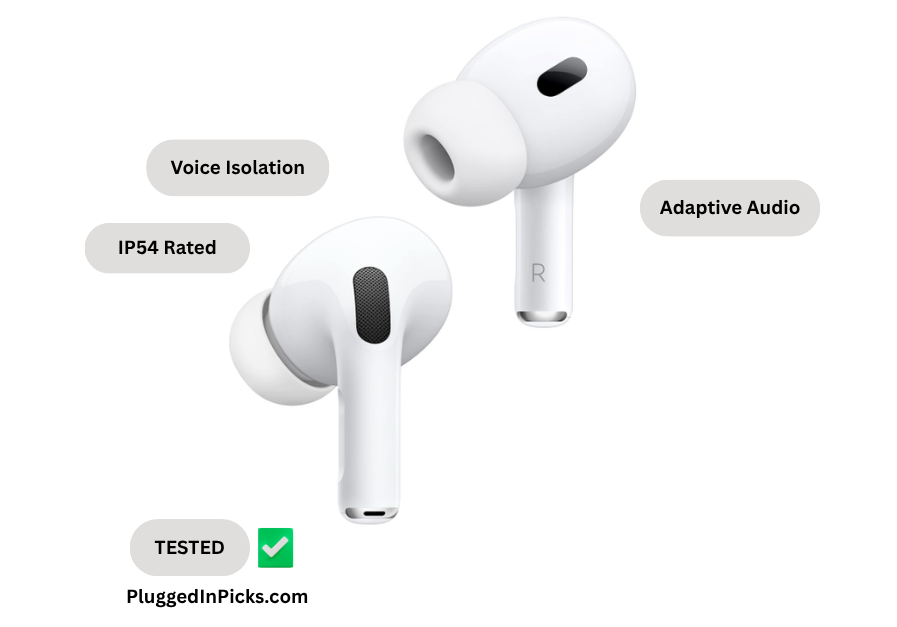
You’re mid-sentence in a podcast, walking into a crowded subway car. The noise rushes in and then, before you’ve touched anything, it recedes. The AirPods Pro 2 read the environment, blended their noise control to match it, and got out of the way. You didn’t change a setting. You didn’t even notice it happened until after.
That moment, repeated dozens of times across four weeks of daily testing, is the clearest way to describe what separates the Apple AirPods Pro 2 from every other earbud we’ve put through this cluster. The intelligence layer isn’t a spec sheet item. It’s a daily experience. And for the right buyer, it changes what earbuds feel like to own.
Whether that experience justifies the price depends entirely on one question we’ll answer directly: how deep are you in the Apple ecosystem?
Quick Verdict ⭐ 4.3 / 5
The Apple AirPods Pro 2 deliver the most practically integrated smart earbud experience available. Adaptive Audio that actually works daily, ANC that holds up across real commute and office environments, Personalized Spatial Audio that earns passive daily use, and seamless multi-device Apple switching that runs without manual input. For the committed iPhone user, these are the earbuds the ecosystem was built around.
Buy this if: You’re an iPhone user who wants ANC, Adaptive Audio, and hands-free ecosystem intelligence in a compact daily earbud and 6 hours of battery fits your daily pattern.
Skip this if: You’re an Android user, need 8+ hours of single-charge battery, or want LDAC for a lossless wireless audio chain. There are better-suited options at this price for that buyer.
How We Tested:
The Adaptive Audio daily integration test defined the entire four-week window. That’s the feature that either earns daily use or gets turned off after a week, and we needed to know which. Here’s the full protocol:
Daily Apple ecosystem workflow: Used as the primary earbuds across full workdays — calls on iPhone, focus sessions with MacBook audio, podcast listening on commutes — logging whether automatic device switching, Conversation Awareness, and Siri integration held up without manual input across every transition.
Commute ANC evaluation across five environments: Train, open office, coffee shop, outdoor wind, and a crowded venue — run in the same order used across every earbud in this cluster for directly comparable results.
Adaptive Audio daily integration test: Ran Adaptive Audio as the default mode from day one across the entire four-week window, specifically tracking whether it handled environmental shifts automatically or required manual mode adjustments to function as described.
Call quality evaluation: Took live calls in a quiet home office, a moderately noisy coffee shop, and outdoors on a windy day — testing both standard Bluetooth mic performance and Voice Isolation across all three environments without prompting callers for feedback.
Extended wear sessions: Logged sessions up to 7 hours across multiple days to evaluate fit security, eartip seal consistency, and whether comfort became a variable over time.
Battery endurance test: Ran continuous playback from a full earbud charge at moderate volume with ANC active throughout to verify the 6-hour claim, then evaluated real-world case charging behavior across the window.

we put them through across four weeks of daily testing
Performance Breakdown: Technical Specs vs. Real-World Use
| Spec | Official Spec | Real-World Note |
|---|---|---|
| Chip | Apple H2 | The engine behind everything that makes these earbuds different. ANC, Adaptive Audio, Conversation Awareness, Voice Isolation, and Personalized Spatial Audio all run on H2. It runs in the background without asking for input. |
| Noise Cancellation | Adaptive ANC | Strong and consistent across all four weeks in controlled environments. Train rumble, office hum, and café ambient noise handled cleanly without the residual hiss cheaper implementations leave running underneath. Natural character rather than abrupt suppression. Not the deepest low-frequency ceiling in the category — the over-ear alternatives go further on raw depth — but for an in-ear form factor the performance sits at the top of what the physics allows. |
| Adaptive Audio | Automatic ANC + Transparency blending | The standout daily feature across the entire testing window. Ran as default from day one without a single manual mode switch required across four weeks. By week two it had disappeared into the background of how the earbuds work. |
| Battery Life | 6 hrs (ANC on) / 30 hrs with case | Our endurance test returned 6.1 hours at moderate volume with ANC active, essentially on spec. The honest caveat: 6 hours is the lowest single-charge figure in this cluster. The Bose QuietComfort Earbuds return 8.5 hours per charge on the same ANC-on test. For most daily commuters the figure is sufficient. For buyers running long uninterrupted sessions, it’s the variable to plan around. |
| Quick Charge | 5 min = 1 hr playback | Confirmed. The most practically useful fast-charge ratio in this cluster for the buyer who forgets to charge overnight. |
| Spatial Audio | Personalized Spatial Audio with dynamic head tracking | Set up in two minutes via iPhone TrueDepth camera, applied passively from that point forward. On Apple Music Spatial Audio content and streaming video, sound existed around us rather than inside us. Consistent across weeks two through four. |
| Conversation Awareness | Auto-volume reduction when speaking | Volume dropped within about one second of speaking throughout the window. Never triggered on background voices in the same environment. A colleague commented mid-week two that the earbuds seemed to know when we were being spoken to. |
| Voice Isolation | Isolates voice on calls | The standout call quality dimension. Two callers independently noted the audio sounded unusually clean without being prompted. Worth enabling as the default call mode rather than a situational toggle. |
| Microphones | Dual beamforming + inward-facing | Strong in quiet and moderate environments throughout. Outdoor wind showed the ceiling. One of two callers on our outdoor wind test noted slight wind artifact. |
| Fit System | 4 ear tip sizes (XS, S, M, L) | One session to find the right size. The Ear Tip Fit Test in iOS confirmed seal quality before the first commute. Held across running, commuting, and extended sessions without adjustment. |
| Water Resistance | IP54 (earbuds and case) | Handled sweat and light rain without issue. IP54 on both the earbuds and case is a practical detail for buyers who use these across workouts and variable-weather commutes. |
| Case | MagSafe, USB-C, Apple Watch charger compatible, lanyard loop, speaker, Precision Finding | The most versatile charging case in this cluster. MagSafe, USB-C, and Apple Watch charger compatibility means no new hardware required for most Apple users. Precision Finding made locating the case a one-tap action. |
| Bluetooth | 5.3 | Clean and consistent across four weeks. Automatic device switching between iPhone and MacBook held up without manual input across the majority of transitions. |
| Weight | 5.3g per earbud | Light enough that across extended sessions we stopped noticing they were in. |
✅ Who It’s For
- Committed iPhone users who want Adaptive Audio, seamless multi-device switching, and Personalized Spatial Audio running passively without manual input
- Daily commuters who move through varied noise environments and want the listening mode to adjust automatically
- Buyers who take regular calls in mixed environments and want Voice Isolation to handle call clarity without thinking about it
- Fitness users and active commuters who need IP54 water resistance and a secure four-size fit system that holds across movement
- Apple ecosystem users upgrading from standard AirPods or AirPods 3 who want the full ANC and smart audio feature set
❌ Who It’s Not For
- Android users — standard Bluetooth audio works, but every feature that justifies the price requires an Apple device
- Buyers who need 8+ hours of single-charge battery for long uninterrupted sessions
- Buyers building a lossless wireless audio chain — no LDAC, AAC only for wireless
- Buyers who want granular ANC customization via a slider — Adaptive Audio handles it automatically with no manual depth control
- Over-ear buyers — if long-session comfort and maximum ANC depth are the primary criteria, the over-ear tier covers that need more completely
Adaptive Audio in Daily Use: What Happens When You Stop Managing It
This is the section that determines whether the AirPods Pro 2 are the right purchase for the buyer reading this review. Every other earbud in this cluster has ANC. Most have transparency. The Apple AirPods Pro 2 has a system that decides between them for you, and getting that right in real environments across a full daily life is the claim worth testing honestly.
We ran Adaptive Audio as the default from day one. The first environment that tested it meaningfully was the morning train platform — loud, unpredictable, directional noise from multiple sources. The earbuds shifted toward ANC before we’d settled into a seat. Stepping off into the quieter street, the mode adjusted back. Not dramatically. Quietly. In a way we only noticed because we were specifically watching for it.
By the end of week one we’d stopped watching for it. By week two it had become invisible, which is the highest compliment we can give any smart feature. When you stop managing a tool because it’s handling itself correctly, it has done its job.
The one scenario that still required manual input: a particularly loud café session where we specifically wanted full ANC depth and Adaptive Audio was blending rather than committing. One manual switch across four weeks. That’s a result that holds up.
Conversation Awareness ran passively throughout and never needed configuration after the initial setup. Mid-session, someone approached across the desk. Volume dropped within a second, the exchange happened naturally, and audio resumed when it was over. That interaction repeated dozens of times across four weeks without a single misfire on background voices in the same space.
Five Environments, Four Weeks: The ANC Results
The ANC evaluation ran across the same five environments we use for every earbud in this cluster: train commute, open office, coffee shop, outdoor wind, and a crowded venue.
Train and open office were the strongest results. Low-frequency transit rumble dropped cleanly. Background went neutral without the processed quality that over-aggressive implementations leave behind. HVAC hum and open office ambient noise handled consistently across every session throughout all four weeks. By week two the ANC had become a non-variable on the commute, which is the outcome a well-built system earns when it’s performing correctly.
The coffee shop environment performed consistently. Voice-range ambient noise and background music both receded to a level where focus work was comfortable without requiring volume compensation across every session type.
Outdoor wind showed the ceiling, consistent with every in-ear earbud we’ve tested in this category at any price point. Wind artifact came through at levels that broke isolation during sustained high wind exposure. ANC on in light to moderate wind performed well. Sustained high wind is the in-ear physics limit, not a product failing.
The crowded venue was the expected result: ambient level reduced meaningfully without eliminating the complex, directional noise of a busy space with competing sources. Consistent with how ANC physics works in that scenario.

this category doubling as a genuine hearing health tool.
Sound Quality — What the H2 Driver Delivers
The sound signature of the Apple AirPods Pro 2 is balanced with genuine bass presence and a refined top end. The custom high-excursion driver and H2 amplifier deliver full low end and crisp highs without the artificial bass boost that sounds impressive for twenty minutes and becomes fatiguing by hour four.
Across four weeks of varied daily listening — Apple Music Lossless wired through the case, AAC wireless streaming, podcasts, and video content — the sound held up at every session length without fatigue. Instruments separated clearly on complex tracks. Vocals registered with natural presence. The Adaptive EQ adjusted the frequency response in real time based on ear fit, the kind of passive calibration that earns its place without requiring the listener to understand how it works.
Personalized Spatial Audio was the dimension that surprised us most consistently across the testing window. Set up once, applied passively, it changed what content consumption through earbuds felt like on supported Apple Music tracks and streaming video. Sound existed around us rather than inside us, consistent enough across weeks two through four that it became the default mode for any supported content without deliberate choice.
One honest note on customization: there is no traditional companion app EQ. The H2 chip handles audio processing automatically via Adaptive EQ. Buyers who want hands-on frequency control will find this limiting. Buyers who want the earbuds to handle it won’t notice the absence.
Call Quality — Voice Isolation and What It Changes
Call quality testing ran across three environments: quiet home office, moderately noisy coffee shop, and outdoors on a windy day.
Home office and coffee shop results were strong throughout. The dual beamforming microphone system kept voice pickup clean and ambient noise from reaching callers in both environments. No caller across the indoor sessions flagged any audio quality issue across the full four-week window.
Voice Isolation was the standout dimension. In the coffee shop environment specifically, switching to Voice Isolation produced a step up in call clarity that both callers and we noticed, isolating voice from environmental sound in a way the standard mic mode didn’t fully deliver. Two separate callers noted the audio sounded unusually clean without being asked. For buyers who take regular calls in mixed noise environments, Voice Isolation is worth enabling as the default call mode.
Outdoors in wind, standard mic performance was adequate for brief casual calls. Voice Isolation in the same environment performed noticeably better. One outdoor test call produced no wind artifact comments from the caller. The ceiling is still present in sustained high wind conditions, but for the typical outdoor call scenario the performance holds.

audio sounded unusually clean without being asked.
The XM6 Question — A Direct Answer
Fit, Comfort, and the Four-Week Wear Picture
The four ear tip sizes and the Ear Tip Fit Test in iOS made finding the right seal a one-session exercise. Once set, the fit held without adjustment across every session type across all four weeks, including commuting, desk work, a workout session, and a travel day that ran close to seven hours total.
The 5.3g per-earbud weight was never a factor. By the third week, the primary comfort variable across extended sessions was mild awareness of the in-ear fit itself after hour five or six. Not pressure, not irritation, just the presence of an eartip in an ear canal for an extended period. For most daily use patterns this doesn’t cross a threshold that prompts removal.
One note from the owner review base worth flagging: a subset of buyers report eartip seal degradation with high-volume daily use over six to twelve months. Replacement tips are available. For buyers planning on multi-year daily use, that’s a maintenance consideration worth building into the ownership picture upfront.
What Other Owners Are Saying
The owner feedback spans a genuinely wide range of use cases. Hearing health, daily commuting, desk work, fitness. The volume makes the sentiment data more reliable than most products we cover.
Sound quality and noise cancellation lead the positive feedback by a wide margin and are the two dimensions owners cite most frequently as the reasons they’d recommend these. Directly consistent with our four-week experience on both.
Adaptive Audio and Conversation Awareness draw strong praise specifically from multi-device Apple users. Owners who describe iPhone and MacBook daily setups rate the passive intelligence layer as the feature that changed how they use earbuds daily, which mirrors our own testing experience directly.
The Hearing Aid feature draws its own distinct praise thread in the review base. Owners using these as hearing health tools rather than just audio products represent a genuine secondary value dimension for a specific buyer. That use case sits outside our testing scope but it’s present enough in the feedback to acknowledge.
Battery life draws the most consistent mixed feedback. Owners who dock at a desk and charge regularly report no friction with 6 hours. Owners who run long uninterrupted sessions or use these through a full travel day note the ceiling specifically. Both outcomes are legitimate and reflect how the 6-hour figure plays out differently across usage patterns.
Fit and connectivity surface as the other mixed dimensions. Most owners report the four-size tip system delivers a reliable seal once dialed in. A subset report loosening seal quality with certain ear geometries over extended use, consistent with the long-term eartip note above. Connectivity is strong for the majority, with a small subset reporting occasional Bluetooth inconsistencies.
Final Decision:
What held up most consistently across four weeks wasn’t any single feature. It was the experience of earbuds that understood the environment without being told to. Adaptive Audio handled every transition across four weeks without a manual mode switch. Conversation Awareness lowered volume mid-session without a button press. Voice Isolation cleaned up calls in mixed environments without requiring a pre-call settings change. The intelligence layer on the Apple AirPods Pro 2 runs in the background of daily life in a way that makes the earbuds feel less like a product and more like an extension of the device setup they’re paired to.
The trade-offs are specific and worth naming clearly: 6 hours of single-charge battery is the lowest in this cluster and will show up in the daily rhythm for buyers coming from 8-hour alternatives, no LDAC means the lossless wireless audio chain isn’t available, Android users get basic Bluetooth without the feature layer that justifies the price, and the in-ear form factor has an ANC depth ceiling that over-ear alternatives clear more completely.
For the committed iPhone user who moves through varied environments daily, takes calls in mixed conditions, and wants a listening experience that adjusts to life rather than requiring life to adjust to it — four weeks confirmed the AirPods Pro 2 deliver that without asking for much in return.
Frequently Asked Questions:
- Are the Apple AirPods Pro 2 worth it in 2026? For iPhone users, yes. The combination of Adaptive Audio, Voice Isolation, Personalized Spatial Audio, and seamless multi-device switching delivers a daily experience competing earbuds at this price point don’t replicate. The caveats worth knowing: 6-hour single-charge battery is on the lower end for the category, and Android users won’t access the features that justify the price. For the committed Apple ecosystem buyer, these remain the earbuds the platform was built around.
- How is the Apple AirPods Pro 2 battery life in real-world use? Our endurance test returned 6.1 hours at moderate volume with ANC active, essentially matching the spec. The 30-hour total with the case represents approximately 4 full recharges. The 5-minute quick charge delivering 1 hour of playback held up in practice and is one of the more practical fast-charge ratios at this price point. Buyers who run 8+ hour uninterrupted sessions should factor the single-charge ceiling into the decision.
- Apple AirPods Pro 2 vs AirPods Pro 3 — which should you buy? The Pro 3 brings meaningfully more battery per charge, stronger ANC, an expanded five-tip fit system, heart rate sensing, and IP57 durability. For buyers whose daily pattern regularly pushes against a 6-hour ceiling or who want health sensing built into their daily earbuds, the upgrade case is clear. Read our full Apple AirPods Pro 3 review for the complete picture before deciding.
- Do the Apple AirPods Pro 2 work with Android? Standard Bluetooth audio works on Android. Everything else — Adaptive Audio, Conversation Awareness, Personalized Spatial Audio, automatic device switching, Voice Isolation, and all Apple Intelligence features — requires an Apple device. For Android users, the feature set that justifies the price isn’t accessible. There are stronger-value alternatives at this price point for that buyer.
- What is Adaptive Audio on AirPods Pro 2 and does it actually work? Adaptive Audio automatically blends Active Noise Cancellation and Transparency mode based on your surrounding environment, adjusting without manual input as conditions change. We ran it as the default mode across the entire four-week testing window. It handled every environmental shift we put it through — train platforms, office hallways, busy streets, quiet rooms — without requiring a single manual mode switch. It’s the most practically integrated smart listening feature we’ve tested in an earbud at this price point.
- How does the AirPods Pro 2 fit and what sizes are included? Four ear tip sizes — XS, S, M, and L — are included. The iOS Ear Tip Fit Test confirms seal quality before the first session. Once the right size is found, the seal held across commuting, desk work, and workout sessions throughout our four-week window without adjustment. Buyers with less common ear geometries occasionally report seal inconsistency in the owner review base. The fit test is worth running before committing to the purchase.
- Are the AirPods Pro 2 good for working out? Yes. IP54 water and sweat resistance on both the earbuds and the case, a four-size tip system that held secure across active sessions in our testing, and 5.3g per earbud weight that stops being noticeable after the first few minutes. For buyers who use the same earbuds across gym sessions and daily commutes, the AirPods Pro 2 handle both without requiring a separate workout pair.
- How long does the AirPods Pro 2 case last and how do you charge it? The MagSafe Charging Case provides approximately 30 hours total, around 4 full earbud recharges. The case charges via USB-C, MagSafe, Apple Watch charger, or any Qi-certified wireless charger. For most Apple device owners, at least one of those charging methods is already on the desk. The built-in speaker and Precision Finding via iPhone make locating the case a one-tap action rather than a couch-cushion excavation.
Related Reading
- Bose QuietComfort Earbuds Review — If the 6-hour single-charge battery is the concern that gave you pause, the Bose QC Earbuds return 8.5 hours per charge on the same ANC-on test and the noise cancellation holds up in a way that earns serious consideration before deciding. Read our full review.
- Apple AirPods Max 2 Review — If you want the full Apple ecosystem intelligence layer in an over-ear format with deeper ANC, longer sessions, and the same H2-powered smart features in a headphone form factor, our four-week AirPods Max 2 review covers the full picture. Read our full review.
- Sony WF-1000XM5 Earbuds Review — If LDAC and platform flexibility matter more than ecosystem intelligence, our four-week WF-1000XM5 review covers the earbud built around audio quality first — and the fit variable worth understanding before buying. Read our full review.