
Bose QuietComfort Earbuds Review: The ANC Case That Doesn’t Need a Premium Price Tag
By Ryan Castillo | Tech & Electronics Editor, PluggedInPicks • May 04 2025
Tested over 4 weeks — daily commute ANC evaluation across five environments, extended wear sessions up to 9 hours, multipoint two-device workflow testing, call quality across three conditions, battery endurance, and Bose QCE app evaluation.
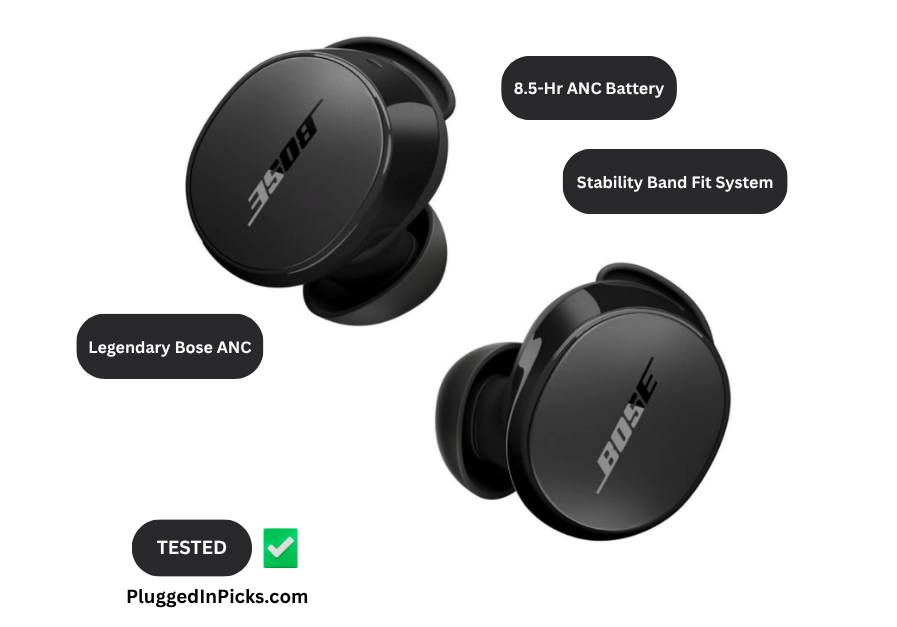
Most noise cancellation research ends at the same bottleneck. You find the products that actually work, and then you find the price. The serious ANC earbuds — the ones reviewers actually recommend — tend to cluster at the top of the market.
The Bose QuietComfort Earbuds are the version of that story where the price moves but the noise cancellation doesn’t. Bose has released these under variations of the same name since 2020 — the current model is the one that finally gets the balance right. We put them through four weeks of daily use to find out how much of the Bose ANC reputation actually carries over at this price point, and where the trade-offs actually land.
The short answer: further than you’d expect. With one specific caveat worth knowing before you buy.
Quick Verdict ⭐ 4.2 / 5
The Bose QuietComfort Earbuds (2024) deliver some of the most effective noise cancellation available at this price — full stop. The 8.5-hour ANC-on battery, wireless charging case, and three-device multipoint are features that earn their place in daily use. The caveats worth knowing upfront: multipoint connectivity produces occasional audio dropouts for a documented subset of owners in sedentary conditions, and the case build quality is noticeably behind the earbuds themselves.
Buy this if: ANC is your primary purchase criterion, all-day battery without reaching for the case matters to you, or you want Bose noise cancellation without committing to the Ultra’s flagship price point.
Skip this if: You spend long stationary sessions using multipoint across two devices, need aptX or LDAC for lossless wireless audio, or want the ANC customization depth and spatial audio that justify the Ultra’s premium.
How We Tested:
ANC performance was the dimension we weighted most — it’s the reason most buyers land on these earbuds, and it’s the claim that either holds across real environments or it doesn’t. Here’s the full protocol across four weeks:
Daily commute ANC evaluation: Worn on train commutes and in transit environments across multiple routes and crowd densities — logging performance against low-frequency rumble, crowd noise, and mid-frequency voices across five environments: train, open office, coffee shop, outdoor wind, and a crowded venue. The same five environments used across every earbud in this cluster for direct comparison.
Extended wear sessions: Used as the primary earbuds across full workdays and listening sessions up to 9 hours — tracking comfort over time, eartip seal consistency, and whether the stability bands held across different session types including movement-heavy use.
Multipoint two-device workflow test: Paired simultaneously to a MacBook and iPhone across a full workweek — switching between calls, media playback, and notifications to evaluate real-world multipoint behavior and log any connectivity inconsistencies as they occurred.
Call quality evaluation: Took live calls in a quiet home office, a moderately noisy coffee shop, and outdoors on a windy day — noting whether callers flagged audio quality without prompting across all three conditions.
Battery endurance test: Ran continuous playback from a full earbud charge at moderate volume with ANC active throughout to verify the 8.5-hour claim, then repeated to verify the case’s 2.5-charge figure.
Bose QCE app evaluation: Logged the full setup flow, EQ customization across the 5-band equalizer, ANC mode switching, and voice control behavior across the testing window.
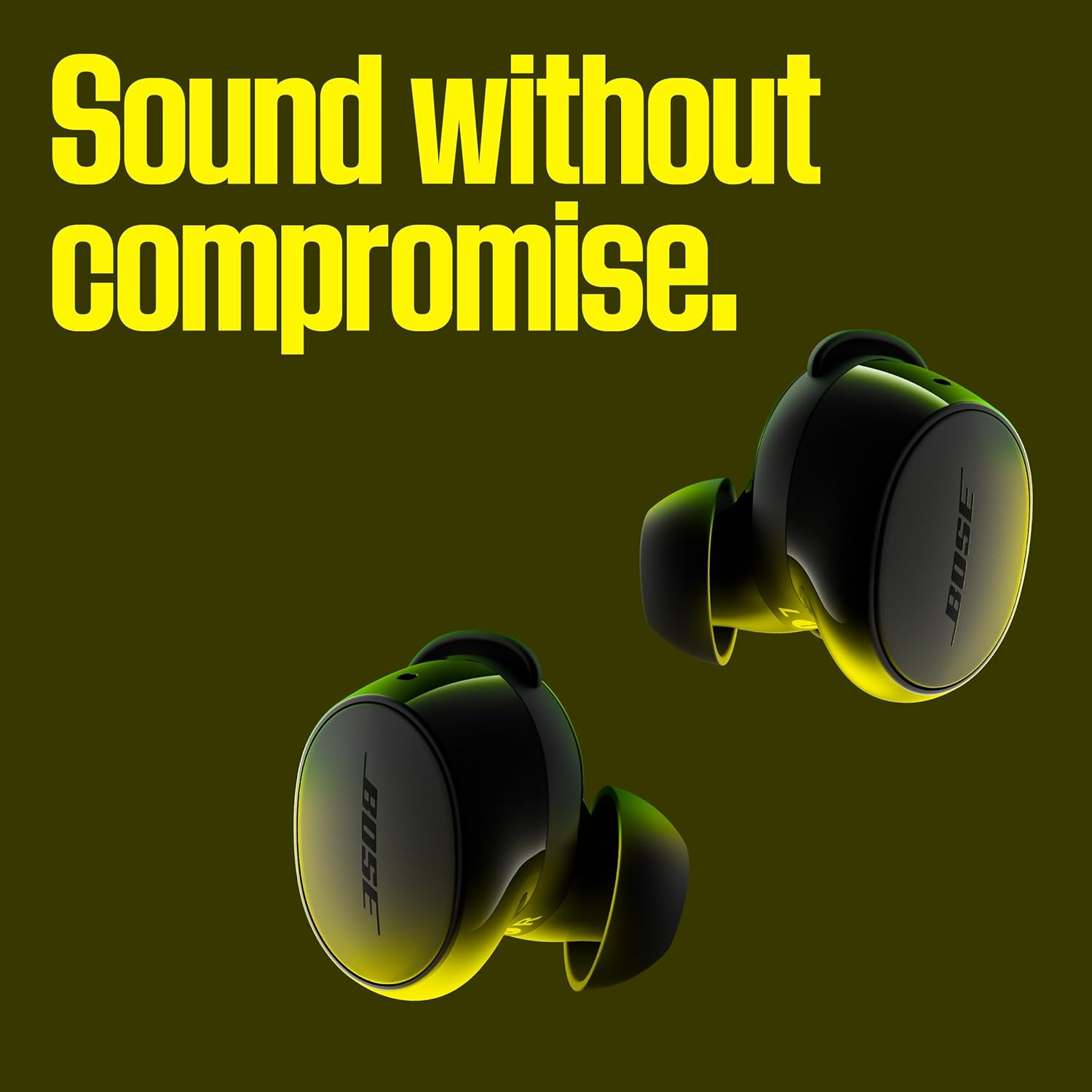
band is what kept these in place across every active session in our testing window.
Performance Breakdown: Technical Specs vs. Real-World Use
| Spec | Official Spec | Real-World Note |
|---|---|---|
| Active Noise Cancellation | Adaptive ANC — Quiet, Aware, Off modes | The standout performer across all four weeks. Train rumble, office hum, and coffee shop ambient noise all handled with an immediacy that earns the Bose reputation at this price. Aware mode was the strongest transparency implementation we tested in this tier — it isolated voices directed at us while suppressing everything else, rather than just letting all ambient sound in equally. Three fixed modes with no granular slider — sufficient for most daily use, but buyers who want 10-level ANC customization are looking at the Ultra Earbuds. |
| Battery Life | 8.5 hours (ANC on) / 31.5 hours total with case | Our endurance test returned 9.1 hours at moderate volume with ANC active throughout — slightly ahead of the spec. The 8.5-hour figure is ANC-on, which runs 2.5 hours longer per charge than the Bose QuietComfort Ultra Earbuds’ 6-hour ANC-on figure. For all-day listeners, that gap is the most practical differentiator between the two models. The case provided 2.5 reliable recharges across our testing window. |
| Quick Charge | 20 min = 2 hours playback | Confirmed in practice. A 20-minute charge before a commute cleared a 90-minute session without issue — useful for the buyer who forgets to charge overnight. |
| Bluetooth | 5.3, multipoint (3 devices) | Single-device pairing was clean and consistent across four weeks. Multipoint is where variable behavior appeared — we experienced brief audio dropouts during source switching between MacBook and iPhone with multipoint active. Disabling multipoint and pairing to one device at a time eliminated the behavior entirely. Worth testing early in the return window if a seamless two-device workflow is the primary use case. |
| Audio Codecs | AAC, SBC | No aptX, no LDAC. For Spotify, Apple Music, and podcast listening the sound quality is excellent without lossless codecs. Buyers building a lossless wireless audio chain should note this limitation — the Sony WF-1000XM5 covers that requirement. See our full review here. |
| Driver | 10mm dynamic driver | Sound signature leans toward punchy bass and crisp highs — engaging across most genres with a midrange that sits slightly behind the other frequencies in stock tuning. The 5-band EQ in the Bose QCE app brought the mids forward meaningfully on our preferred setting. Enjoyable without any EQ adjustment; the app expands the ceiling for buyers who want more control. |
| Microphones | Beamforming array, AI background suppression | Strong in quiet and moderate indoor environments throughout. In our outdoor windy test, one of two callers noted slight wind artifact — worth factoring in before purchasing if outdoor calls are a daily variable rather than an occasional one. |
| Fit System | Stability bands + ear tips, 3 sizes each | Nine fit combinations is a genuinely useful range. One session to find the right pairing — once dialed in, the earbuds held across running, commuting, and extended desk sessions without a single unintended removal. The stability band is less visually minimal than a stemless design but the practical security it provides is real. |
| Water Resistance | IPX4 | Handled sweat and light rain without issue across four weeks. Sufficient for workouts and variable-weather commuting. |
| Wireless Charging | Yes — case supports wireless charging | Convenient and confirmed. The case build quality is the counterpoint: it feels lightweight to the point of plasticky compared to the earbuds themselves — a clear cost-reduction that shows at this price tier. |
| App | Bose QCE — separate from Bose Music app | 5-band EQ, voice controls, ANC mode switching, Battery Prediction, Fast Mute for calls. Cleaner layout than the standard Bose Music app — most settings on the main screen without submenus. The separate app requirement is a minor inconvenience for existing Bose users expecting cross-product integration. |
| Weight | 8.5g per earbud | Light enough that across multiple extended sessions we forgot they were in — which is the practical ceiling for this form factor. |
✅ Who It’s For
- Commuters and office workers for whom ANC is the primary daily use case — the noise cancellation performance delivers at a level that competes well above this price point
- All-day listeners who need 8+ hours of ANC-on battery in a single charge without managing a mid-day top-up
- Buyers coming from mid-range earbuds looking for a meaningful step up in ANC without reaching flagship pricing
- Fitness users who need a secure fit across movement — the stability band system held across every active session in our testing window
- Platform-agnostic buyers who want Bose ANC quality and aren’t locked into Apple or Android ecosystems
❌ Who It’s Not For
- Buyers who spend long stationary sessions at a desk with multipoint active across two devices — the documented connectivity behavior in sedentary conditions is the most consistent complaint in the owner review base
- Audiophiles with a lossless wireless audio requirement — no aptX, no LDAC, full stop
- Buyers who want granular ANC control — three fixed modes without a customizable slider is the clear gap versus the Bose QuietComfort Ultra Earbuds
- Buyers expecting the same app ecosystem as other Bose products — the Bose QCE app is a dedicated separate download that doesn’t communicate with the Bose Music app
- Buyers for whom case build quality matters — it’s a noticeable weak point relative to the earbuds themselves
Why the ANC Story Holds Up at This Price
The first morning we wore these on the train, two stops in the person across the aisle was visibly still talking. We hadn’t noticed. That’s the Bose ANC working exactly as advertised, and it held up across every controlled environment we ran them through.
What makes the ANC worth discussing beyond “it’s good” is where it performs relative to the price. At this price point, the noise cancellation competes directly with earbuds that cost significantly more. Train rumble, office HVAC hum, coffee shop ambient noise — all handled cleanly without the residual background hiss that cheaper ANC implementations leave running underneath the music.
The three-mode system — Quiet, Aware, Off — covers the real daily range without feeling limiting. Quiet for commuting and focus work, Aware for situations where staying oriented to your surroundings matters. Aware mode was the strongest transparency implementation we tested at this price — it isolated voices and suppressed background noise simultaneously rather than simply turning everything up.
The ceiling we hit consistently was outdoor wind at higher intensities. In our open-environment test and on one particularly gusty commute, high-frequency wind noise came through at levels that broke the isolation. This is consistent with every earbud we’ve tested at any price and isn’t unique to this model — but worth noting for the buyer whose primary environment is outdoor movement.
Battery Life Is the Underreported Advantage
The battery result that surprised us going in: these outlast their own flagship sibling by a meaningful margin. The Bose QuietComfort Ultra Earbuds deliver 6 hours of ANC-on battery per charge. These deliver 8.5 hours. Our endurance test returned 9.1 hours at moderate volume with ANC running throughout.
By week two these had become the earbuds we reached for on long work days specifically because we weren’t thinking about charging. Back-to-back calls in the morning, focused work in the afternoon, a commute home — the battery outlasted every full day we put it through without the case coming out of the bag.
The wireless charging case covered 2.5 full earbud recharges before needing its own charge, consistent with the stated spec. Quick charge via a 20-minute case top-up added right around 2 hours of playback in practice — reliable recovery for the “forgot to charge it last night” scenario.
One note that comes up in the owner review base: the case charges via USB-C only. Wireless charging is for the earbuds inside the case — the case itself needs the cable. Minor, but a detail that catches buyers off guard often enough to flag.

train commute, the ambient noise dropped to nothing without any adjustment.
Fit, Comfort, and the Stability Band Reality
The stability band design is the element that generates the most pre-purchase skepticism — a rubber ridge protruding from the side of an earbud looks less refined than the clean stemless designs competitors are using at this price. In practice, the hold it provides is the reason these stayed in across four weeks of varied use without a single unintended removal.
Nine fit combinations — three eartip sizes paired with three stability band sizes — sounds like more friction than it is. One session to find the right pairing, then it’s done. Running, commuting, desk work, a workout — the security was consistent across every session type.
Comfort across extended wear was strong. During our longest continuous session — 9 hours across a travel day — we noticed mild eartip pressure by hour seven but nothing that prompted removal. The 8.5g earbud weight was never a factor.
The long-term caveat worth knowing: silicone eartips stretch and degrade with extended use. Several owners in the review base at the 6-12 month mark report that seal quality has degraded enough to affect ANC meaningfully. Replacement tips are available but not included. For buyers planning daily use over an extended period, that’s a maintenance cost worth building into the ownership picture.
Multipoint and Connectivity — The Picture in Full
Two distinct experiences define the connectivity story here, and separating them clearly is more useful than summarizing either.
Single-device pairing across four weeks: clean, reliable, and automatic. Initial pairing through the Bose QCE app completed in under a minute. Reconnection on subsequent days happened without manual input. Range across a home office with the phone in another room held without dropouts.
Multipoint pairing with two simultaneous device connections: variable. During the first week we logged periodic audio stutters and brief dropouts specifically during source transitions between MacBook and iPhone with multipoint active. The pattern was consistent — transitions triggered the behavior more than sustained single-source use. Disabling multipoint eliminated it completely.
This is the most thoroughly documented owner complaint across the review base — nearly 8,000 Amazon ratings with connectivity surfacing as a recurring theme in the critical reviews. The specific framing from the owner base that matches our testing: sedentary use with multipoint enabled is where it appears most consistently. Active users report far fewer instances. For buyers whose daily workflow is a single device, this likely never surfaces. For buyers running a seamless MacBook-and-iPhone setup at a standing desk, test it early in the return window.
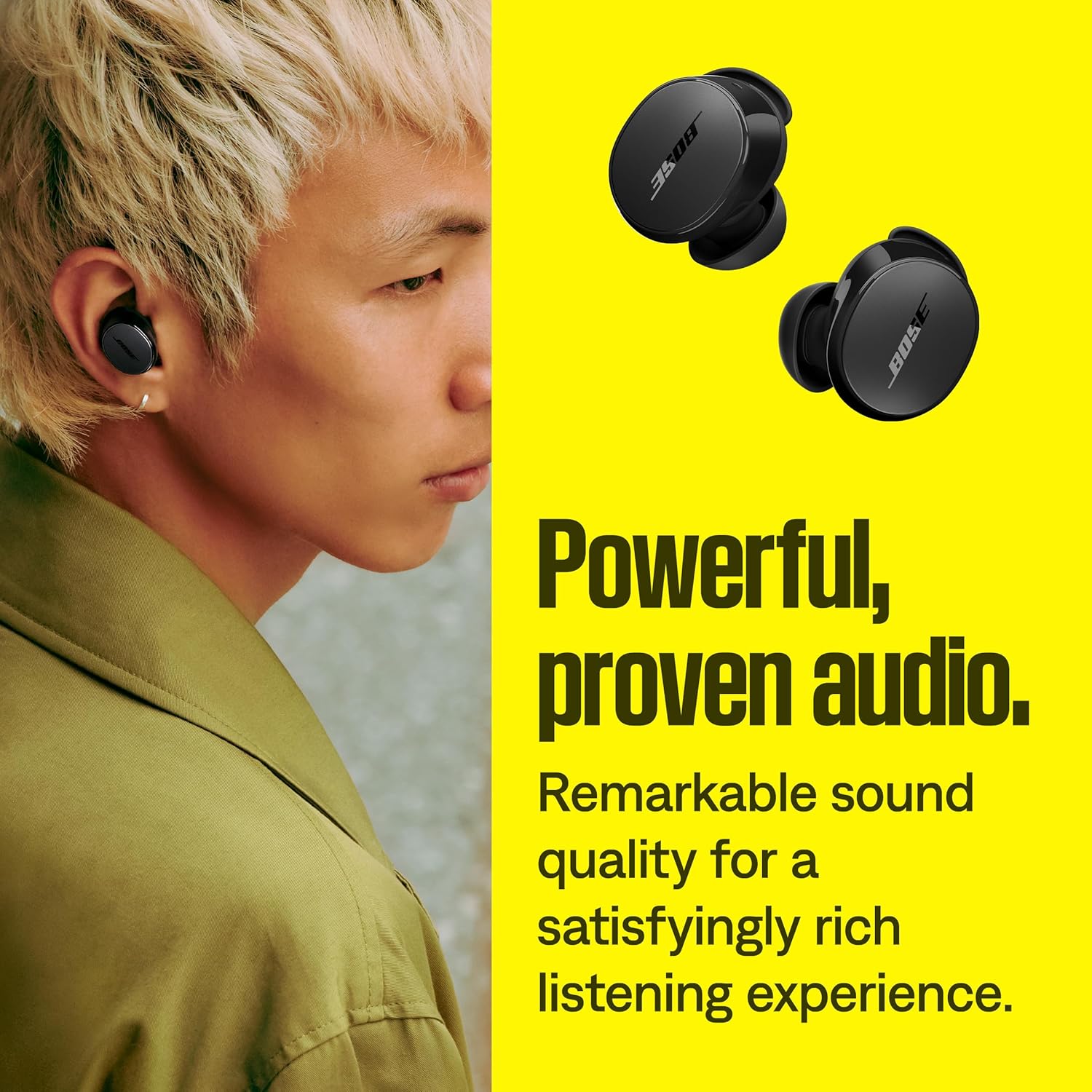
— engaging across genres without EQ applied, with the 5-band app tuning available
for buyers who want more control.
Sound Quality and the Bose QCE App
The 10mm dynamic driver delivers a sound signature that’s engaging without demanding EQ — punchy bass, clear highs, midrange that sits slightly behind the other frequencies in stock tuning. For streaming music, podcasts, and video calls, it sounds full and clean straight out of the box.
Where the app earns its place is for buyers who want more balanced, neutral sound. The 5-band EQ allowed us to bring the midrange forward noticeably on complex recordings — more separation, better defined layers. EQ settings save to the earbuds rather than just the app, meaning the tuning persists when connected to devices without the app installed.
The no-aptX, no-LDAC situation is worth being direct about. For Spotify and Apple Music streaming — which covers the majority of daily listening for most buyers — AAC is sufficient and the audio quality is genuinely good. For buyers with a lossless file library and a DAC-equipped source device, this isn’t the product for that use case. The Sony WF-1000XM5 serves that lane; we’ll link that review here when it’s live.
What Other Owners Are Saying
The owner feedback on these earbuds tells a consistent story across a large review base, and it splits almost exactly along the same lines our testing did.
ANC is the most universally praised dimension — across use cases, listening habits, and audio backgrounds, owners consistently cite it as the reason they’d recommend these to someone else. Battery life is the second most consistent positive, with several long-term owners specifically noting it outperforms what they expected at this price.
The connectivity concern surfaces in a meaningful portion of the critical reviews with enough specificity to take seriously: sedentary stationary use with multipoint enabled is where the behavior appears. Active users — commuting, working out, moving through a day — report far fewer issues than buyers who sit motionless at a desk for hours. That distinction tracks directly with what we observed in our own testing window.
The case quality is a recurring theme on the negative side and aligns precisely with our observation. The earbuds feel premium. The case does not.
Long-term owners at the 6-12 month mark flag eartip seal degradation for high-volume daily users. Our testing window can’t confirm this firsthand — but it appears with enough consistency in the review base to include it in the ownership picture.
What our four weeks confirmed: the ANC, battery, and fit claims hold. What owners with longer history add: factor in eartip maintenance and verify multipoint behavior against your specific use pattern before the return window closes.
Final Decision:
The category position on these earbuds is clear after four weeks: this is the Bose ANC experience at a price that makes it genuinely accessible, with trade-offs that are specific enough to know whether they affect your situation before buying.
The ANC delivers. Not a scaled-down version of what Bose is known for — the actual noise cancellation performance that earned the brand its reputation, at an accessible premium price point. For the commuter, the open-office worker, or the buyer who simply wants to disappear into a playlist without fighting ambient noise, these earbuds hold up across every scenario we put them through.
The connectivity caveat is real and specific. Single-device users and active listeners are unlikely to encounter it meaningfully. Stationary multipoint users should verify early in the return window.
The case is a compromise. The earbuds are not.
For the buyer who wants Bose-tier noise cancellation, all-day battery that actually outlasts the flagship model, and a secure fit that works across a full daily life — this is the version of the Bose earbud story worth buying.
Frequently Asked Questions:
- Are the Bose QuietComfort Earbuds 2024 worth it? For buyers whose primary criterion is ANC, yes — the noise cancellation performs at a level that competes with earbuds costing significantly more. At its current price point, it’s among the strongest value propositions in the earbud category right now. The caveat worth weighing is the multipoint connectivity behavior that affects a subset of users in sedentary conditions — factor that against your specific use pattern.
- Bose QuietComfort Earbuds vs. Bose QuietComfort Ultra Earbuds — which should you buy? The Ultra Earbuds are built for the buyer who wants Cinema Mode, SpeechClarity call quality, and Bose’s most current ANC system in an earbud and can work within a six-hour charge window. These are built for the buyer for whom all-day battery without reaching for the case is the priority — 8.5 hours per charge is a real advantage over the Ultra Earbuds at a lower price point. Read our full Bose QuietComfort Ultra Earbuds 2nd Gen review for the complete picture.
- Bose QuietComfort Earbuds vs. AirPods Pro 2 — which is better? These two are the most common same-tier comparison. The right answer depends almost entirely on your ecosystem — the AirPods Pro 2 are built for iPhone users, the Bose are platform-agnostic. The Bose return 8.5 hours per charge versus 6 hours on the AirPods Pro 2, but the Apple intelligence layer — Adaptive Audio, Voice Isolation, Conversation Awareness — isn’t available on the Bose side. Read our full Apple AirPods Pro 2 review for the complete picture.
- What is the difference between Bose QuietComfort Earbuds II and the 2024 model? The 2024 model is the current replacement for the discontinued Earbuds II. Key additions in the 2024 version: wireless charging on the case (the Earbuds II had none), three-device multipoint (Earbuds II had no multipoint), a new Bose QCE companion app with a 5-band EQ and voice controls, and a redesigned more compact fit system. The Earbuds II had stronger passive isolation due to its deeper-insert design — buyers who preferred that fit may find the 2024 model sits differently. Overall the 2024 model is the meaningfully better product at a lower price than the Earbuds II launched at.
- Do the Bose QuietComfort Earbuds 2024 have multipoint? Yes — they support up to three simultaneous Bluetooth device connections. Single-device pairing was clean and reliable throughout our testing. Multipoint produced occasional audio dropouts during source switching in our testing — specifically during stationary use with two active devices. Disabling multipoint eliminated the behavior for single-device use.
- How long does the battery last on the Bose QuietComfort Earbuds 2024? Bose rates them at 8.5 hours with ANC on. Our endurance test returned 9.1 hours at moderate volume with ANC active throughout — slightly exceeding the spec. The wireless charging case adds 2.5 full recharges, bringing total battery including the case to approximately 31.5 hours.
- Do the Bose QuietComfort Earbuds 2024 have LDAC? No — AAC and SBC only, no aptX or LDAC. For streaming from Spotify, Apple Music, or YouTube Music, the audio quality is excellent without lossless codecs. Buyers with a specific LDAC requirement should look at the Sony WF-1000XM5 — we’ll have that review linked here when it’s live.
- Are the Bose QuietComfort Earbuds 2024 good for working out? Yes — the stability band fit system delivered a secure hold across running, gym sessions, and active movement throughout our testing window without a single unintended removal. The IPX4 rating covers sweat and light rain adequately for most workout conditions.
Related Reading
- Sony WF-1000XM5 Earbuds Review — If the LDAC gap is a genuine requirement or sound quality is the primary criterion, our four-week WF-1000XM5 review covers the only earbud at this price with hi-res wireless audio — and the one fit variable worth understanding before buying. Read our full review.
- Bose QuietComfort Ultra Headphones (2nd Gen) Review: The Comfort Argument Is Real Same Bose ANC family, over-ear form factor. If the eartip seal or sedentary connectivity behavior gave you pause, this is what the Bose comfort story looks like without either variable in play.
- Beats Studio Pro Review: The Headphone That Punches Across Two Ecosystems If you’re still weighing earbuds against over-ear and cross-platform flexibility matters — iPhone today, Android tomorrow — this is the over-ear option that covers both without asking you to choose.