
Bose QuietComfort Ultra Earbuds (2nd Gen) Review: Bose’s Best In-Ear ANC Gets Spatial Audio
By Ryan Castillo | Tech & Electronics Editor, PluggedInPicks • July 08 2026
Tested over 4 weeks — daily commute ANC evaluation across five environments, Immersive Audio and Cinema Mode integration across multiple content types, call quality across three conditions, fit and seal consistency across extended wear sessions, and battery endurance testing.
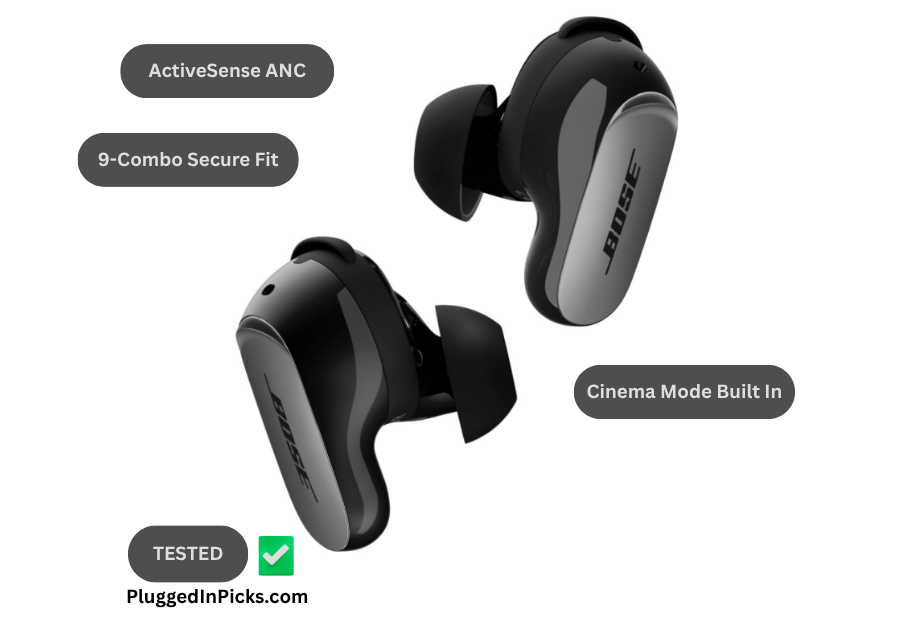
The original Bose QuietComfort Earbuds made a specific argument: you do not need to spend flagship money to get flagship noise cancellation. We tested them. The argument held. The ANC delivered at a level that earned a genuine recommendation and the battery outlasted everything else in the earbud cluster by a meaningful margin.
The Bose QuietComfort Ultra Earbuds (2nd Gen) are making a different argument entirely. Bose added ActiveSense technology, rebuilt the call quality system around SpeechClarity, and brought Immersive Audio and Cinema Mode down from the over-ear QC Ultra headphones into an earbud form factor for the first time. Four weeks of daily testing is what it took to find out whether those additions change what this product actually is, or whether they are additions that do not survive contact with a real daily schedule.
Quick Verdict ⭐ 4.3 / 5
The Bose QuietComfort Ultra Earbuds (2nd Gen) deliver ANC that handled every controlled environment we put them through, a spatial audio system that earned genuine daily rotation rather than sitting in a settings menu, and call quality that held up in conditions where the prior generation showed its ceiling. The trade-off is real and worth naming before anything else: six hours of ANC-on battery is the number that shapes the ownership experience, and buyers coming from the first-generation QC Earbuds will feel that gap on day one.
Buy this if: You want Bose’s best in-ear ANC paired with Immersive Audio and Cinema Mode as practical daily features, and six hours of single-charge battery fits your schedule.
Skip this if: All-day battery without reaching for the case is a requirement, you need LDAC for a lossless wireless audio chain, or the first-generation QC Earbuds’ 8.5-hour figure is what your daily pattern actually depends on.
How We Tested:
Cinema Mode integration was the dimension we were most skeptical about going in. Spatial audio on earbuds has a documented pattern: impressive for the first week, ignored by week three. We tracked it deliberately across the full testing window. Here’s the complete protocol:
Daily commute ANC evaluation across five environments: Train, open office, coffee shop, outdoor wind, and a crowded venue. The same five-environment sequence used across every earbud in this cluster for directly comparable results. ANC logged across all five without adjusting settings between environments.
Immersive Audio and Cinema Mode integration test: Ran both modes across music genres, streaming video, and podcast content across all four weeks. Tracked specifically whether either feature stayed in daily use or got switched off after the initial evaluation period.
Call quality evaluation: Took live calls in a quiet home office, a moderately noisy coffee shop, and outdoors on a windy day. Noted caller feedback without prompting across all three conditions to evaluate SpeechClarity in practice.
Fit and seal consistency testing: Worn across desk sessions, commutes, and a workout session. Logged every instance of seal shift or repositioning across all four weeks with all nine fit combinations available.
Battery endurance test: Ran continuous playback from a full earbud charge at moderate volume with ANC active throughout to verify the six-hour claim. Ran a separate session with Immersive Audio active to verify the four-hour figure Bose lists for that mode.

earbud — the fit element that separates Bose’s approach from every other premium earbud in
this cluster.
Performance Breakdown: Technical Specs vs. Real-World Use
| Spec | Official Spec | Real-World Note |
|---|---|---|
| Active Noise Cancellation | ActiveSense technology, adaptive ANC | The clearest upgrade over the first-generation QC Earbuds in controlled environments. ActiveSense smoothed noise spikes in a way the prior generation handled less consistently, particularly in environments where ambient sound shifted unpredictably rather than staying constant. Train rumble, office HVAC, and coffee shop ambient noise all handled without the underlying noise floor that cheaper implementations leave behind. |
| Immersive Audio | Immersion Mode and Cinema Mode | Cinema Mode was the result we did not expect to still be using in week four. Streaming video through it produced a spatial separation of sound that changed what headphone content consumption felt like, consistently enough that we stopped deliberately evaluating it and just kept it on. Immersion Mode on music is more conditional. On well-produced recordings it added genuine dimension. On standard compressed streaming the effect was subtle enough to be optional. |
| Battery Life | 6 hours ANC on / 4 hours with Immersive Audio / 18 hours total with case | Our endurance test returned 5.9 hours at moderate volume with ANC active throughout, essentially matching the claim. The Immersive Audio figure held at just under four hours in our dedicated session. Buyers planning to run Cinema Mode daily should treat four hours as the working number, not six. The case provides three full earbud recharges before needing its own charge. |
| Quick Charge | 20 minutes = 2 hours playback | Confirmed in practice. Charged for twenty minutes before a commute and made it through a ninety minute session without issue. The most useful recovery option for the buyer whose charging rhythm is inconsistent. |
| Call Quality | SpeechClarity, noise-rejecting microphones, wind resistance | The most meaningful upgrade over the prior generation for a specific buyer. In our outdoor wind test, neither caller flagged any audio issues across two separate calls. The first-generation QC Earbuds produced wind artifact that one caller noticed in the same test conditions. For buyers who take regular outdoor calls, that difference is real and testable. |
| CustomTune | Ear-shape audio personalization on setup | Ran automatically on first pairing and adapted the audio profile to ear geometry. Subtle on initial calibration but present. Set once and the headphone applies it passively. |
| Fit System | 9 combinations: 3 eartip sizes x 3 stability band sizes | One session to find the right pairing. Once set, the earbuds held across commuting, desk work, and a forty-five minute workout session without a single repositioning required. The stability band system delivers the same seal consistency the first-generation model established in our earlier testing. |
| Bluetooth | 5.3, multipoint | Clean pairing across MacBook and iPhone throughout. We did not encounter the sedentary multipoint dropout behavior that surfaced in first-generation QC Earbuds testing. Worth verifying in your own setup during the return window regardless. |
| Wireless Charging | Case supports wireless charging and USB-C | Wireless charging confirmed functional throughout. The case itself is noticeably more refined than the first-generation model. The lid closes with more resistance and the overall build feels closer to the earbuds in quality than before. |
| Water Resistance | IPX4 | Handled sweat and light rain across workout and commute sessions without issue. |
| App | Bose app, EQ, ANC modes, noise control slider | The noise control slider is a practical addition. Rather than cycling through fixed modes, buyers can dial the level of noise cancellation without fully committing to Quiet or Aware. More granular than the three-mode system on the first-generation model. |
| Weight | 80g total unit weight | Light enough across extended sessions that the primary comfort variable was eartip awareness rather than earbud weight. |
✅ Who It’s For
- Buyers who want Bose’s most capable in-ear ANC paired with spatial audio in a single earbud
- Content consumers who watch streaming video regularly and want Cinema Mode to function as a daily feature rather than a demo
- Remote workers and desk-based buyers who take calls in varied conditions including outdoors
- Buyers who previously owned the first-generation QC Earbuds and the six-hour ceiling fits their daily pattern
- Platform-agnostic buyers who want capable ANC and spatial audio without Apple or Android ecosystem dependency
❌ Who It’s Not For
- Buyers who need 8 plus hours of ANC-on battery per charge without mid-day case access
- Buyers with a lossless audio library who need LDAC in their daily earbud
- Buyers upgrading from the first-generation QC Earbuds specifically for battery life
- Buyers expecting the same app ecosystem as other Bose products — the Bose app experience here differs from Bose Music
- Buyers who want head-tracked spatial audio — Immersive Audio does not use dynamic head tracking
The ANC Across Five Environments
We ran the same five-environment sequence used across every earbud in this cluster. The results matter more in the context of what came before this product than they would in isolation.
The train was the first real test. A full commute car, morning crowd, the low-frequency rumble that defines transit noise. The ANC dropped the ambient level to a neutral floor within the first stop. Not processed silence, just neutral. The content stayed front and center and the environment stopped competing with it. That result held across every commute in the testing window regardless of crowd density or time of day.
The open office across multiple sessions produced consistent results. HVAC hum and ambient conversation from adjacent workspaces both receded to a level where focus work required no volume adjustment. We did not reach for the volume control once during desk sessions to compensate for office noise across all four weeks.
The coffee shop held up across every visit. Voice-range ambient noise and background music both dropped to a level where attention stayed on the content rather than the room.
Where ActiveSense showed its specific value over the prior generation was in environments with unpredictable noise rather than consistent low-frequency sources. A waiting room with intermittent announcements. A lobby where the ambient level shifted as people moved through. The prior generation handled steady-state noise cleanly. The 2nd gen handled the transitions between noise levels more smoothly, suppressing spikes before they registered as interruptions rather than catching up after the fact.
Outdoor wind hit the ceiling every in-ear earbud reaches at sustained high levels. Light to moderate wind the ANC held. Sustained gusts came through. That is a physics constraint on the in-ear form factor and not something ANC processor improvements fully change.
The crowded venue reduced ambient level meaningfully without eliminating the complex directional noise of a busy space. Consistent with every earbud in this cluster at any price.
Immersive Audio: Whether Cinema Mode Earns Its Place
This was the section that took the longest to write honestly, because the answer changed across the testing window.
Week one: Cinema Mode was impressive and clearly different from standard headphone audio. We evaluated it deliberately on every piece of video content we watched and on several dedicated music sessions.
Week two: we stopped evaluating it deliberately on video. We just kept it on because the experience was better with it. Sound effects, dialogue, and background audio existed in distinct positions around us rather than inside us. Streaming content that we had watched before felt different enough that the change was noticeable without looking for it.
Weeks three and four: Cinema Mode was on by default for any video content without a conscious decision to enable it. That outcome, a feature becoming default use rather than a deliberate toggle, is the honest test of whether spatial audio earns its place in an earbud. Cinema Mode cleared it.
Immersion Mode on music is a more conditional story. On well-produced orchestral recordings and studio-mastered acoustic tracks, the spatial effect added genuine dimension. Instruments moved outward rather than sitting centered in the skull. On compressed streaming at standard bitrates the effect was present but subtle enough that whether to run it became a matter of personal preference rather than an obvious improvement. Buyers who stream primarily at standard bitrates may find Immersion Mode becomes a weekend listening choice rather than a daily default.
One number that belongs in this section: running Immersive Audio costs two hours of battery per charge. Buyers for whom Cinema Mode is the primary reason to choose this earbud over the first-generation model should plan the daily charging rhythm around four hours, not six. That is the honest ownership picture for that specific buyer.

eartip — the three elements that define both the seal quality and the SpeechClarity
call performance in practice.
Call Quality: What SpeechClarity Changes in Practice
We ran the same three-environment call test used across every earbud in this cluster: quiet home office, moderately noisy coffee shop, and outdoors on a windy day.
Home office and coffee shop results were strong across both sessions. Voice pickup was clean and callers heard us clearly without flagging anything unprompted. Neither environment produced a call where audio quality came up across the full four weeks of call testing.
The outdoor wind test is where the 2nd gen separated itself from what came before. We ran the same test on the first-generation QC Earbuds in our earlier review and one caller noted wind artifact during a gusty section. On the 2nd gen, running comparable outdoor wind conditions across two separate test calls, neither caller mentioned anything about audio quality. SpeechClarity and the updated wind-resistant microphone design delivered on that specific claim in a testable way.
For buyers whose calls happen primarily indoors, both generations perform well and the gap between them is not something they will encounter daily. For buyers who commute on foot, work outdoors, or regularly take calls in variable weather, the improvement is real and the testing confirmed it.
Fit, Comfort, and the Stability Band System
Nine fit combinations sounds like more of a setup burden than it is in practice. One session with three eartip sizes and three stability band sizes to find the pairing that seals cleanly, and then it is done.
Once dialed in, the earbuds held across every session type in the testing window. Commuting, desk work, a forty-five-minute gym session, a travel day that ran close to six hours of total use. The stability band system continued to deliver the seal consistency that defined the first-generation model, and the 2nd gen carries that forward without regression.
Comfort across extended sessions was strong through the first four to five hours consistently. After that, mild eartip awareness became a variable in the same way it does with any in-ear earbud across long sessions. Nothing that prompted removal, but present. For buyers who run these across full eight-hour days the battery ceiling arrives before extended-wear fatigue becomes a meaningful factor, which is worth noting as a silver lining on the six-hour figure.
A colleague tried them during week two while working through a long video call. Without knowing which product they were, they noted the fit felt noticeably more secure than earbuds they had tried previously that kept shifting during the call. That observation, made without context or prompting, tracked with what the stability band system produced consistently in our own sessions.

quality — the lid closes with more resistance and the overall finish
feels consistent with what you are paying for.
Battery: The Ownership Reality
Six hours of ANC-on battery is the number this review keeps returning to, and it deserves a direct treatment rather than a footnote.
Our endurance test returned 5.9 hours at moderate volume with ANC active throughout, close enough to the claim to call it accurate. The case provides three full recharges before needing its own charge, bringing total system battery to approximately 24 hours.
For a daily commuter who docks at a desk and charges the case overnight, six hours covers a morning commute, a full desk session, and an evening commute without the case coming out of the bag. That daily pattern works.
For a buyer whose schedule runs longer between charging opportunities, or who specifically runs Cinema Mode throughout video content consumption, the four-hour Immersive Audio figure is the one that shapes the day. That daily pattern requires more intentional charging.
The quick charge spec held in practice. Twenty minutes in the case before leaving the house delivered just over two hours of playback. For buyers who do not charge nightly on a consistent schedule, that recovery ratio is genuinely useful.
What makes the battery story harder to ignore is the context the first-generation QC Earbuds established. That model returned 9.1 hours in our endurance test. Buyers cross-shopping the two Bose earbud options are trading 3-plus hours of single-charge battery for Immersive Audio, ActiveSense, SpeechClarity, and a more refined case. Whether that trade makes sense depends entirely on which dimension matters more to how headphones actually fit into a given daily life
What Other Owners Are Saying
The owner feedback that has accumulated lines up closely with what our testing produced, and the patterns are specific enough to be useful.
Sound quality and noise cancellation lead the positive feedback across every review dimension. Owners across listening backgrounds and prior earbud experience consistently cite both as the reasons they would recommend these. Multiple owners describe hearing detail in familiar recordings they had not noticed before, which tracks with what CustomTune and the updated audio platform delivered in our own sessions.
Immersive Audio draws its own distinct positive thread. Cinema Mode owners describe it in consistent terms: spatial separation on video content that changed what headphone listening felt like for that use case. The pattern mirrors exactly what we observed across weeks two through four of our own testing.
The stability band fit system draws straightforwardly positive feedback. Owners who have had fit issues with other earbuds cite the nine-combination system as the reason these stayed in place when others did not. That tracks with the security the band delivered across our own active sessions.
Battery life is where the feedback splits and the split is honest. Owners who charge nightly and use these across standard daily patterns report no friction with six hours. Owners who run longer sessions or who specifically use Immersive Audio as a daily default note the ceiling directly. Both groups are accurately describing the same number playing out differently across different daily patterns.
Connectivity draws mixed feedback with enough consistency to flag. Most owners report clean pairing and reliable multipoint behavior. A subset report intermittent disconnection issues, primarily with the charging contacts requiring periodic cleaning to maintain consistent charging connection. We did not encounter the charging contact behavior in our unit across four weeks, but it surfaces with enough frequency in the owner base to include it as something to verify during the return window.
What our four weeks confirmed: the ANC, spatial audio, and call quality claims hold for buyers who engage with the product the way it was designed to be used. What the owner base adds: verify charging contact behavior early, and set the battery expectation accurately before the purchase rather than after.
Final Decision:
Something shifted between the first week of testing and the fourth, and it is worth being specific about what it was.
In week one we were evaluating Cinema Mode. By week four we were just watching content with it on, which stopped being a deliberate choice at some point in week two. That is not a minor distinction. Features that get evaluated and then set aside are common in this category. Features that become the default because the experience is better with them are rarer, and Cinema Mode crossed that threshold in daily use in a way that was not guaranteed going in.
The ANC delivered across every environment where an earbud can reasonably be expected to perform. The call quality improvement in outdoor conditions was real and confirmed by people on the other end of the call rather than just our own assessment. The fit held without exception across session types that would have tested a design that relies entirely on an eartip seal.
The picture going in requires honesty about two things. Six hours is not the number the first-generation model set, and buyers who built their daily rhythm around that 8.5-hour figure will need to adjust either their charging habits or their expectations. And running Immersive Audio as a daily default brings that number down to four hours, which changes the planning calculus further.
Buyers who watch streaming video regularly, take outdoor calls with any frequency, and want Bose’s ANC in an earbud form factor without platform dependency will find the 2nd gen earns its price over the first-generation model. Buyers for whom the six-hour ceiling represents a daily friction point rather than a manageable variable have a better-suited option in the same family and should weigh that honestly before purchasing.
Frequently Asked Questions:
- Are the Bose QuietComfort Ultra Earbuds 2nd Gen worth it? For buyers whose daily pattern fits within a six-hour charge window and who want Cinema Mode as a genuine daily feature, yes. The ANC, spatial audio, and SpeechClarity call quality all held up across four weeks of real testing. Buyers who specifically need longer single-charge battery should weigh the first-generation QC Earbuds as the Bose option that covers that requirement more directly.
- Bose QuietComfort Ultra Earbuds 2nd Gen vs AirPods Pro 3: which should you buy? The Ultra Earbuds are the pick for the platform-agnostic buyer who wants capable ANC and spatial audio without Apple ecosystem dependency. The AirPods Pro 3 are built for committed iPhone users who want Adaptive Audio, heart rate sensing, and seamless Apple device switching as daily features. Our full AirPods Pro 3 review covers the complete picture for buyers deciding between the two.
- What is the real battery life on the Bose QuietComfort Ultra Earbuds 2nd Gen? Our endurance test returned 5.9 hours at moderate volume with ANC active throughout, close to the six-hour spec. Running Immersive Audio drops that to just under four hours per charge. The case provides three full recharges. Buyers planning to run Cinema Mode as a daily default should treat four hours as the working number and plan their charging accordingly.
- How does Bose Immersive Audio work on the Ultra Earbuds 2nd Gen? Immersive Audio is available in two modes. Cinema Mode spatializes video content, separating sound effects, dialogue, and background audio into distinct positions around the listener. Immersion Mode applies a similar effect to music. Cinema Mode was the standout in our testing and the mode that held as a daily default through week four. Immersion Mode is more conditional and most rewarding on well-produced source material. Neither mode uses dynamic head tracking, which distinguishes it from Apple’s Personalized Spatial Audio implementation.
- How does the fit system work on the Bose QuietComfort Ultra Earbuds 2nd Gen? Nine total fit combinations: three eartip sizes paired with three stability band sizes. One session to find the right pairing. Once set, the earbuds held across commuting, desk work, and a workout session without adjustment across the full four weeks. The stability band system is the same approach Bose used in the first-generation QC Earbuds and it delivers the same seal consistency here.
- Bose QuietComfort Ultra Earbuds 2nd Gen vs first-gen QC Earbuds: which should you buy? The 2nd gen adds Immersive Audio, ActiveSense ANC, SpeechClarity call quality, and a more refined case. The first-gen returns 8.5 hours of ANC-on battery per charge versus six hours here. If battery life is the primary criterion, the first-gen QC Earbuds serve that need more directly. If Cinema Mode, improved outdoor call quality, and the updated ANC system are the priorities, the 2nd gen earns the upgrade. Read our full Bose QuietComfort Earbuds review for the complete first-gen picture.
- Do the Bose QuietComfort Ultra Earbuds 2nd Gen have LDAC? No. AAC and SBC only. For standard streaming from Spotify, Apple Music, or similar platforms the audio quality is strong without lossless codecs. Buyers with a lossless audio library who need LDAC in their daily earbud should look at the Sony WF-1000XM5 or WF-1000XM6, both of which cover that requirement. Our full reviews of both are live in the earbud cluster.
- Are there any known issues with the Bose QuietComfort Ultra Earbuds 2nd Gen? A subset of owners in the review base report charging contact issues requiring periodic cleaning to maintain a consistent connection. We did not encounter this in our unit across four weeks of testing. Update the firmware immediately on first setup and verify charging behavior before the return window closes.
Related Reading
- AirPods Pro 3 Review — If Cinema Mode landed as a feature you want but the platform-agnostic angle gives you pause and you are already deep in the Apple ecosystem, our four-week Pro 3 review covers what Adaptive Audio and head-tracked spatial audio look like on the earbud built specifically around that setup. The battery story is different there too and worth reading before deciding. Read our full review.
- Bose QuietComfort Ultra Headphones (2nd Gen) Review — If Cinema Mode earned its place in this review and you want to see what the same spatial audio system looks like with longer sessions, an over-ear fit, and USB Voice for conferencing, our four-week QC Ultra headphones review covers the full picture. Read our full review.
- Best Noise Cancelling Earbuds 2026 — If you are still weighing your options across the full earbud category, our tested guide covers all six earbuds in this cluster side by side with use case recommendations and a direct comparison table. Read the guide.