
Sony WF-1000XM5 Earbuds Review: The LDAC Earbuds That Come With One Major Catch
By Ryan Castillo | Tech & Electronics Editor, PluggedInPicks • May 11 2026
Tested over 4 weeks — daily commute ANC evaluation across five environments, LDAC audio quality testing across multiple source types, fit and seal consistency testing across session types, call quality across three conditions, multipoint two-device workflow evaluation, and battery endurance testing.
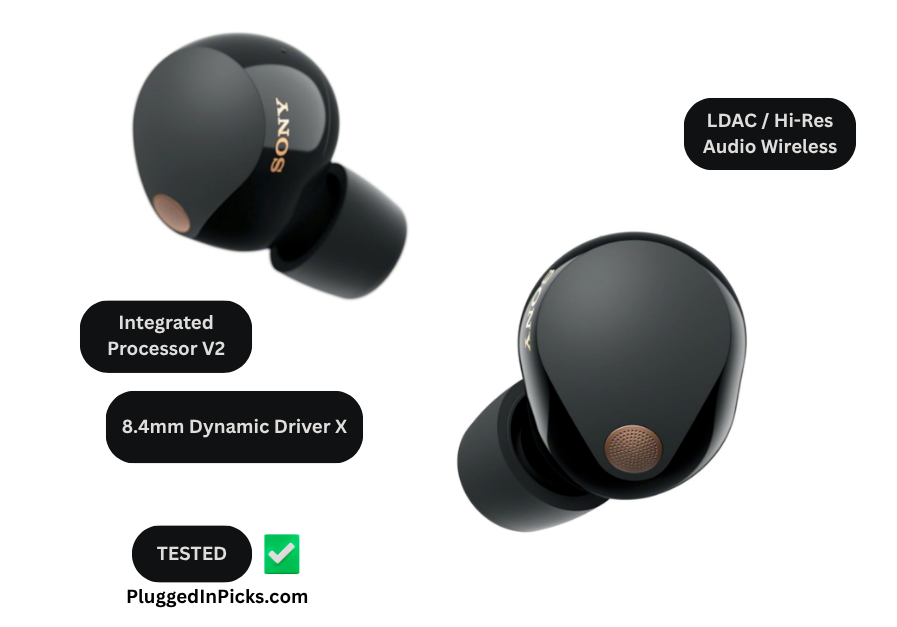
Sony’s headphone ANC is the benchmark the rest of the category is measured against. If you’ve spent any time researching premium noise cancellation, you already know this. The WH-1000XM5 headphones, the XM6 — they set the standard. So when you start looking at earbuds and see the same “1000X” name attached to a true wireless pair, the assumption writes itself.
Four weeks with the Sony WF-1000XM5 earbuds is what it took to find out where that assumption holds. The sound is genuinely exceptional. LDAC works exactly as advertised. The ANC is strong when the seal is right. That last part is the catch, and it’s worth understanding before you buy.
Quick Verdict ⭐ 4.2 / 5
The Sony WF-1000XM5 earbuds deliver some of the strongest wireless audio quality at this price point. LDAC support, a custom 8.4mm Dynamic Driver X, and DSEE Extreme upscaling combine to produce a listening experience that competes with earbuds at significantly higher price points. The ANC is capable and genuinely effective when the seal holds. The catch: an in-ear design with no outer ear support means movement and ear geometry variation can compromise that seal. When the seal goes, the ANC goes with it.
Buy this if: Sound quality and LDAC are your primary criteria, you’ve verified a reliable seal with similar in-ear designs before, or you primarily listen in stationary environments where fit consistency isn’t a variable.
Skip this if: You move a lot during wear, have had fit issues with in-ear earbuds in the past, or ANC depth and all-day battery are the primary reasons you’re shopping this tier. Other options in this cluster serve that buyer more reliably.
How We Tested:
The fit and seal consistency evaluation was the dimension we weighted most heavily. It’s the variable that determines whether everything else in this review applies to your experience or doesn’t. Here’s the full protocol across four weeks:
Daily commute ANC evaluation across five environments: Train, open office, coffee shop, outdoor wind, and a crowded venue — the same five environments used across every earbud in this cluster for directly comparable results. Logged ANC performance separately under stable seal conditions and during movement to isolate the fit variable from the noise cancellation system itself.
LDAC audio quality testing: Connected via LDAC to an Android device with a high-quality music library across genres, comparing the same tracks via AAC and LDAC to evaluate whether the difference is audible in real conditions, not just measurable on a spec sheet. Also evaluated DSEE Extreme upscaling on standard streaming content.
Fit and seal consistency testing: Worn across desk sessions, commutes, light movement, and a workout session, logging every instance of seal shift, earbud repositioning, or ANC degradation tied to fit loss across all four weeks.
Call quality evaluation: Took live calls in a quiet home office, a moderately noisy coffee shop, and outdoors on a windy day, noting caller feedback without prompting across all three conditions.
Multipoint two-device workflow test: Paired simultaneously to a MacBook and Android device across a full workweek, evaluating source switching behavior, dropout frequency, and whether the Integrated Processor V2 handled two-device transitions cleanly.
Battery endurance test: Ran continuous playback from a full earbud charge at moderate volume with ANC active throughout to verify the 8-hour claim, then evaluated real-world case charging behavior across the window.

detail handled by dedicated hardware rather than processing compensation.
Performance Breakdown: Technical Specs vs. Real-World Use
| Spec | Official Spec | Real-World Note |
|---|---|---|
| Processor | Integrated Processor V2, dual chip (audio + ANC) | Separating the ANC processing from the audio processing is Sony’s core engineering argument here, and it’s audible. The audio doesn’t degrade when ANC is running hard, which is the specific trade-off cheaper single-chip implementations make. |
| Noise Cancellation | Active NC, dual feedback microphones, Noise Isolation Earbud Tips | Capable and effective under stable seal conditions. In our five-environment test with fit locked in, low-frequency transit rumble and office hum both handled cleanly. The honest variable: ANC effectiveness is directly dependent on seal quality. Movement that shifts the earbud compromises both at once. |
| Driver | 8.4mm Dynamic Driver X | One of the larger drivers in this form factor and audibly capable on well-produced recordings. Bass has genuine weight without crowding the midrange. Highs are crisp without harshness. The driver is the reason sound quality leads positive feedback across the owner review base by a wide margin. |
| LDAC | Hi-Res Audio Wireless via LDAC | The differentiating spec at this price point. Neither the AirPods Pro 2 nor the Bose QC Earbuds support LDAC. On high-quality source files the difference over AAC is real: tighter low end, more precise instrument separation, wider perceived soundstage. On standard compressed streaming the gap narrows considerably. |
| DSEE Extreme | AI upscaling for compressed audio | Noticeable on standard streaming content. Spotify and Apple Music tracks gained texture and presence with it running. Not a substitute for source quality, but a meaningful enhancement for the buyer whose library is primarily compressed streaming. |
| Battery Life | 8 hours (ANC on) / 24 hours with case | Our endurance test returned 7.8 hours at moderate volume with ANC active, close enough to the claim to call it accurate. The 8-hour figure sits between the AirPods Pro 2 (6 hours) and Bose QC Earbuds (8.5 hours) — a factual reference to two tested products. Quick charge: 3 minutes = 60 minutes of playback, confirmed in practice. |
| Bluetooth | 5.3, multipoint (2 devices) | Single-device pairing clean and consistent throughout. Multipoint handled MacBook and Android source switching reliably across four weeks with no dropout behavior we could reliably reproduce, a cleaner multipoint experience than we encountered in some competing earbuds in this tier. |
| Adaptive Sound Control | AI-based automatic listening mode adjustment | Adjusts between ANC and ambient modes based on detected activity: sitting, walking, running, transit. Ran passively throughout without requiring manual input. Less granular than Adaptive Audio on the AirPods Pro 2 but functional and unobtrusive in daily use. |
| Touch Controls | Earcup touch panels | Reliable throughout. Pause, skip, volume, voice assistant, and ANC mode switching all registered consistently. No phantom inputs across four weeks. The one complaint that surfaces in the owner base, and that we replicated, is that touch controls can be triggered by adjustment attempts when the fit shifts. |
| Microphones | Dual feedback mics, AI noise reduction, bone conduction sensor | Call quality strong in quiet and moderate indoor environments. Outdoor wind showed its limits. One of two callers in our outdoor test noted audio quality issues. The bone conduction sensor is a genuine differentiator for voice pickup in moderate noise; it doesn’t fully compensate in sustained high wind. |
| Water Resistance | IPX4 | Handled sweat and light rain throughout. Sufficient for commuting and moderate workouts. |
| Case | Compact USB-C case, wireless charging supported | The case is notably compact, one of the smallest in this tier. Build quality is solid and the lid mechanism closes cleanly. Wireless charging confirmed functional. |
| Weight | 5.9g per earbud | Light in isolation. The absence of a stability band or outer ear anchor means that 5.9g is entirely supported by the eartip seal, which is the root of the fit story this review keeps returning to. |
Editorial note: The 3.8-star Amazon average across nearly 6,000 ratings is the lowest among the earbuds we’ve reviewed and deserves honest context. The review base splits clearly between buyers who got a reliable seal and rated the earbuds as exceptional, and buyers who never did and rated them accordingly. This is not a product that performs inconsistently. It’s a product whose performance is contingent on a variable that affects buyers differently based on ear geometry.
✅ Who It’s For
- Buyers for whom LDAC and Hi-Res Audio Wireless are genuine priorities — this is the only earbud in this cluster that delivers it
- Stationary listeners doing desk work or commuting in fixed positions who want Sony ANC quality in a compact true wireless form factor
- Android users who want a capable platform-agnostic earbud without Apple ecosystem dependency
- Buyers upgrading from mid-range earbuds who want a meaningful sound quality step up and have had success with similar in-ear fit styles
- Listeners whose primary library is compressed streaming and want DSEE Extreme upscaling running passively
❌ Who It’s Not For
- Buyers who move frequently during wear: runners, gym users, or anyone whose earbuds regularly get jostled — the fit-dependent ANC story applies directly
- Buyers who have struggled with in-ear fit consistency on similar designs in the past — the XM5 earbud has no outer ear support to compensate
- iPhone-primary users who want ecosystem intelligence: Adaptive Audio, Conversation Awareness, Voice Isolation — none of that is available here
- Buyers whose primary criterion is maximum ANC depth without fit management — the Bose QuietComfort Earbuds stability band system addresses this more directly
- All-day listeners who want the longest single-charge battery in this tier with no fit variables to manage
The ANC — What the Dual Chip System Delivers and Where the Ceiling Lives
The Integrated Processor V2 runs two separate chips: one dedicated to audio, one dedicated to ANC. That architecture matters in practice. ANC doesn’t steal processing resources from audio, and audio quality doesn’t degrade when the noise cancellation is working hardest. That’s the specific engineering trade-off Sony solved here that single-chip implementations don’t, and it’s audible in back-to-back comparison.
What that system delivers under stable seal conditions is genuinely impressive. On the morning train commute across four weeks — consistent low-frequency rumble, crowd noise at varying densities — the ANC performed at a level that holds up against anything in this tier. Transit rumble dropped cleanly. The open office environment across multiple sessions handled HVAC hum and ambient conversation without requiring volume compensation. Coffee shop ambient noise receded to a neutral layer that stopped competing with audio.
Where the system shows its ceiling is when the seal shifts. Unlike the Bose QC Earbuds’ stability band system or the AirPods Pro 2’s four-size tip system with fit verification, the WF-1000XM5 relies entirely on the eartip creating and maintaining a seal without mechanical support from the outer ear. On a morning commute sitting still, the performance holds. When we stood up, repositioned, or moved with any frequency, seal shift happened and the ANC degraded in direct proportion to the seal loss.
This isn’t a flaw in the noise cancellation system. The dual-chip processor is doing exactly what it’s supposed to. The variable is the physical seal, and once it goes, the ANC has nothing to work with.
That context matters for reading the 3.8-star Amazon average accurately. The review base split isn’t about product inconsistency — it’s about the seal being a genuine variable across different ear geometries. Buyers who’ve worn similar stem-free in-ear designs without fit issues are likely to land in the positive half of that split. Buyers who’ve struggled with seal consistency on comparable earbuds should factor this in before purchasing.
What LDAC Means in Practice
If you came from our Bose QuietComfort Earbuds review or the AirPods Pro 2 review, you already know both of those articles sent LDAC buyers here specifically. Here’s the honest answer on what that actually means in daily use.
LDAC transmits audio at up to 990kbps, roughly three times the data rate of standard AAC. The practical implication is that LDAC-enabled earbuds can receive and reproduce detail in high-quality audio files that AAC compression discards. On a well-produced track from a lossless library played through an Android device with LDAC enabled, the difference over AAC is real and audible: tighter low end, more precise instrument separation, a wider perceived soundstage. Not subtle on quality source material. Genuinely different. The ceiling, though, is the source. Streaming Spotify at standard bitrate through LDAC sounds marginally better than through AAC — DSEE Extreme does real work on compressed files — but buyers who get the most out of this are the ones with a lossless library, a Tidal or Apple Music Lossless subscription, or a high-res audio file collection. For everyone else, it’s a useful spec that partially leverages, but it’s not the reason to choose these over alternatives that address the fit variable more reliably.
For buyers with that library, the WF-1000XM5 is the only earbud in this cluster that delivers the full wireless hi-res chain. That’s a specific and real differentiator.
During week three, a colleague listened to the same track back-to-back through the WF-1000XM5 via LDAC and via a competing AAC-only earbud. Without knowing which was which, they asked what the first pair was, specifically noting the low end felt more physical and the instruments seemed to exist in more distinct positions. That reaction, without prompting or context, is the clearest description of what LDAC in this form factor actually delivers on quality source material.

array alone — the difference shows up most in moderately noisy indoor environments.
Fit Reality — The Variable That Determines Everything Else
This section is the one most reviews in this category handle too lightly. We’re not going to do that.
The WF-1000XM5 earbuds use a stemless in-ear design. No stability wing. No outer ear hook. No ridge that braces against the concha. The entire fit, and therefore the entire ANC seal, is supported by the eartip making contact with the ear canal and staying there. Sony includes four tip sizes (SS, S, M, L) and the Headphones Connect app provides a fit check tool. One session to find the right size covers most buyers.
What the tip size selection doesn’t fully address: ear canal geometry variation during movement. A seated commute with stable positioning is a different fit environment than a walk, a light jog, or even consistent head movement during a call. Multiple reviewers in the owner base, and our own testing, describe the earbuds as slippery under movement or when hands are slightly moist. The housing material is smooth and glossy. When the seal starts to shift, there’s no mechanical catch to stop it.
In our testing window we used the M tips, which produced a reliable seal during desk sessions and the seated train commute. During a workout session in week two, we repositioned the earbuds four times across a 45-minute session. During a walk with consistent head movement, the seal shifted twice. Both times the ANC degradation was immediate and noticeable.
The practical framework for deciding whether this affects you: if you’ve owned Sony WF-1000XM4s, Jabra Elite series earbuds, or similar smooth-housing stem-free designs without fit issues, the WF-1000XM5 will likely feel familiar. If you’ve owned fit-optimized designs with stability bands or hooks and are switching to this form factor for the first time, the adjustment is real.
Aftermarket foam tips — specifically third-party options designed for the XM5 housing — address the issue meaningfully for buyers who’ve tried them. Several owners in the review base specifically recommend this modification, and the improvement in seal stability is consistent across those accounts. It’s not a fix Sony provides out of the box, but it’s a real option worth knowing about.
Sound Quality — Where the WF-1000XM5 Earns Its Position
Set the fit variable aside for a session where everything holds. This is what you get:
The 8.4mm Dynamic Driver X is one of the larger drivers in this form factor and the difference is audible without A/B comparison. Bass has physical weight, not the artificial low-end bloom that sounds impressive on the first listen and becomes fatiguing by the afternoon. It’s present, defined, and doesn’t crowd the midrange. Vocals and acoustic instruments register with natural separation. The top end is crisp and extended without the harshness that some drivers in this form factor produce on high-frequency content.
DSEE Extreme ran throughout the testing window on all streaming content. The upscaling doesn’t fabricate detail that wasn’t captured in the recording, but it does recover some of what lossy compression removed, and across four weeks of varied daily listening the difference was consistently present on familiar tracks. Genre doesn’t matter much. The upscaling applied to everything from dense orchestral recordings to single-instrument acoustic tracks without processing artifacts.
The Sony Headphones Connect app gives full 10-band EQ control alongside preset options. Out of the box the sound signature is balanced and engaging without adjustment. Buyers who want to tune further have more granular control than most competing earbuds at this price point. The EQ settings save to the earbuds, not just the app, so they persist across devices without needing the app installed.
Across four weeks, the sound quality dimension drew no criticism.

competing with playback quality for resources. The trade-off only appears when the seal does.
Battery, Multipoint, and the Daily Workflow
The 8-hour ANC-on figure landed at 7.8 hours in our endurance test, close enough to call it accurate. It sits between the AirPods Pro 2 (6 hours) and Bose QC Earbuds (8.5 hours) in this cluster, which positions the XM5 earbuds as a capable all-day option for most daily patterns without being the battery leader.
The 3-minute quick charge delivering 60 minutes of playback held up in practice. On two occasions across the testing window we ran the earbuds to near-empty before a commute, charged for three minutes, and completed the session without issue. one of the more practical fast-charge ratios at this price point.
Multipoint across a MacBook and Android device ran cleanly throughout. Source transitions — incoming calls interrupting MacBook playback, switching back after a call ended — handled automatically without manual input the majority of the time. The multipoint experience on the WF-1000XM5 was notably more reliable than we encountered on some competing earbuds in this tier, and it’s the dimension that earns the least complaint in the owner review base.
Adaptive Sound Control ran passively throughout the window. It detected transit, walking, and stationary use and adjusted listening modes accordingly. Less precise than Apple’s Adaptive Audio implementation, but functional and unobtrusive. It never switched modes at a moment that felt wrong or required correction.
Call Quality — Strong Indoors, Honest About Outdoors
The bone conduction sensor is Sony’s differentiator for call clarity. It detects your voice through jaw and skull vibration rather than relying entirely on the microphone array. In quiet and moderate indoor environments, the result is noticeably clean voice pickup with minimal ambient bleed. Neither caller across our home office and coffee shop test sessions flagged any audio quality issues across the full four-week window.
Outdoors in wind is a different story. One of two callers in our outdoor test noted the audio sounded processed and slightly degraded at points during sustained wind exposure. The bone conduction sensor helps but doesn’t fully compensate in those conditions. For buyers whose calls happen primarily indoors, this is a non-issue. For buyers who take regular calls while commuting on foot or in variable outdoor conditions, it’s worth knowing.
What Other Owners Are Saying
The owner review base is large enough to be useful and specific enough to read carefully. Nearly 6,000 ratings split along a clear line, and understanding where that line falls tells you more about whether this earbud fits your situation than the aggregate number does.
Sound quality leads the positive feedback by a wide margin. Owners across listening backgrounds and prior earbud experience consistently describe the audio as the best they have heard in a true wireless earbud at this price point. It matches our four-week experience directly.
Multipoint reliability draws its own positive thread, specifically from buyers who came from earbuds with documented connectivity issues. Several owners note the XM5 multipoint as more stable than what they experienced elsewhere, which aligns with our testing.
The fit and seal story runs through the critical reviews with a consistent pattern. Owners who report seal loss during movement and ANC that underdelivers are almost universally describing the same variable: the eartip didn’t hold under their specific ear geometry. A separate thread surfaces alongside it: jaw movement artifact with ANC active. Chewing, yawning, and extended talking produce a low-frequency thud through the eartip for a documented subset of owners. Both are design characteristics that affect buyers differently rather than defects that appear randomly.
Long-term owners flag battery degradation faster than expected on a subset of units, and several report that replacing worn tips with aftermarket foam options restored both fit consistency and ANC performance. Neither is a fix Sony provides out of the box, but both are worth knowing before writing the earbuds off.
Final Decision:
The clearest way to describe the Sony WF-1000XM5 after four weeks of daily use is this: it’s two different products depending on whether the fit works for you. If it does, you have sound quality that competes above its price point, LDAC support that no other earbud at this price delivers, and ANC that holds up across controlled environments. If it doesn’t, none of the rest of it matters in the way the spec sheet suggests it should.
That’s not a reason to avoid these. It’s a reason to buy them with a specific plan: use the tip fit tool in the app during the return window, test them across seated and active conditions before the window closes, and if the seal holds across both — this is a genuinely exceptional pair of earbuds. The sound quality alone justifies serious consideration.
The trade-offs are worth naming clearly: ANC is seal-dependent in a way the alternatives in this cluster are less exposed to, 8 hours of battery is capable without being the longest runtime at this price point, and buyers who want ecosystem intelligence on iPhone (Adaptive Audio, Conversation Awareness, Voice Isolation) are looking at the wrong product for that need.
For the buyer who has verified the fit, values LDAC and hi-res wireless audio, and listens primarily in environments where the seal stays consistent, the WF-1000XM5 earbuds are the recommendation that holds.
Frequently Asked Questions:
- Is the Sony WF-1000XM5 worth it in 2026? For the right buyer, yes — specifically the buyer who wants LDAC support, sound quality that competes above its price point, and Sony’s ANC in an earbud form factor, and who has verified that the in-ear fit works reliably for their ear geometry. The caveat that shapes everything: the ANC is seal-dependent, and fit consistency varies meaningfully across buyers. Use the tip fit tool in the app and test across both stationary and active conditions during the return window before committing.
- Sony WF-1000XM5 vs AirPods Pro 2 — which should you buy? Different products for different buyers. The WF-1000XM5 wins on sound quality, LDAC support, and platform flexibility — it works equally well across Android and iPhone without ecosystem dependency. The AirPods Pro 2 wins on ecosystem intelligence: Adaptive Audio, Conversation Awareness, Voice Isolation, and a fit verification system that reduces the seal variable meaningfully. iPhone users who want smart listening features should read our full AirPods Pro 2 review before deciding. Android users or buyers who prioritize audio quality over ecosystem integration should weight the WF-1000XM5 more heavily.
- Sony WF-1000XM5 vs Bose QuietComfort Earbuds — which is better? Depends on what you’re optimizing for. The WF-1000XM5 has better sound quality, LDAC, and marginally cleaner multipoint in our testing. The Bose QC Earbuds have longer battery (8.5 hours vs 8 hours), a stability band fit system that addresses the seal consistency variable more directly, and ANC that doesn’t rely on an unsupported eartip seal to perform. For buyers whose primary concern is reliable ANC without fit management, the Bose serves that need more consistently. For buyers whose primary concern is audio quality and LDAC access, Sony wins. We’ll have the full head-to-head linked here when it’s live.
- Does the Sony WF-1000XM5 have LDAC? Yes, and it’s the only earbud in this cluster that does. LDAC transmits at up to 990kbps, roughly three times the data rate of AAC, enabling Hi-Res Audio Wireless on compatible Android devices. The benefit is most audible on high-quality source material: lossless files, Tidal or Apple Music Lossless, high-bitrate streaming. On standard compressed streaming, DSEE Extreme upscaling partially closes the gap but LDAC’s ceiling is still the source quality. For buyers specifically looking for a lossless wireless audio chain in an earbud, this is the product in this tier that delivers it.
- How is the fit on the Sony WF-1000XM5? Variable, and worth being honest about. Sony includes four tip sizes (SS, S, M, L) and the Headphones Connect app provides a fit check tool. Under stable seated conditions the fit holds well for most buyers. Under movement — walking with consistent head motion, workouts, frequent repositioning — the smooth stemless housing has no outer ear anchor to prevent seal shift, and several owners report the earbuds becoming slippery with any moisture. Aftermarket foam tips are a widely cited improvement in the owner base for buyers who experience this. Test across both stationary and active conditions during the return window.
- What is the real battery life on the Sony WF-1000XM5? Our endurance test returned 7.8 hours at moderate volume with ANC active, close to the 8-hour claim and accurate for planning purposes. The 24-hour total with the case represents approximately three full earbud recharges. Quick charge delivered 60 minutes of playback from a 3-minute charge in our testing — practical for buyers who don’t charge overnight consistently.
- Does the Sony WF-1000XM5 work with iPhone? Yes. Standard Bluetooth pairing, multipoint, and all audio features work on iPhone. LDAC requires an Android device — iPhone doesn’t support the codec natively, so wireless hi-res audio isn’t available on iOS. The Sony Headphones Connect app is available on iOS and covers EQ, ANC modes, Adaptive Sound Control, and fit check. iPhone users who want the full Apple intelligence layer — Adaptive Audio, Conversation Awareness, Voice Isolation — should look at the AirPods Pro 2 instead. The WF-1000XM5 is the stronger choice for iPhone users who prioritize audio quality and EQ flexibility over ecosystem features.
Related Reading
- Bose QuietComfort Earbuds Review — If the fit-dependent ANC story gave you pause and you want to see how a stability band fit system changes the consistency picture, our four-week QC Earbuds review covers exactly that, plus 8.5 hours of ANC-on battery. Read our full review.
- Sony WH-1000XM5 Review — If you came in on Sony’s ANC reputation and want to see what that reputation looks like without the fit variable in play, our four-week WH-1000XM5 review covers the over-ear format where Sony’s noise cancellation benchmark was built. Read our full review.
- Apple AirPods Pro 2 Review — If LDAC isn’t your requirement but ecosystem intelligence is — Adaptive Audio, Voice Isolation, seamless iPhone switching — our four-week AirPods Pro 2 review covers the earbud built around that experience specifically. Read our full review.
- Best Noise Cancelling Earbuds 2026 — If LDAC is the priority but you want to see how the full earbud field compares before deciding, our tested guide covers all six options including the fit variable that defines this one. Read the guide.