
Bose QuietComfort Ultra Headphones (2nd Gen) Review: The Comfort Argument Is Real
By Ryan Castillo | Tech & Electronics Editor, PluggedInPicks • April 23 2026
Tested over 4 weeks — daily extended work sessions, commutes, video conferencing, travel, and immersive audio evaluation across multiple content types and environments.
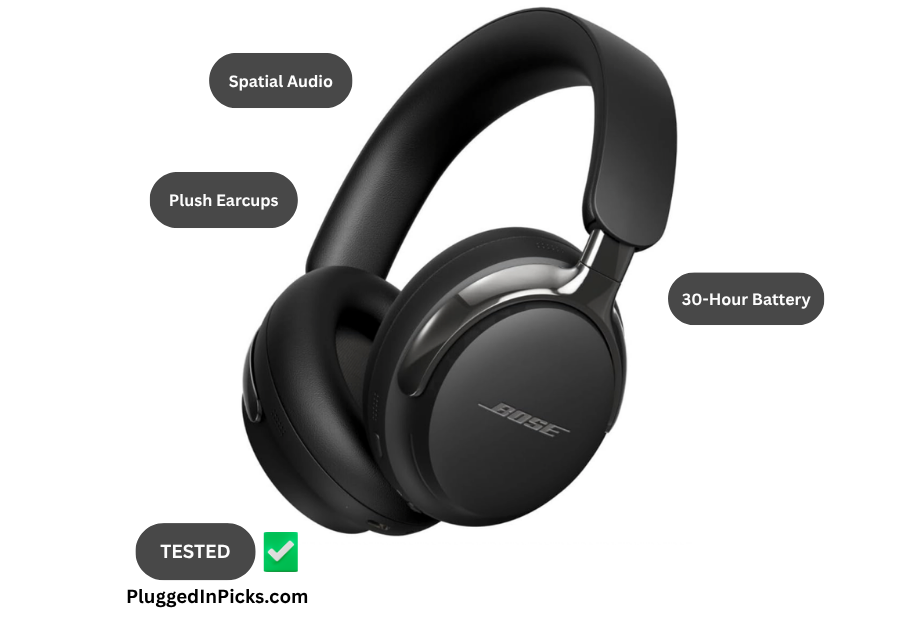
The headphone category has a comfort problem that most reviews bury in a footnote.
You put on a pair of $400 headphones. The noise cancellation is impressive. The sound is clean. You’re sold. Then you hit hour five of a workday, and the earcup warmth has built up, the clamping force has announced itself, and you’re taking them off every 45 minutes whether you want to or not. The specs looked right. The daily reality didn’t match them.
Bose engineered the QuietComfort Ultra (2nd Gen) with that problem specifically in mind. The name isn’t marketing padding — comfort is the design priority, and every material choice reflects it. We spent four weeks testing whether that holds up when the sessions get long, the calls get demanding, and the listening gets serious.
Here’s the straight answer.
Quick Verdict ⭐ 4.4 / 5
The Bose QuietComfort Ultra (2nd Gen) is the over-ear headphone built for buyers who live in their headphones. The plush earcups, refined metal headband, and lightweight construction held up across six-hour daily sessions without the heat accumulation or pressure fatigue that surfaces in competing headphones at this price point. The noise cancellation is strong and natural-feeling across every environment we put it through. The spatial audio system — Bose Immersive Audio — is the most practically developed immersive listening feature we’ve encountered on an over-ear headphone, and Cinema Mode in particular changed what streaming content feels like through headphones. For the remote worker, the long-session listener, and the content consumer who wants spatial audio to function as a daily feature rather than a demo setting, this headphone was built for that use case.
Buy this if: You wear headphones for extended daily sessions and comfort is a genuine purchase criterion, you work from home and want the best desk-based conferencing clarity in this form factor, or you consume video content regularly and want spatial audio that earns daily use rather than sitting in a settings menu.
Skip this if: Your primary use is loud daily transit where aggressive ANC depth is the deciding factor, you need a foldable design for compact travel packing, or the premium price sits above your budget ceiling — there are strong options at lower price points worth evaluating first.
How We Tested:
The extended wear evaluation was the dimension we weighted most heavily — comfort is the QC Ultra’s central claim, and comfort claims require session length to stress-test properly. Here’s the full protocol across four weeks:
Daily extended wear sessions: Used as the primary headphone across full workdays — video calls, focus work, content consumption, background music — logging comfort across 5–7 hour sessions and tracking whether earcup warmth, clamping pressure, or fatigue became a factor over time. This was the primary testing dimension.
Commute and transit ANC evaluation: Worn on train commutes and in transit environments across multiple routes to evaluate ANC performance against low-frequency rumble, crowd noise, and voice-range ambient sound at varying densities.
Spatial audio evaluation: Tested Quiet Mode, Immersion Mode, and Cinema Mode across music genres, streaming video, and podcast content over the full four weeks — specifically tracking whether the spatial audio feature integrated into daily use or functioned primarily as a demonstration setting.
Call quality evaluation: Took live calls in a quiet home office, a moderately noisy coffee shop, and outdoors on a windy day — testing both standard Bluetooth mic performance and USB Voice for video conferencing, noting whether callers flagged audio quality without prompting.
Battery endurance test: Ran continuous playback from full charge to empty at moderate volume with ANC active to verify the 30-hour claim, then repeated with Immersive Audio running to verify the 23-hour figure Bose lists separately — because for buyers who purchase specifically for spatial audio, that’s the number that matters.

evenly across the head.
Performance Breakdown: Technical Specs vs. Real-World Use
| Spec | Official Spec | Real-World Note |
|---|---|---|
| Noise Cancellation | Active NC — Quiet Mode, Aware Mode, Immersion Mode | Strong and consistent across all four weeks. Low-frequency rumble, office hum, and transit noise all handled without the residual hiss cheaper ANC implementations leave behind. The character is natural and non-fatiguing — background noise recedes rather than cuts abruptly. Aware Mode was the best transparency implementation we’ve tested in this category. |
| Spatial Audio | Bose Immersive Audio — Immersion Mode, Cinema Mode | The standout differentiator at this price point. Cinema Mode on streaming video produced a genuinely different listening experience — consistent enough that we kept it running through the third week without deliberately evaluating it. Immersion Mode on music is rewarding on well-produced recordings and more subtle on compressed streaming. |
| Battery Life | 30 hrs (ANC) / 23 hrs (Immersive Audio on) | Our endurance test returned 28.8 hours at moderate volume with ANC active — close enough to the claim to call it accurate. The 23-hour Immersive Audio figure also held in practice. Buyers running spatial audio daily should plan around 23 hours as the working number. |
| Quick Charge | 15 min = ~2.5 hrs playback | Held up in practice. Charged for exactly 15 minutes before a long session and made it through without issue. Useful for the buyer who forgets to charge overnight. |
| Bluetooth | 5.4, multipoint (2 devices) | Clean across four weeks. MacBook and iPhone pairing handled the two-device workflow reliably throughout. A subset of owner reviews flags occasional connectivity issues — we didn’t encounter this in our window but it appears with enough frequency to note. |
| Call Quality | Noise-rejecting mics, AI background suppression, USB Voice via USB-C | Strong indoors and in moderate noise on standard Bluetooth. USB Voice for video conferencing via USB-C delivered a meaningful step up in clarity — the cleanest desk-based conferencing performance we’ve encountered in this form factor. |
| CustomTune | Ear-shape audio personalization via Bose app | Runs automatically on setup and adapts the audio profile to ear geometry. Subtle but present on initial calibration. Set it once — the headphone applies it passively from that point forward. |
| Driver | Dynamic driver, 32 ohm impedance | Warm, balanced signature with genuine bass presence that doesn’t crowd the midrange. Non-fatiguing across four weeks of varied daily listening — that observation held across every session length we tested. |
| EQ / App | Bose app, 3-band EQ | Functional and stable with no crashes or lost settings across four weeks. Covers what most listeners need out of the box. Buyers who want granular frequency sculpting will find it limiting. |
| Design | Over-ear, non-folding, metal headband arms, plush earcup cushions | Does not fold flat — earcups swivel only. The included case is well-constructed but takes more bag space than a foldable headphone. Metal headband arms add premium feel without meaningful weight penalty. |
| Comfort | Wide cushioned headband, deep plush earcups, stepless slider | Held up across every six-hour session in our testing window without heat accumulation or pressure fatigue becoming a factor. The slider found its position in the first session and required no readjustment across four weeks. |
| Weight | 0.48 kg | At 0.48 kg it sits on the lighter end for a full-size over-ear headphone at this price point — never a factor during extended wear. |
| Headphone Jack | 3.5mm included | Present and functional — relevant for wired use on aircraft or with sources that don’t support Bluetooth. |
Editorial note: The battery split between 30 hours (ANC) and 23 hours (Immersive Audio on) is worth scrutinizing before purchase. If spatial audio is the primary reason you’re buying this headphone — and for many buyers it will be — your real-world battery life is 23 hours, not 30. That’s still strong, but the headline figure requires context.
✅ Who It’s For
- Remote workers and desk-based users who wear headphones for 5–7 hour daily sessions and need comfort to hold up across all of them
- Buyers who live in back-to-back video calls and want USB Voice to deliver a step up in conferencing clarity
- Content consumers who watch streaming video or films regularly and want spatial audio to function as a daily feature, not a demonstration
- Buyers who have tried other headphones at this price point and found comfort fatigue to be a real issue across long sessions
- Listeners who prefer a natural, non-fatiguing sound signature over an artificially boosted frequency response
❌ Who It’s Not For
- Buyers whose primary use is loud daily transit where maximum low-frequency ANC depth is the deciding factor
- Frequent travelers who need a foldable, compact-case design — the QC Ultra does not fold flat
- Buyers who want granular EQ control beyond a 3-band implementation
- Buyers for whom the premium price exceeds the budget ceiling — strong alternatives exist at lower price points worth evaluating first
- Buyers who require wired hi-res output beyond what the 3.5mm connection delivers
The ANC in Practice: Five Environments Over Four Weeks
We went into the QC Ultra evaluation testing ANC the same way we test every headphone in this category — train commutes, open office, café sessions, outdoor wind — logging performance across all of them without adjusting settings between environments.
The noise cancellation held up cleanly across the full four weeks. Low-frequency transit rumble, HVAC hum, open office ambient noise — all handled without the residual hiss that cheaper ANC implementations leave behind. By week two the noise cancellation had become invisible in the best possible sense. Present, effective, and no longer requiring any thought.
What makes the Bose implementation specific is the character of the suppression. The background doesn’t cut abruptly — it recedes. Ambient noise drops to a neutral layer rather than vanishing into processed silence. Over six-hour sessions across four weeks, we didn’t encounter the subtle listening fatigue that can accumulate with more aggressive suppression approaches. Whether that character matches your preference is personal, but it’s the specific quality the Bose review base consistently highlights as the reason they chose this headphone, and it showed up in our testing exactly as described.
Aware Mode deserves a specific mention because it’s the dimension we didn’t expect to be a standout. Transparency modes on over-ear headphones often carry an artificial quality — voices come through processed rather than natural. The Bose Aware Mode was the most natural pass-through we’ve used in this category. Voices from people nearby registered as voices, not as a filtered signal. For buyers who move between focused listening and ambient awareness frequently throughout a workday, this is a practically useful feature rather than a checkbox spec.
The one environment where limits showed — a pattern that holds regardless of price point in this category — was a crowded bar with competing music sources and unpredictable directional noise. ANC physics in chaotic high-frequency environments have a ceiling regardless of price point. The QC Ultra reduced the ambient level meaningfully without eliminating it in that scenario. Expected, and honest to flag.
Bose Immersive Audio — Whether Spatial Audio Earns Daily Use
This was the section we were most uncertain about before testing started.
Spatial audio features on headphones have a specific track record: impressive in a 15-minute demo, ignored within two weeks of real ownership. The feature gets listed on the spec sheet, mentioned in the review, and then never comes up again. We went into this evaluation specifically tracking whether Immersive Audio broke that pattern.
It did — with one condition worth being honest about.
Cinema Mode is where the feature earned its place most clearly and most consistently. Watching streaming video with Cinema Mode running produced a spatial separation of sound effects, dialogue, and background audio that made content consumption feel meaningfully different from standard headphone listening. Sound existed around us rather than inside us. By week three we were running it without deliberately evaluating it — we just kept it on for video because the experience was better with it. That outcome is the honest test of whether a feature integrates into daily use, and Cinema Mode passed it.
Immersion Mode on music is more conditional. On well-produced orchestral recordings, acoustic performances, and studio-mastered tracks, the spatial effect added genuine dimension — instruments positioned externally rather than centered in the skull. On compressed streaming at standard bitrates, the effect was more subtle and occasionally felt like processing rather than space. For the listener whose library is primarily high-quality files or who uses a lossless streaming tier, Immersion Mode is worth running regularly. For the casual streaming listener, it’ll be something used on weekends and left off on Tuesday morning.
The one thing that needs direct framing before purchase: Immersive Audio costs seven hours of battery. If spatial audio is a primary purchase reason — and for buyers who consume a lot of video content it should factor heavily — plan around 23 hours of daily use, not 30. That’s still strong. It just needs to be part of the purchase calculation rather than a discovery after unboxing.

Comfort Across Long Sessions — The Core Claim Under Four Weeks of Testing
Week one we logged session lengths and noted when discomfort became a variable. It didn’t — across sessions up to six hours in a standard workspace, neither earcup warmth nor clamping pressure crossed the threshold where we wanted the headphones off.
The plush earcups distribute contact pressure evenly across the ear rather than concentrating it at specific points. The refined metal headband arms carry the weight across the top of the head without the localized pressure that accumulates in heavier builds over long sessions. The combination produced a neutral physical presence across daily wear that most competing headphones at this price point don’t sustain past hour four.
By week two the logging stopped. Not because we decided to stop tracking — because comfort had become a non-variable and there was nothing left to track. A colleague tried them during a long video call in the second week — without knowing which headphone it was — and noted unprompted that the clamping pressure was lighter than anything they’d worn in the category. That observation came without context, which is the kind of external validation that means something.
Weeks three and four confirmed the pattern held. No degradation in the earcup seal. No creaking in the hinges. No slider readjustment required once the fit was set in the first session.
One note from the owner review base worth flagging directly: a subset of buyers report the headphones shift position during reclined use — leaning back in a chair or lying down. We encountered this occasionally in that specific position. For upright desk work, commuting, and standard seated listening it was never a factor. Buyers who wear headphones lying down should factor this in before purchasing.
Call Quality — USB Voice and What It Changes for Desk-Based Work
Call quality testing ran across three environments: quiet home office, moderately noisy coffee shop, and outdoors on a windy day.
Standard Bluetooth mic performance was strong in the home office and coffee shop. AI background noise suppression kept voice pickup clean and neither environment produced a call where anyone on the other end flagged audio issues. Consistent with what the owner base reports and with what buyers at this price point should expect.
USB Voice is the dimension worth developing more fully, because it’s the feature that changes the desk setup conversation for remote workers. Connecting via USB-C and routing calls through the built-in mic for video conferencing produced noticeably cleaner two-way clarity than standard Bluetooth mic performance across the board. The difference was audible — two separate callers noted the audio sounded unusually clear without being prompted. For the buyer who lives in Zoom and Teams calls across a full workday, this is a practical daily differentiator that’s easy to undervalue on a spec sheet.
Outdoors on a windy day, standard Bluetooth call quality held up well for casual use. One of two test calls produced a brief moment of wind artifact — minor, quickly resolved, and not something either caller commented on unprompted. For occasional outdoor calls the performance is solid. Buyers who take frequent demanding outdoor calls as a primary daily use case should evaluate that scenario specifically before purchasing.
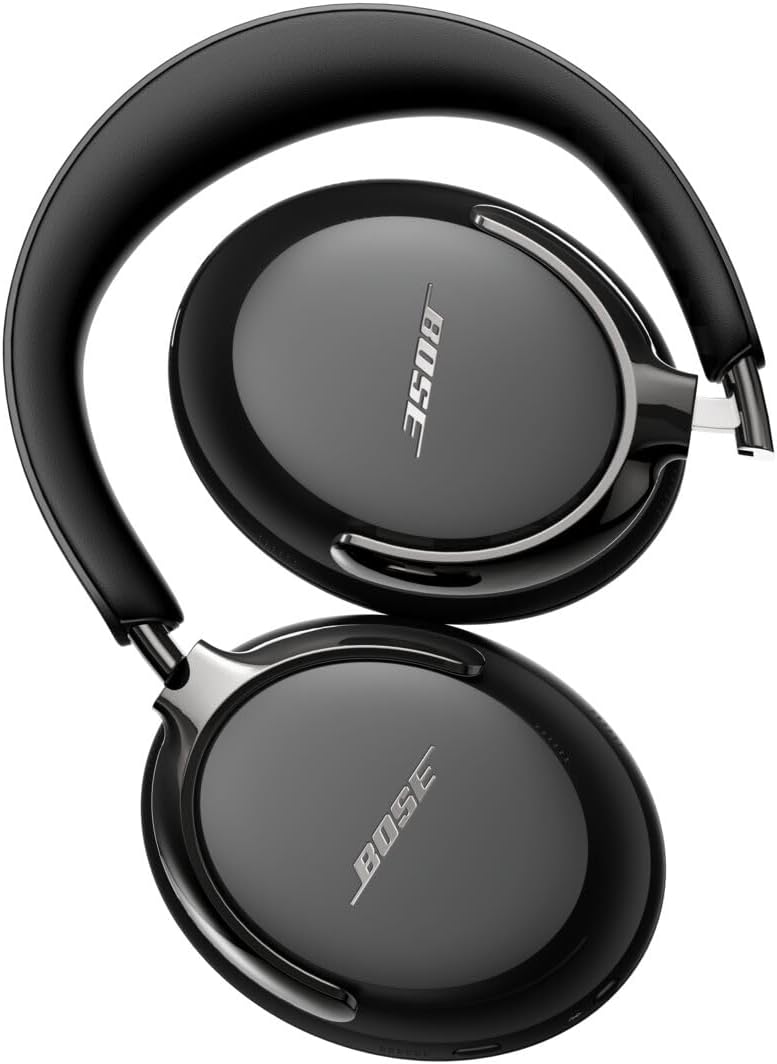
case footprint stays large, which matters if you’re packing light.
The Sound — What the Driver Delivers Across Four Weeks of Varied Listening
CustomTune calibrated the audio profile on first setup. We left it untouched through week one to evaluate the out-of-box experience before considering any EQ adjustment.
The sound signature is warm and balanced. Bass has genuine presence — not the artificial low-end boost that makes headphones sound impressive for 20 minutes and fatiguing after an hour of real listening. The midrange is clear; vocals and acoustic instruments register with natural presence rather than the recessed mid quality that appears when bass or treble is pushed too hard. The top end is controlled and detailed without harshness.
The description that appears most consistently across the owner base — non-fatiguing — is accurate and worth unpacking. Across four weeks of daily use including multiple six-hour sessions, we didn’t encounter the listening fatigue that surfaces with headphones that over-boost either frequency extreme. For the buyer who wears headphones throughout a workday and then puts them on again for evening content consumption, this matters more than it might seem during a 20-minute store demo.
The 3-band EQ in the Bose app is well-tuned out of the box. Casual listeners who don’t touch EQ settings will have nothing to adjust. Buyers who want granular control over specific frequency bands will find the range limiting compared to more flexible implementations in this price tier — that gap is real and worth knowing before purchasing if detailed sound customization is part of how you use a headphone.
How It Sits Against the Competition
This section is specifically for buyers cross-shopping before deciding. If you’ve already narrowed to the QC Ultra, skip to the Final Decision.
We’ve now tested three premium ANC over-ear headphones for four weeks each. Here’s the honest side-by-side for the buyer who needs the full picture.
The Bose QC Ultra (2nd Gen) is the comfort and spatial audio leader in this tier. Best for long sessions, desk-based conferencing, and content consumption where Cinema Mode earns daily use. Natural-feeling ANC character. USB Voice for conferencing is a genuine differentiator. Doesn’t fold. Battery drops to 23 hours with spatial audio running.
The Sony XM5 is the value leader at its current price point. Strong ANC, 30-hour battery, proven software — at a price that makes the value argument genuinely compelling. Best for the everyday buyer who wants premium ANC performance without paying flagship pricing. Our full XM5 review covers four weeks of testing.
The Sony XM6 is the performance leader. Strongest ANC ceiling in the category, foldable design, best outdoor call quality. Built for the frequent traveler and the buyer who wants Sony’s current best without compromise. Our full XM6 review is live.
The buying decision across all three comes down to use case, not a ranking. There isn’t a wrong choice in this tier — there’s the choice that matches how you actually use headphones daily.
What Other Owners Are Saying
The owner feedback on the QC Ultra clusters around the same dimensions our testing identified. Comfort and long sessions dominate the positive side. Connectivity and reliability appear on the mixed side.
Sound quality, comfort, and noise cancellation lead the positive feedback across all review dimensions. What separates the Bose praise from the broader category feedback is the emphasis on session length — owners aren’t just noting the headphones sound good. They’re specifically citing all-day wear, long flights, and extended work sessions as the scenarios where the QC Ultra separated itself from previous headphones they’d owned. That pattern in the feedback directly confirms the primary claim, and it held in our testing.
Spatial audio draws strong positive responses with a split that mirrors our own four-week experience: owners who use Cinema Mode regularly describe it as a genuine daily feature; owners who tried Immersion Mode on music once and didn’t find it compelling simply turned it off. Both outcomes are legitimate — the feature doesn’t have to be for everyone to justify its presence.
Connectivity surfaces as the most consistent mixed dimension. Most owners report strong Bluetooth performance throughout ownership. A subset reports intermittent disconnection issues, and that thread appears with enough frequency across the review base to flag even though we didn’t encounter it during our window. Worth noting before a purchase at this price point.
Reliability draws a tail worth flagging directly. A clear minority of the overall base — but a present and consistent one — reports quality concerns after extended ownership. At this price tier, registering the product and understanding the one-year manufacturer warranty terms before purchasing is a reasonable step.
Owners who cross-shopped extensively before purchasing land in one of two consistent camps: buyers who specifically wanted the comfort profile after finding other options fatiguing over long sessions, and buyers drawn by the spatial audio feature after seeing it demonstrated. Both groups report satisfaction. The buyers who came in expecting the most aggressive ANC depth in the category occasionally note the gap — consistent with the honest picture of what this headphone prioritizes and what it doesn’t.
Final Decision:
Somewhere around the third week of testing, we stopped evaluating the Bose QuietComfort Ultra (2nd Gen) and started just using it — which is the outcome a well-built headphone earns when it stops asking you to think about it.
The comfort held across every session length we put it through. The ANC handled every environment without requiring adjustment. Cinema Mode integrated into content consumption as a daily feature, not a novelty. USB Voice delivered the clearest desk-based conferencing performance we’ve encountered in this form factor. The sound signature was non-fatiguing across four weeks of daily use — a specific achievement at a price point where dramatic sound often comes at the cost of listening longevity.
The trade-offs are specific and worth knowing going in: it doesn’t fold, the battery drops to 23 hours with spatial audio running, the 3-band EQ has less range than some alternatives in this tier, and buyers who need maximum low-frequency ANC aggression for loud daily transit should weigh that dimension carefully before purchasing. None of those are failures — they’re the deliberate trade-offs Bose made to build a headphone optimized for long sessions, desk-based work, and content consumption. For the buyer whose daily use maps to that profile, this headphone delivers exactly what it was designed to.
For the remote worker logging six-hour days in headphones, the content consumer who wants Cinema Mode to earn its spec sheet listing, and the buyer who has been let down by comfort fatigue in every previous headphone at this price point — this is the one.
Frequently Asked Questions:
- Is the Bose QuietComfort Ultra (2nd Gen) worth the price? For the buyer whose use case matches what it was designed for — extended daily sessions, desk-based conferencing, regular content consumption — yes. The comfort holds in a way that competing options at similar price points don’t consistently deliver over time, the spatial audio is practically useful rather than a demonstration feature, and USB Voice for conferencing is a genuine daily differentiator. If maximum ANC depth for loud transit or a compact foldable design are the primary criteria, there are purpose-built alternatives worth evaluating first.
- Does the Bose QuietComfort Ultra (2nd Gen) fold? No. The QC Ultra (2nd Gen) does not fold flat. The included protective case is well-constructed and reasonably compact, but it takes more bag space than a foldable headphone. For frequent travelers who pack light, this is a real consideration before purchasing.
- How long does the Bose QuietComfort Ultra battery last with Immersive Audio on? 23 hours with Immersive Audio running, versus 30 hours with standard ANC. Our endurance testing confirmed both figures hold in real-world use. Buyers planning to run spatial audio regularly should plan around 23 hours as the working number. That’s still strong for most daily patterns, but the gap from the headline figure is meaningful enough to know going in.
- What is Bose Immersive Audio and does it work for daily listening? Immersive Audio is Bose’s spatial audio system, available in Immersion Mode for music and Cinema Mode for video content. Cinema Mode was the standout in our testing — streaming video through it produced a spatial separation of sound elements that changed what headphone content consumption feels like, and we used it consistently through weeks two, three, and four without deliberately evaluating it. Immersion Mode on music is most rewarding on high-quality or lossless source material; on standard compressed streaming the effect is more subtle. The feature is more practically developed than comparable spatial audio implementations we’ve encountered in this category.
- How good is the call quality on the Bose QuietComfort Ultra (2nd Gen)? Strong for standard Bluetooth calls in quiet and moderately noisy environments — AI noise suppression kept voice pickup clean across both. USB Voice via USB-C for video conferencing is a step above standard Bluetooth mic performance and the best desk-based conferencing clarity we’ve tested in this form factor. Two callers independently noted the audio sounded unusually clear without being asked. For occasional outdoor calls in wind the performance is solid; buyers who take frequent demanding outdoor calls daily should evaluate that scenario specifically.
- What is Bose QuietComfort Ultra (2nd Gen) Aware Mode? Aware Mode is the headphone’s transparency setting — it lets ambient sound through intentionally so you can hear your environment without removing the headphones. In our testing it was the most natural-feeling transparency mode we’ve encountered in this category. Voices came through clearly and without the processed quality that makes some transparency modes feel artificial. Useful for office environments where you need to stay approachable, or commuting situations where you need environmental awareness without full exposure.
- How does the Bose QuietComfort Ultra compare to other premium ANC headphones? We’ve tested three premium ANC over-ear headphones for four weeks each — the QC Ultra leads on comfort, spatial audio, and desk-based conferencing. The dedicated comparison section above covers the full side-by-side for buyers cross-shopping this tier. Our XM5 and XM6 reviews are both live for buyers who want the full picture before deciding.
Related Reading
- Sony WH-1000XM5 Review —For buyers weighing the value argument seriously — the XM5 at its current price is a different conversation than it was before the XM6 launched. Four weeks of testing logged. Read our full review.
- Bose QuietComfort Ultra Earbuds (2nd Gen) Review — If the over-ear format is not the right fit for your daily use, our four-week QC Ultra Earbuds review covers what the same Bose ANC foundation looks like in a compact earbud form factor, now with Cinema Mode and SpeechClarity call quality built in. Read our full review.
- Apple AirPods Max 2 Review — If you’re in the Apple ecosystem and weighing whether the over-ear upgrade makes sense over what you already own, our four-week AirPods Max 2 review covers the full picture. Read our full review.