
Michelin Defender 2 Review: The Best All-Season Tire for Long-Haul Drivers?
By Jake Morrison | Automotive & Outdoor Gear Editor, PluggedInPicks • November 1st, 2025
Tested on a 2014 Honda Odyssey across highway miles, daily commuting, and mixed seasonal conditions.
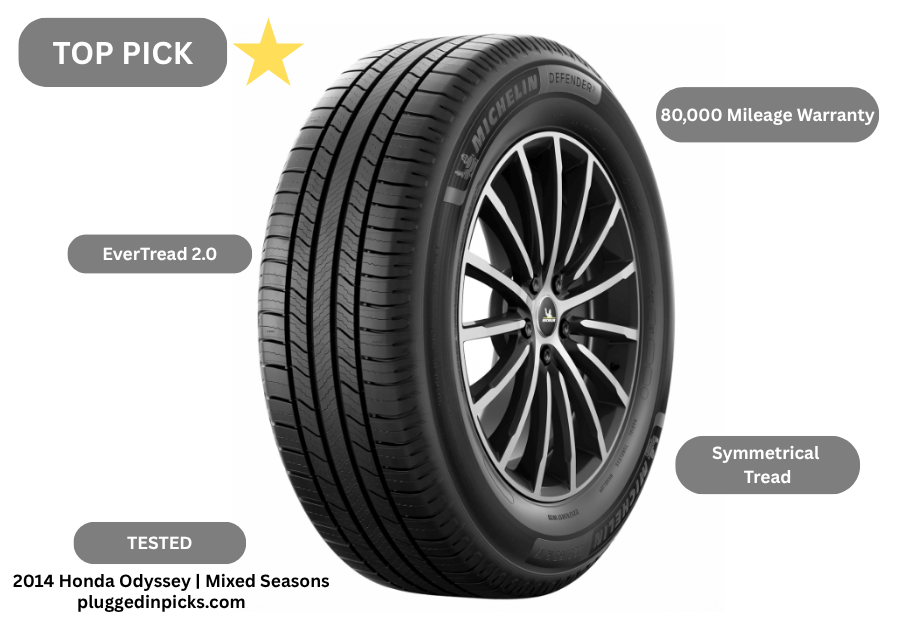
If your driving life looks like long highway stretches, daily commutes, and a climate that doesn’t demand dedicated winter rubber — the Michelin Defender 2 was built for exactly that. Where most all-season tires ask you to choose between longevity and performance, Michelin’s pitch with the Defender 2 is that you shouldn’t have to. An 80,000-mile treadwear warranty backs that claim. So does the symmetrical tread design, the softer ride profile, and the way this tire holds up after the first 20,000 miles when most competitors start showing their limits.
I put these on my wife’s 2014 Honda Odyssey — a van that logs serious annual mileage between school runs, highway trips, and all the other demands a family vehicle accumulates. I also run the Michelin CrossClimate 2 on my own 2017 Honda CRV, which gives me a useful same-brand, same-roads comparison across two vehicles built for different priorities. Here’s the full picture on the Defender 2 and where it fits.
Quick Verdict
The Michelin Defender 2 delivers on its core promise: a long-wearing, comfortable all-season tire built for drivers in mild-to-moderate climates who prioritize value over years, not months. The 80,000-mile warranty is the strongest in its class, the symmetrical tread allows full cross-rotation flexibility, and the ride quality is noticeably softer than more aggressive all-season options. The trade-off is winter capability — the Defender 2 does not carry the Three-Peak Mountain Snowflake (3PMSF) certification. In real winter weather, the CrossClimate 2 is the stronger tire. But for drivers who don’t regularly face snow or sustained heavy conditions, the Defender 2 makes a compelling case on longevity and ride comfort alone.
Buy this if: You’re in a mild-to-moderate climate, logging significant annual mileage, and want a tire that wears slowly, rides quietly, and doesn’t need to perform in serious winter conditions.
Skip it if: You deal with real winters — regular snow, sustained wet roads, or unpredictable shoulder seasons. The CrossClimate 2 is the right tire for that use case.
How I Tested:
- Vehicle testing: My wife’s 2014 Honda Odyssey — a high-mileage family van that sees a mix of highway driving, suburban commutes, and longer road trips. The Odyssey is about as representative a test platform as you can get for this tire: it’s exactly the kind of vehicle the Defender 2 is designed for. Running the CrossClimate 2 separately on my own CRV gave me a useful same-brand comparison across different platforms and use cases.
- Braking feel: Wet and dry stopping feel from highway speeds, compared against the previous set on the same vehicle. Driver feel and reaction distance — not instrumented numbers.
- Noise: Monitored across smooth highway asphalt, rough concrete, and suburban streets. Observations from mile 300 onward after initial break-in. The Odyssey’s cabin is well-insulated, so any noise floor difference shows up clearly.
- Ride quality: The Odyssey amplifies ride character differences well — you feel compound softness and road absorption clearly in a minivan, more so than in a car. Paid specific attention to how the Defender 2’s ride profile compares to the CrossClimate 2’s firmer feel on similar roads.
- Wear tracking: Tread depth monitored across mileage intervals. Early wear pattern and rotation behavior noted after the first full rotation cycle.

forces across a larger contact patch — the heat map overlay shows where the tread
is doing the most work. The EverTread 2.0 compound underneath is what backs the
80,000-mile warranty claim. On the Odyssey, that even contact patch distribution
shows up early — no unusual shoulder wear after the first rotation cycle.
Performance Breakdown: Technical Specs vs. Real-World Use
| Feature | Spec | Real-World Note |
|---|---|---|
| Season Rating | All-Season | No 3PMSF certification. Performs well in light wet conditions and mild shoulder seasons — not rated for serious snow traction. |
| Tread Type | Symmetrical | Unlike directional tires, symmetrical tread allows full cross-rotation — front-to-rear and side-to-side. Better long-term wear evenness and simpler service at every rotation. |
| Tread Depth | 10.5/32nds | Slightly deeper than the CrossClimate 2 at new. More starting depth contributes to the longer treadwear warranty. |
| Treadwear Warranty | 80,000 miles | Strongest warranty figure in this category — 20,000 miles more than the CrossClimate 2. Michelin also backs it with a 6-year standard limited warranty. |
| Load Capacity | Size-dependent | More than adequate for passenger cars, CUVs, minivans, and SUVs. Confirm your specific size’s load index before purchasing — the Odyssey’s load demands are well within range. |
| Speed Rating | H (up to 130 mph, size-dependent) | Appropriate for the vast majority of passenger, minivan, and CUV driving. Lower than the CrossClimate 2’s V-rating — not a real-world factor for most drivers. |
| Locking 3D Sipes | Yes | Sipes provide grip edges in wet and light cold conditions while locking together under load to protect tread life. Same technology family as the CrossClimate 2, different compound tuning. |
| Max Pressure | 51 PSI (size-dependent) | Standard — always follow your vehicle’s door placard, not the tire’s maximum rating. |
| Available Sizes | Multiple — R16 through larger | Size-specific specs vary. The fundamentals covered here apply across the lineup. |
✅ Who It’s For
- High-mileage drivers who want maximum tread life
- Families running a minivan or CUV as a primary vehicle
- Mild-climate drivers in the South, Southwest, or Pacific Coast
- Drivers who want full cross-rotation flexibility
- Anyone replacing a tire that wore faster than expected
❌ Who It’s Not For
- Drivers in four-season climates with real winter weather
- Anyone who needs 3PMSF snow certification
- Budget buyers — these carry a premium price
- Performance drivers who prioritize handling over longevity
- Drivers in the upper Midwest, mountain states, or Northeast with heavy winter conditions

confirmation all live here. Worth checking against your vehicle’s door placard
before mounting. No directional arrows on the sidewall either, which tracks with the
symmetrical design and means no special orientation requirement at install.
Dry and Highway Performance — Where This Tire Lives
The first thing you notice on the highway is how settled the Odyssey feels on the Defender 2. The ride character is distinctly softer than what I get from the CrossClimate 2 on the CRV — more absorption on rough concrete transitions, less firmness transmitted through the seat. On a loaded family highway run, that difference compounds. After two or three hours, the lower road noise and softer compound make the cabin noticeably more comfortable than it was on the previous set.
Lane changes are clean and predictable. No vagueness, no delay between input and response — which matters more in a minivan than people expect, because a loaded Odyssey has real mass to manage at highway speeds. The symmetrical tread pattern doesn’t have the V-shaped aggression of the CrossClimate 2’s directional design, and on dry roads that shows up as a more composed, relaxed feel rather than an alert, planted one. For a family hauler, that’s the right trade.
Dry braking from highway speeds is confident. No drama, no pull. The Locking 3D Sipes give the tread blocks enough edge without the compound stiffness that can make performance-oriented all-seasons feel harsh on everyday surfaces.
Wet Performance — Capable, Not Exceptional
In everyday wet conditions — rain-slicked highways, wet suburban streets, damp morning school runs — the Defender 2 handles well. Hydroplaning resistance is solid, wet braking feels controlled, and the tire inspires confidence in the kind of rain you deal with on a regular basis.
What it doesn’t do is match the CrossClimate 2 in more demanding wet conditions. The V-shaped directional tread on the CrossClimate 2 evacuates water more aggressively, and in heavy rain or standing water that difference is real. For drivers in climates where heavy rain is the worst they regularly see — not snow — the Defender 2’s wet capability is adequate. For drivers who deal with sustained heavy rainfall, the CrossClimate 2 is the stronger tool.
Winter Performance — Know the Limits
This is the section that matters most for buyers comparing the two Michelin options. The Defender 2 does not carry the Three-Peak Mountain Snowflake rating. In light frost and the occasional dusting, it holds its own. On lightly packed residential streets, it’s manageable. But in genuine winter conditions — sustained accumulation, icy secondary roads, unpredictable shoulder season transitions — it is not the right tire.
Putting a family minivan on the wrong tire in winter is exactly the kind of risk that matters. Drivers in Chicago, Minnesota, the mountain states, or anywhere that sees real seasonal weather should be looking at the CrossClimate 2 instead. That’s not a knock on the Defender 2 — it’s built for a different use case. Understanding that distinction is the whole point of the comparison.
Road Noise
Quiet — noticeably so. The symmetrical tread doesn’t generate the tread-pattern noise that directional designs can produce, and the softer compound absorbs surface variation rather than transmitting it. The Odyssey’s cabin isolation helps, but the Defender 2 is doing real work here too. Rough concrete adds some drone as it does with any tire, but smooth highway asphalt is genuinely calm.
For families spending significant time on highway miles, this matters. A quieter tire means a quieter cabin, which on a long drive with kids in the back is worth more than a spec sheet communicates.
Tread Life — The Core Argument
The 80,000-mile treadwear warranty is the headline spec, and after the first full rotation cycle on the Odyssey the early wear pattern supports it. Even wear across the contact patch, no premature shoulder wear, and the 10.5/32nds starting depth gives a long runway before the replacement threshold. These are early readings — one rotation cycle isn’t a wear story — but there’s nothing in the early pattern to suggest the warranty is optimistic.
The symmetrical tread helps here too. Full cross-rotation — front-to-rear and side-to-side — distributes wear more evenly than directional tires, which are limited to front-to-rear only. Over 80,000 miles of family driving, that flexibility adds up. The Odyssey also tends to run harder on front tires than the rear given its weight distribution, so full cross-rotation flexibility is a practical advantage on this platform specifically.
For context: the CrossClimate 2 carries a 60,000-mile warranty. The Defender 2’s 80,000-mile figure represents a meaningful difference for high-mileage drivers calculating cost per mile over the life of a set.
Getting Them Installed Through Amazon
Amazon offers professional installation through local participating shops when you purchase tires at checkout. The tires ship directly to the installer, you schedule your appointment, and show up. Pricing varies by location — check the current options at checkout for your area. If Amazon installation isn’t available near you, any tire shop can handle these. The symmetrical tread has no directional mounting requirement, which simplifies installation slightly compared to the CrossClimate 2 — no risk of a shop mounting them backward.
What Other Owners Are Saying
Across a strong base of verified reviews, the pattern is consistent with what the tire is designed for: long wear life, quiet ride, and confident handling in everyday conditions. High-mileage drivers specifically call out how well these hold up deep into their mileage. Owners on CUVs and minivans consistently mention the improvement in ride quality over their stock tires — quieter, smoother, more planted on long highway stretches.
The honest friction point in the feedback mirrors the limitation in this review: drivers who encounter real winter conditions note the Defender 2 reaches its limits faster than a 3PMSF-certified tire would. That’s a confirmation that the tire is doing exactly what it’s built to do, in the conditions it’s built for — not a defect in an otherwise wrong-fit purchase.
Defender 2 vs. CrossClimate 2 — Which Michelin Is Right for You?
This is the comparison most buyers are actually working through, and it comes down to climate and priorities.
The CrossClimate 2 is built around all-weather versatility. The 3PMSF certification is real — wet braking and snow traction are meaningfully better than a standard all-season, and the directional V-shaped tread evacuates water aggressively in heavy rain. The trade-off is a slightly firmer ride, a 60,000-mile warranty instead of 80,000, and directional mounting that limits rotation options.
The Defender 2 is built around longevity and comfort. The 80,000-mile warranty is the strongest in the category, the symmetrical tread allows full cross-rotation, and the ride character is softer and quieter on everyday surfaces. The trade-off is no 3PMSF certification — in real winter conditions, it is the weaker tire.
The decision point: if you deal with real winters, get the CrossClimate 2. If your climate is mild and your priority is maximizing wear life and ride comfort across years of high-mileage driving — especially on a family vehicle that racks up serious annual miles — the Defender 2 makes a stronger case. See our full Michelin CrossClimate 2 review for the complete breakdown on the other side of that comparison.

highway and suburban driving this image captures is exactly where this tire
spends most of its life. Quiet, composed, and consistent across conditions that
don’t push the limits in either direction.
Final Decision:
The Michelin Defender 2 doesn’t try to be everything — and that’s what makes it good at what it does. For high-mileage family vehicles in mild-to-moderate climates, the case is straightforward. The 80,000-mile warranty isn’t just a marketing figure — the symmetrical tread design, the 10.5/32nds starting depth, and the early wear pattern on the Odyssey all point toward a tire built to back that number up. The softer ride character and full rotation flexibility are genuine advantages over more aggressive all-season designs, and the noise floor on highway miles is one of the lower ones in this category. On a family minivan that spends real time on the highway, those qualities compound in ways that matter.
The honest limitation is winter. The Defender 2 is not the tire for drivers who deal with real seasonal weather — snow, sustained heavy rain, or unpredictable shoulder season conditions. In those climates, the Michelin CrossClimate 2 is the stronger choice, full stop. But for the driver this tire is actually built for — high mileage, mild climate, prioritizing long-term value on a family vehicle — it’s one of the better-executed all-season tires in its class.
Frequently Asked Questions:
- Is the Michelin Defender 2 a good tire? Yes — for the right driver. It carries one of the longest treadwear warranties in the all-season category, rides quietly, and handles everyday wet and dry conditions with confidence. The limitation is winter performance: it does not carry the 3PMSF certification, and in real snow or sustained heavy rain it is outperformed by tires built specifically for those conditions. For mild-climate, high-mileage drivers — and especially for family vehicles like minivans and CUVs — it’s a strong choice.
- How long do Michelin Defender 2 tires last? Michelin backs the Defender 2 with an 80,000-mile treadwear limited warranty — one of the strongest figures in the all-season category. A 6-year standard limited warranty is included as well. Actual wear depends on driving style, road surface, load, and rotation schedule. The symmetrical tread design allows full cross-rotation, which distributes wear more evenly and supports the long warranty claim.
- Does the Michelin Defender 2 have a 3PMSF rating? No. The Defender 2 is a standard all-season tire without the Three-Peak Mountain Snowflake certification. It handles light frost and dusting adequately, but it is not rated for serious snow traction. Drivers in four-season climates who need snow confidence should look at the Michelin CrossClimate 2 instead.
- Is the Michelin Defender 2 good in rain? Yes, for everyday wet conditions — rain-slicked highways, damp commutes, and light to moderate rainfall. The Locking 3D Sipes provide wet grip, and hydroplaning resistance is solid in normal driving conditions. In sustained heavy rainfall or standing water, the CrossClimate 2’s directional V-shaped tread evacuates water more aggressively.
- Can you get Michelin Defender 2 tires at Costco? Michelin tires are commonly stocked at Costco Tire Centers, and the Defender 2 is among the models typically carried. Availability varies by location and time of year. Costco’s tire pricing often includes installation, balancing, rotation, and flat repair in the purchase price — worth factoring in when comparing against online pricing. Amazon also offers installation through participating local shops at checkout if you purchase online.
- What’s the difference between the Michelin Defender 2 and Defender LTX M/S2? The Defender 2 is designed for passenger cars, CUVs, and minivans. The Defender LTX M/S2 is designed for light trucks and SUVs requiring a higher load capacity. If your vehicle calls for a light truck tire designation, check whether the LTX M/S2 is the right fit — your door placard or owner’s manual will clarify.
- What size Michelin Defender 2 do I need? Check your vehicle’s door placard or owner’s manual for the recommended tire size. The Defender 2 is available across a wide range of sizes for passenger cars, CUVs, minivans, and SUVs. Load index and speed rating vary by size — confirm the specific size’s ratings match your vehicle’s requirements before purchasing.
- How does the Defender 2 compare to the CrossClimate 2? The Defender 2 prioritizes longevity and ride comfort — 80,000-mile warranty, symmetrical tread, softer compound. The CrossClimate 2 prioritizes all-weather versatility — 3PMSF snow certification, directional tread, stronger wet and winter performance. For mild climates and high-mileage driving, the Defender 2. For four-season climates with real winter weather, the CrossClimate 2. See our full Michelin CrossClimate 2 review for the complete side-by-side.
Related Reading
- Michelin CrossClimate 2 Review — if your climate is more demanding, the full breakdown on Michelin’s all-weather alternative
- Noco GB40 Jump Starter — new tires are only half the equation; cold weather is hard on batteries too
- Airmoto Tire Inflator — tires lose pressure with temperature swings; the best portable inflator for staying ahead of it without a gas station trip