
MEKOH 20″ Pressure Washer Surface Cleaner Review: Does It Actually Cut Cleaning Time in Half?
By Sara Navarro | Home & Kitchen Editor, PluggedInPicks • August 05, 2025
Tested over 3 sessions — driveway cleaning, patio tile, and sidewalk concrete, with back-to-back wand vs. surface cleaner comparison runs.
The driveway doesn’t lie. After a winter of road salt, tire tracks, and whatever that dark staining is that accumulates along the edges — it looks exactly as bad as it sounds, and a pressure washer wand makes it feel like a full afternoon project that still leaves streaks behind.
The MEKOH 20″ surface cleaner attachment is built around one promise: cover more ground faster, without the stripes and uneven coverage that a wand leaves. After three cleaning sessions across a driveway, patio, and front sidewalk — here’s what three sessions across real surfaces produced.
Quick Verdict
The MEKOH 20″ surface cleaner is the attachment I’d recommend to anyone who’s been pressure washing large flat surfaces with a wand and wondering if there’s a better way. The 20″ spinning coverage eliminates stripe marks, the four wheels make it genuinely easy to push across a driveway without fighting the tool, and the time difference versus wand cleaning is noticeable from the first session. It requires a pressure washer with sufficient PSI to perform — pair it with something underpowered and you’ll be disappointed.
Buy this if: You have a 3000+ PSI pressure washer, regularly clean large flat surfaces like driveways, patios, or sidewalks, and want to cut cleaning time down meaningfully without fighting stripe marks.
Skip this if: You’re working with a lower-powered electric pressure washer under 2500 PSI, need precision cleaning around edges and tight corners, or want a fully self-contained cleaning tool rather than an attachment.
How I Tested:
Unit tested: MEKOH 20″ Pressure Washer Surface Cleaner, connected to a 3400 PSI gas pressure washer. Three dedicated cleaning sessions. Here’s exactly what I put it through:
Back-to-back wand comparison: Cleaned one half of the driveway with the standard wand and one half with the MEKOH attachment in the same session to directly compare coverage, stripe marks, and time on an identical surface.
Multi-surface test: ran the attachment across three distinct surfaces — concrete driveway, patio tile, and front sidewalk — to assess how the spinning nozzles handled different textures and staining types.
Maneuverability check: Tested the four-wheel push system across flat and slightly sloped surfaces, noting handle adjustability and whether the wheels maintained consistent nozzle height throughout.
Connection and setup: Timed the 3/8″ quick-connect setup from box to running water, noted whether any steps required tools or created friction, and checked for water leakage at the connection point during all three sessions.

path evenly in a way a wand simply can’t replicate on brick or concrete.
Performance Breakdown: Technical Specs vs. Real-World Use
| Spec | Official Spec | Real-World Note |
|---|---|---|
| Cleaning Width | 20″ | Covers meaningfully more ground per pass than a standard wand. On a two-car driveway the difference in total passes required is noticeable — fewer passes, less time, less fatigue. |
| Max PSI | 4500 PSI max, 2000+ PSI compatible | Performed well paired with a gas pressure washer in the 3400+ PSI range. Owners running lower-powered electric washers under 2500 PSI report slower results — the attachment needs real pressure behind it to spin at full speed. |
| Max Flow Rate | 4 GPM | Consistent water flow throughout all three sessions with no pressure drop or stuttering at the connection point. |
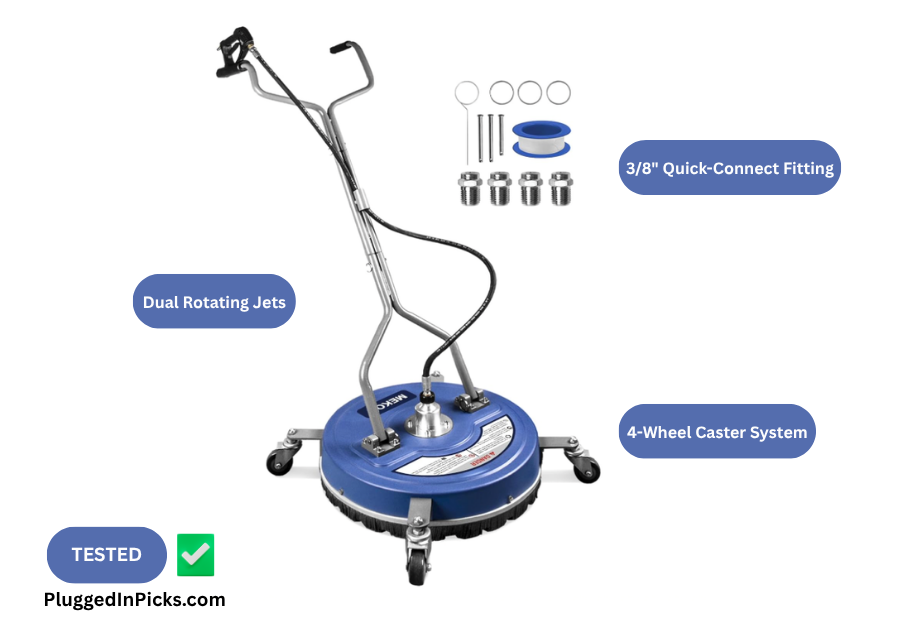
| Nozzles | Two spinning high-pressure jets, changeable | The dual spinning nozzle design is what eliminates stripe marks. Coverage is even across the full 20″ path on each pass — the difference versus a wand is visible immediately on concrete. |
| Wheels | 4 casters | The wheels do real work here. Pushing the attachment across a driveway felt more like guiding than fighting — the casters maintained consistent nozzle height automatically without manual adjustment. On slightly sloped surfaces there was minor drift but nothing that affected cleaning coverage. |
| Handles | 2 angle-adjustable handles | The dual handle setup is more comfortable than single-handle alternatives for extended sessions. Angle adjustment took about 30 seconds and made a noticeable difference in posture during longer cleaning runs. |
| Connection | 3/8″ quick-connect | Connected to the pressure washer in under a minute with no tools. No leakage at the connection point across all three sessions. |
| Hose | 63″ integrated hose | Long enough for full range of motion across the attachment’s sweep without tension. Not a limitation in any session. |
| Material | PP disc housing, steel handle frame, solid brass fittings, sealed bearing | The disc housing is lightweight PP — easy to carry and position. The handle frame and crossbar are steel, which gives the unit a noticeably more solid feel than the listing photos suggest. Brass connection points felt secure throughout all three sessions with no leakage. |
✅ Who It’s For
- Homeowners with large flat surfaces — driveways, patios, sidewalks — who spend too much time on pressure washing sessions
- Anyone tired of stripe marks from wand cleaning — the dual spinning nozzles produce even coverage across the full 20″ path
- People who clean regularly and want a tool that reduces back strain — pushing the wheeled attachment is significantly less fatiguing than wanding a full driveway
- Anyone who assembles and stores equipment frequently — the handle folds down and the unit breaks apart for compact storage
❌ Who It’s Not For
- Anyone running a lower-powered electric pressure washer under 2500 PSI — the attachment needs sufficient flow and pressure to spin at full effectiveness
- Buyers who need precision edge cleaning — the 20″ disc footprint can’t get into corners, along fence lines, or tight spaces the way a wand can
- People expecting a self-contained cleaning unit — this is a pressure washer attachment, not a standalone tool
- Buyers who want stainless steel construction throughout — the body is PP plastic, which is lightweight and functional but not the same as full metal build competitors

the full disc, they cover more surface per pass while keeping nozzle height fixed and consistent.
The Wand Comparison
The most useful thing I did in session one was split the driveway in half — wand on the left, MEKOH on the right, same pressure washer, same starting conditions. The right half was done first. The driveway told the story before I finished the second half.
The stripe marks on the wand side were visible from ten feet away — parallel lines where passes overlapped unevenly, darker patches where the angle changed mid-pass. The MEKOH side was even. Not perfect — there were a few areas along the edges where I had to follow up with the wand — but across the main surface the coverage was consistent in a way that wand cleaning simply isn’t.
The time difference was real. I didn’t run a stopwatch but the right half of the driveway was finished well before I completed the wand pass on the left. For a full two-car driveway, that compounds quickly.
Surface Behavior Across Three Surfaces
Concrete driveway was the strongest performance. The spinning nozzles cut through winter salt residue and the dark tire track staining along the edges with steady passes — areas that had been wand-cleaned before and still looked dingy came out noticeably cleaner.
Patio tile required slower passes. The grout lines trap debris differently than flat concrete, and moving too fast left residue in the joints. Slowing down to let the nozzles work over each section fully produced clean results — the tile surface itself came out well, and the grout lines cleared with deliberate overlapping passes.
Front sidewalk was the quickest of the three sessions. Flat, consistent concrete with light staining — the MEKOH moved through it efficiently and the results were even across the full width.
The Handle and Wheel System
The four-wheel setup is more than a convenience feature — it keeps the nozzles at a fixed height above the surface automatically, which is what produces even coverage. With a wand you’re managing angle and height manually the entire time. With the MEKOH you’re just guiding the direction.
The angle-adjustable handles made a real difference during longer passes. I adjusted them once at the start of the driveway session and didn’t touch them again. The dual grip is noticeably more stable than single-handle alternatives — pushing a 20″ disc across a full driveway benefits from two-handed control.
One practical note: when you set the attachment down between sessions, the handle flops to the ground without a lock. It’s a minor thing but a few owners mention it and I noticed it too — leaning it against the pressure washer or a wall is the workaround until you’re ready to pack it up.
What to Know About PSI Pairing
This attachment rewards a capable pressure washer. Paired with a 3400+ PSI gas unit the nozzles spin at full speed and the cleaning results are immediate. Owner reports from buyers using lower-powered electric washers under 2500 PSI describe slower results and less satisfying coverage — the attachment works, but the spinning nozzle speed depends on flow rate and pressure to reach full effectiveness.
If your pressure washer is in the 2000–2500 PSI range, the MEKOH will still outperform a wand on flat surfaces but the gap narrows. The 3000+ PSI range is where the time savings become significant.
What Other Owners Are Saying
687 ratings and a 4.5 average tells part of the story — the details in the review base fill in the rest: owners who switched from wand-only cleaning describe the time and physical relief as the headline benefit. One owner with a corner lot and a long driveway described their previous pressure washing routine as an all-day affair with back pain to close — with the MEKOH, they reported cutting time in half with no back strain. That matches what I experienced across three sessions.
The PSI pairing point comes up in the reviews exactly as I’d expect — owners running 3400+ PSI units are consistently enthusiastic, owners on smaller electric washers describe results as adequate but less dramatic. One owner specifically noted that 3400 PSI felt like the minimum for the attachment to perform at its best.
The handle lock issue is a recurring minor note — enough owners mention the handle flopping when the unit is set down that it reads as a known product characteristic rather than a defect. It doesn’t affect cleaning performance but it’s the most consistent practical complaint in the review base.
Customer service feedback is notably positive — owners who encountered connection issues or received damaged units describe fast responses and resolution. One Canadian owner called the support responsiveness unusual by current standards.

reliability — no leakage at the connection point across all three testing sessions.
Final Decision:
Three sessions across a driveway, patio, and sidewalk confirmed what the review base suggests at scale: the MEKOH 20″ delivers on its core promise. The stripe-free coverage is real, the time reduction versus wand cleaning is noticeable, and the wheeled push system makes extended cleaning sessions meaningfully less tiring. Pair it with a capable pressure washer and it changes how a driveway cleaning session feels — from a slow, arm-intensive process to something you push through efficiently and finish ahead of schedule.
Going in with the right expectations makes this an easy call. Edge work still requires the wand. Lower-powered electric pressure washers won’t unlock the full performance. And a handle lock would be a welcome addition to a future version. None of those are reasons to walk away if a driveway or patio is what you’re cleaning.
For anyone with a 3000+ PSI pressure washer and a driveway that needs attention — this belongs in the garage.
Frequently Asked Questions:
- What PSI pressure washer do I need for the MEKOH surface cleaner? The MEKOH is rated for pressure washers 2000+ PSI, but owner experience — and what I observed in testing — suggests 3000+ PSI is where the attachment performs at its best. Below that the spinning nozzles still work but the time savings are less dramatic. One owner noted 3400 PSI as the practical minimum for consistent results on a full driveway.
- Does the MEKOH surface cleaner leave stripe marks? No — and that’s the core reason to buy it over wand cleaning. The dual spinning nozzles cover the full 20″ path evenly on each pass. In a direct side-by-side comparison with a wand on the same driveway, the difference in stripe marks was visible immediately.
- Can the MEKOH surface cleaner be used on wood decks? Yes, with some care. The spinning nozzles are powerful enough to clean deck surfaces but softer or older wood requires slower passes and a lower pressure setting to avoid surface damage. Keep the attachment moving and do a test pass on an inconspicuous area first.
- How do you connect the MEKOH surface cleaner to a pressure washer? The MEKOH uses a 3/8″ quick-connect fitting. Connection takes under a minute with no tools — fit the quick-connect to your pressure washer hose and the attachment is ready to run. Compatible with most electric and gas pressure washers with a standard quick-connect outlet.
- Is the MEKOH surface cleaner good for removing oil stains? It handles general surface staining, algae, and road residue well — Owners report clearing multi-year staining from concrete that wand cleaning hadn’t fully addressed — consistent with the surface performance I observed on my own driveway in testing. Deep set oil stains typically benefit from a degreaser applied before pressure washing regardless of the tool used. The surface cleaner will pass over treated oil stains more evenly than a wand but the pre-treatment does the heavy lifting on stubborn oil.
- How do you store the MEKOH surface cleaner? The handle folds down and the unit disassembles for compact storage. It fits easily in a garage without taking up significant floor space. One practical note: the handle doesn’t lock upright when the unit is set down mid-session — lean it against a wall or your pressure washer to keep it from flopping to the ground.
Related Reading
- Give S14 Outdoor Smart String Lights Review — Once the driveway and patio are clean, the lighting is what makes the outdoor space worth spending time in. The Give S14 string lights are what we’d add to a patio setup that’s just been pressure washed back to life. Read our full review.
- Auveri Outdoor Solar Pathway Lights Review — Clean walkways deserve lighting that shows them off. The Auveri solar pack covers a full driveway perimeter or garden path without any wiring — a natural next step after a deep sidewalk and pathway clean. Read our full review.
- Dupray Neat Steam Cleaner Review — For the indoor surfaces that need the same attention as the driveway outside — tile, grout, and sealed floors respond well to steam where a pressure washer can’t go. Read our full review.