
Cobra RAD 480i Review: Best Radar Detector for the Money?
By Jake Morrison | Automotive & Outdoor Gear Editor, PluggedInPicks • September 05, 2025
Tested over six weeks of daily driving — highway commutes, city routes, and suburban roads — in a 2017 Honda CRV.
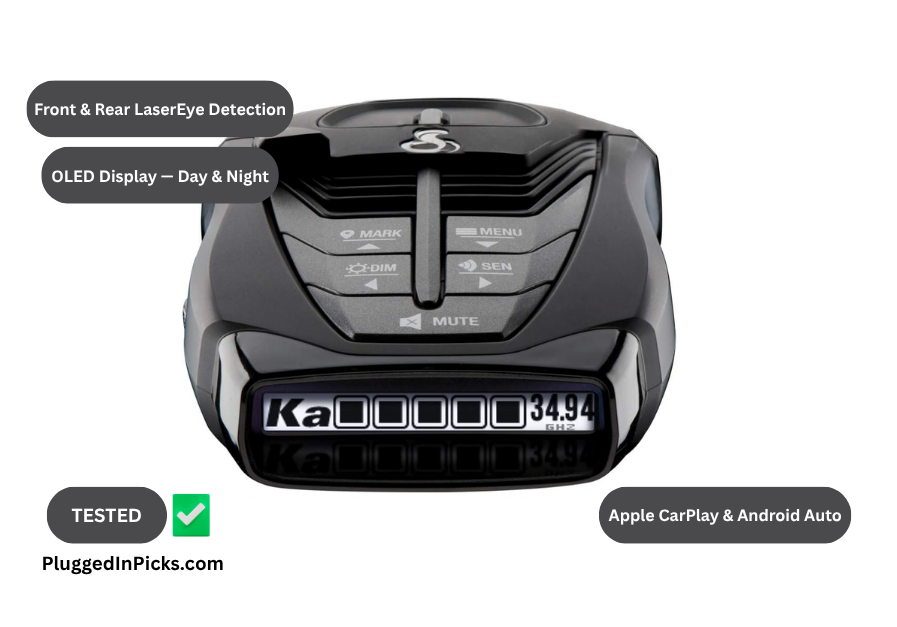
The first time a radar detector saves you from a ticket, it pays for itself. The second time, you wonder how you ever drove without one. The question most buyers are actually asking isn’t whether a radar detector is worth having — it’s whether this one specifically is worth the money, or whether you need to spend significantly more to get something that actually works without crying wolf every half mile
The Cobra RAD 480i is the #1 Best Seller in Radar Detectors on Amazon with over 10,500 ratings. It sits in the middle of Cobra’s own lineup — above the entry-level RAD 380, well below the premium RAD 700i — and positions itself on front and rear LaserEye detection, Apple CarPlay and Android Auto compatibility, and a shared community alert network. I ran it in the CRV for six weeks across highway commutes, city driving, and suburban routes to find out whether the #1 ranking reflects real-world performance or just strong brand recognition at an accessible price point.
Quick Verdict
The Cobra RAD 480i delivers on a highway. Long-range Ka-band detection, front and rear laser coverage, and the community alert network make it a genuinely useful tool for drivers who spend most of their time on open roads. On a six-week highway commute it performed consistently — alerts came early enough to matter, false positives were manageable with the right sensitivity settings, and the OLED display stayed readable in direct sunlight.
City driving is a different story. K-band false alerts from blind spot monitoring systems on surrounding vehicles are a documented reality with this unit, and without GPS-based AutoLearn — which requires the premium RAD 700i tier — there’s no way to teach the detector to ignore repeat false alert locations. It’s manageable with the right filter settings but it requires patience and some upfront configuration time.
Buy this if: You do most of your driving on highways or open roads, want front and rear laser detection at an accessible price, and are comfortable spending thirty minutes configuring sensitivity settings out of the box.
Skip this if: You drive primarily in dense urban environments, want GPS-based AutoLearn to silence repeat false alert locations, or need reliable Bluetooth app connectivity as part of your setup.
How I Tested:
Six weeks in the 2017 CRV across three distinct driving environments — a mix of highway commuting on I-90 and I-294, city driving through Chicago surface streets, and suburban routes through the northwest suburbs. The detector ran in every session from the first day with factory settings, then with progressively refined sensitivity and filter configurations as I learned what the unit needed to perform well in each environment.
Here’s what I was paying attention to throughout:
Detection on the road that matters: How early the unit picked up Ka-band signals at highway speeds, whether confirmed law enforcement presence followed the alert, and how the front and rear laser coverage performed across different traffic scenarios.
False alert reality in real traffic: K-band false triggers are the most documented complaint in the owner base going in — I tracked how often they fired, in what environments, and whether the filter settings made a meaningful difference across the testing window.
Configuration learning curve: How long it took to get the unit dialed in from factory settings to something usable in both highway and city environments — and what settings actually moved the needle.
App and CarPlay in practice: Bluetooth pairing to the iRadar app across multiple sessions, CarPlay alert integration on the CRV’s display, and whether the community alert network delivered anything useful on routes I drive regularly.

features that actually matter on a highway run. The OLED display reads clearly at a glance
without taking your eyes off the road.
Performance Breakdown: Technical Specs vs. Real-World Use
| Feature | Spec | Real-World Note |
|---|---|---|
| Detection Bands | Ka, K, X, Laser | Ka-band is where it earns its keep — early and consistent on highway. K-band false alerts from blind spot monitoring systems on other vehicles are the main challenge in city driving. |
| Frequency Bands | 34.7 GHz, 24.125 GHz, 10.525 GHz | Full band coverage. X-band can be disabled in most areas — it’s outdated and a common false alert source. |
| LaserEye | Front and rear | Front detection is the primary workhorse. Rear laser detection adds meaningful coverage on multi-lane highways where you can get tagged from behind. |
| IVT Filter | Advanced anti-falsing | Reduces blind spot monitoring false alerts noticeably versus no filtering — but doesn’t eliminate them in heavy traffic. City driving still requires patience. |
| GPS AutoLearn | Not included | The meaningful gap versus premium competitors. Without GPS AutoLearn the unit can’t learn to ignore specific repeat false alert locations. Manual sensitivity adjustment is the workaround. |
| Display | OLED | Clear and readable in direct sunlight. Dark mode doesn’t broadcast the detector’s presence to drivers in adjacent lanes — a practical detail worth knowing. |
| Bluetooth / App | iRadar app, Apple CarPlay, Android Auto | CarPlay integration works cleanly. Bluetooth pairing to the iRadar app was inconsistent in my testing — required multiple reconnection attempts across several sessions. |
| Community Alerts | Drive Smarter network | Real-time shared alerts from other Cobra users. More useful on populated highways than rural routes where the user base thins out. |
| Mount | Suction cup + hook and loop dash mount | Suction cup holds reliably. Cord management is functional but not particularly clean — a longer or more flexible cord would improve the install. |
| Size | 4.25″L x 2.75″W x 1.25″H | Compact enough to sit low on the windshield without blocking sightlines. |
Cobra’s “2x detection range of its predecessor” is their own product marketing. What I observed over six weeks was consistent early warning on Ka-band at highway speeds — I’ll leave the specific range comparisons to Cobra’s internal testing.
✅ Who It’s For
- Highway commuters who want early Ka-band warnings
- Drivers who want front and rear laser coverage at this price point
- Anyone upgrading from a basic entry-level detector
- Drivers who use Apple CarPlay or Android Auto
- Road trippers and long-haul drivers
- Anyone who wants community-shared alerts on their route
❌ Who It’s Not For
- Dense city drivers who can’t tolerate frequent K-band false alerts
- Buyers who need GPS AutoLearn to silence repeat false alert locations
- Buyers who expect plug-and-play performance without upfront configuration
- Drivers in areas with heavy blind spot monitoring traffic

earns its keep. Shared alerts from the Drive Smarter network add a layer of coverage no single
detector can provide on its own.
Six Weeks Behind the Wheel — What I Actually Found
Week one was factory settings, no adjustments. The first highway session on I-90 produced the result that matters most — an early Ka-band alert well before the patrol car came into visual range. Distance was sufficient to adjust speed before the situation became a problem. That’s the core job of this product and it did it on day one.
City driving in week one was a different experience. K-band alerts fired repeatedly on surface streets — most of them traced back to blind spot monitoring systems on surrounding vehicles rather than law enforcement. The IVT filter was running but heavy traffic in Chicago generates enough K-band noise that false alerts were a regular occurrence through the first two weeks.
Week two was configuration work. Disabled X-band entirely — outdated in this area and a consistent false alert source. Set Ka sensitivity to Auto, which adjusts based on speed. Kept K-band enabled but moved sensitivity to medium. The false alert frequency in city driving dropped meaningfully. Not eliminated, but manageable enough that I stopped reaching to mute it reflexively.
Weeks three and four settled into a rhythm. Highway performance was the consistent highlight — Ka-band alerts on I-294 came in reliably early, the OLED display was clear in every lighting condition I encountered, and the dark mode meant the unit wasn’t visible to adjacent drivers at night. The community alert feature surfaced a speed trap on a stretch of I-90 I drive regularly before I reached it — that’s exactly what the network is built for and it worked.
Weeks five and six confirmed the highway performance held and gave me enough city sessions to form an honest picture there too. The Bluetooth app connectivity was the most frustrating recurring issue — the iRadar app disconnected and required manual reconnection across multiple sessions. The CarPlay integration worked consistently, but the standalone app pairing was unreliable enough that I stopped counting on it as part of my standard setup.
The False Alert Problem — Addressed Directly
This is the issue the review base raises most consistently and it deserves its own section rather than a passing mention.
K-band false alerts from blind spot monitoring systems are real on this unit and they’re more frequent in urban environments than on open highways. They’re not unique to the Cobra RAD 480i — K-band false alerts are a category-wide challenge for detectors without GPS AutoLearn — but the RAD 480i’s IVT filter handles them less completely than premium units with location-based learning.
The practical workaround that consistently works: run Ka sensitivity on Auto, set K-band to medium or low sensitivity in urban environments, and disable X-band entirely in most US markets. That configuration significantly reduces false alert frequency without sacrificing meaningful detection capability on the bands that actually matter.
It requires upfront configuration time. Buyers who plug it in expecting silence except for real threats will be frustrated in city traffic. Buyers who spend thirty minutes with the settings and the manual will get a meaningfully different experience.
The App Situation
Cobra markets the iRadar app as a core feature — GPS lockouts, AutoSensitivity based on speed, and community alert access all route through it. In practice, Bluetooth connectivity to the app was the most inconsistent element of my six-week test.
Pairing worked initially, but the connection dropped across multiple sessions and required manual reconnection through the phone settings rather than from within the app. Multiple owners document the same experience in the review base — it’s not isolated to my unit.
The CarPlay integration is a different story and it works well. If your vehicle supports CarPlay or Android Auto, the community alert network and basic display functions route through your car’s screen cleanly without relying on a stable Bluetooth connection to your phone. That’s the more reliable path for most buyers.
Is It Worth It?
At this price point relative to the premium alternatives that dominate the upper end of the radar detector space, the Cobra RAD 480i represents solid value with a clear limitation set. Front and rear laser detection, Ka-band performance that held up consistently over six weeks of highway driving, CarPlay integration, and the community alert network are all real features at a price that’s a fraction of what premium competitors charge.
What you’re giving up relative to those premium alternatives: GPS AutoLearn that silences specific repeat false alert locations, more sophisticated false alert filtering in dense urban traffic, and more reliable app connectivity. If your driving is primarily highway, those gaps are manageable. If your driving is primarily urban, they start to matter more.
The value math works for highway and mixed drivers. For buyers who spend most of their time in dense city traffic and want a detector that stays quiet until it means something — the investment in a GPS-equipped unit higher up the price ladder is the more appropriate call.
What Other Owners Are Saying
With over 10,500 ratings the picture that emerges is consistent with what I experienced: highway performance draws the strongest praise, with multiple owners documenting specific incidents where early Ka-band warnings gave them enough time to adjust. The community alert network comes up positively among owners who commute on populated corridors.
The recurring negatives center on two things — K-band false alerts in urban environments and Bluetooth app connectivity. Both track exactly with what I observed over six weeks. One owner documented false alerts triggering at sliding grocery store doors even with most bands disabled and sensitivity set to low — that’s an extreme case but it reflects the city-driving reality. The app connectivity complaint is consistent enough across the base that it reads as a product characteristic rather than isolated unit variation.
The comparison to Escort detectors comes up repeatedly in the owner base — those who’ve used both note the GPS-based filtering handles urban false alerts more cleanly at the higher price point. That’s a fair observation and one worth weighing depending on your driving environment. We’ll cover Escort options in a dedicated review when that’s live.

than the standalone Bluetooth app connection in my experience over six weeks.
Final Decision:
The Cobra RAD 480i is a highway detector priced like one. Six weeks of daily driving in the CRV confirmed what the #1 Best Seller ranking suggests — it does the core job well in the environment it’s built for. Ka-band detection came in early and consistently, front and rear laser coverage adds a layer of protection that entry-level units skip, and the CarPlay integration is genuinely useful rather than a checkbox feature.
The city driving picture is straightforward: K-band false alerts are a regular occurrence without GPS AutoLearn, and the Bluetooth app connectivity is unreliable enough that I stopped depending on it. Neither disqualifies the product for its target buyer — a highway commuter or road tripper who wants meaningful protection at an accessible price. For that buyer, the RAD 480i delivers a strong return from day one.
Frequently Asked Questions:
- Is it illegal to have a radar detector? Radar detectors are legal for use in private passenger vehicles in most US states. Virginia and Washington D.C. are the primary exceptions where they’re prohibited. Federal law prohibits their use in commercial vehicles over 10,000 lbs. Laws vary internationally — if you’re traveling outside the US, check local regulations before using any detector.
- Is a radar detector illegal in Texas? No — radar detectors are legal in Texas for use in private passenger vehicles. Texas has no state prohibition on radar detector use in personal vehicles.
- Is a radar detector legal in California? Yes — radar detectors are legal in California for use in private passenger vehicles. California does have a windshield obstruction law that affects where you can mount one — the unit should be mounted low on the windshield or on the dash to avoid obstructing the driver’s view.
- What does Ka band mean on a radar detector? Ka band is the most commonly used radar frequency by law enforcement in the US today, operating between 33.4 and 36 GHz. It’s the band that matters most for detection — when your detector alerts on Ka, that’s the signal most likely to be a genuine speed enforcement situation rather than a false alarm from another vehicle’s electronics.
- What does K band mean on a radar detector? K band operates around 24 GHz and is used by some law enforcement agencies, but it’s also the frequency used by blind spot monitoring systems and adaptive cruise control on modern vehicles. That overlap is the source of most false alerts on detectors without GPS AutoLearn — your detector can’t distinguish between a police radar and the blind spot sensor on the SUV next to you without location-based learning.
- How does a radar detector work? A radar detector scans for radio frequency signals in the bands used by law enforcement speed measurement devices. When it picks up a signal in a monitored frequency range it alerts the driver. The detection range — how far away it can pick up a signal — determines how much warning time you get. Laser detection works differently since laser guns are typically aimed at a specific vehicle, which means laser alerts are often less advance warning than radar alerts.
- Is the Cobra RAD 480i good for city driving? It works in the city but requires configuration to be tolerable. K-band false alerts from blind spot monitoring systems on surrounding vehicles are frequent with factory settings in dense traffic. With X-band disabled, K-band sensitivity set to medium or low, and Ka on Auto sensitivity, the false alert frequency drops to a manageable level. Buyers who want a detector that handles urban environments quietly without manual configuration would be better served by a GPS-equipped unit with AutoLearn capability.
Related Reading
- Redtiger Dash Cam Review — A natural companion for any driver building out their vehicle setup — our Redtiger review covers the dash cam worth pairing with a radar detector for complete road coverage
- Rove Dash Cam 4K Review — If you want a higher-resolution recording option alongside your detector, our Rove review covers the 4K alternative worth considering
- Hauxiy CarPlay Screen Review — For drivers who want to maximize the RAD 480i’s CarPlay integration, our Hauxiy review covers the aftermarket CarPlay screen worth adding to vehicles without a factory display