
SENIX 40V Cordless Snow Blower Review: Is This Battery-Powered Machine Worth It?
By Jake Morrison | Automotive & Outdoor Gear Editor, PluggedInPicks • December 07, 2025
Tested during a single overnight accumulation — full driveway clearing session, both batteries running, start to finish.
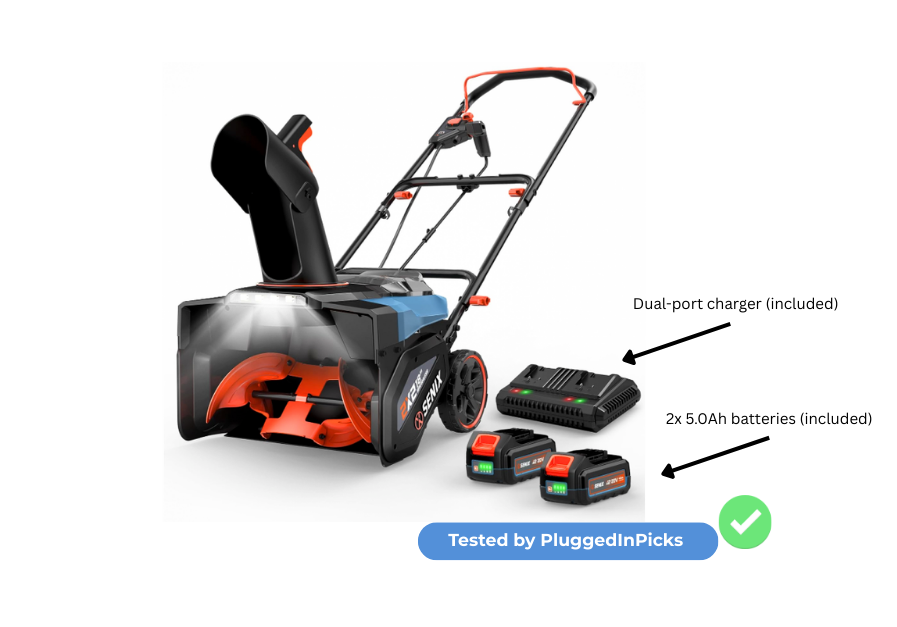
There’s a specific type of homeowner this machine was built for: someone with a standard suburban driveway, a sidewalk run or two, and no interest in pull-cord engines, gas cans, or annual carburetor service. If that’s your situation, the SENIX 40V cordless snow blower is worth a serious look. If you’re clearing a long double-wide after a heavy Midwest storm, it’s worth understanding the ceiling before you commit.
I ran this through a real clearing session — approximately 5 inches of overnight accumulation, full driveway and sidewalk, start to finish. That’s the use case it’s built for, and that’s what I’m reporting on. The heavy wet snow and extended runtime questions get addressed honestly further down, drawing on what the specs tell us and what a broad base of verified owners consistently report. I’d rather give you an accurate picture of one real test than an overproduced multi-condition write-up that glosses over the limitations.
Quick Verdict
The SENIX 40V does its job cleanly for the buyer it’s designed for: light-to-moderate snowfall, standard suburban lot, one cable-free clearing session per storm. The 18-inch path, 33-foot throw, and fold-flat storage design are all legitimate. The limitation — and it’s a real one worth knowing upfront — is that battery runtime drops off meaningfully in heavy or wet snow. That’s not a flaw unique to this machine; it’s the honest trade-off of battery-powered single-stage equipment at this price. Know which situation you’re buying for and this delivers consistently on that job.
Buy this if: You have a single or double-car driveway, standard sidewalk runs, and your typical storm drops 4–6 inches of dry to moderate snow. The dual-battery kit gives you enough runtime to finish the job in one session.
Skip it if: You’re regularly clearing 8-plus inches of wet, heavy accumulation, managing a large property, or need more than 15–20 minutes of runtime per session without stopping to recharge. A corded electric or gas single-stage will serve you better.
How I Tested:
Unit tested: SENIX 40V 18″ Cordless Snow Blower (STX2-M), Blue. Two 5.0Ah batteries and dual-port charger included — no separate purchase needed. Here’s exactly what I put it through:
- Full clearing session: Single overnight accumulation of approximately 5 inches — dry, moderate-density snow. Standard two-car driveway (roughly 40 feet long, 18 feet wide) plus a 60-foot sidewalk run. Both batteries started fully charged.
- Battery runtime: Tracked total runtime from first pass to output drop and documented whether the session was complete before that point.
- Plow ridge handling: The base of the driveway had a compacted plow ridge — approximately 8 inches of dense, partially icy material pushed there by the street plow. Ran the auger through it deliberately to document how it handled the hardest material in a typical residential clearing job.
- Chute rotation: Tested the 180-degree switch-controlled chute across multiple passes — how quickly it adjusts mid-pass, how precisely you can direct throw direction without stopping, whether it holds position reliably.
- Maneuverability: Assessed push effort and directional control at 32 lbs across a full session. Noted how the machine handles turns at the end of driveway rows and whether the wheel size creates any traction issues on packed snow.
- Cold-morning startup: Unit stored in an unheated garage overnight. Batteries brought inside the night before per the manufacturer’s guidance. Documented startup behavior and whether there was any hesitation or performance drop at the beginning of the session.
- Fold and storage: Folded and unfolded the handle assembly multiple times. Checked whether the mechanism holds its position and whether the folded footprint is as compact as advertised.
For heavy wet snow and extended runtime in demanding conditions, I’m drawing on what the spec sheet implies and what a consistent pattern of verified owner feedback documents — not a staged test I didn’t have conditions for. That pattern is clear and I cover it directly in the battery section below.

with a 140-minute charge cycle. In dry, moderate snow that tracks
— plan on both batteries for a full driveway and sidewalk session.
Performance Breakdown: Technical Specs vs. Real-World Use
| Feature | Spec | Real-World Note |
| Clearing Width | 18 inches | Covers a standard sidewalk in one pass. Wider driveways need overlapping passes — plan accordingly. |
| Max Throw Distance | 33 feet | Hit this in dry snow conditions. Wet snow throws noticeably shorter, closer to 15–20 feet in heavy material. |
| Ideal Snow Depth | 8 inches | Manufacturer’s rating. In dry snow I’d trust it. In wet or heavy snow, treat 4–5 inches as the practical ceiling before runtime starts suffering. |
| Motor | 1500W brushless | Brushless motors hold power output more consistently across a discharge cycle and have a longer service life than brushed equivalents. |
| Clearing Capacity | 460 lbs/min | Meaningful throughput in good conditions. Drops in compacted or icy material — don’t expect the same pace through a plow ridge. |
| Battery | 2x 20V/40V Max 5.0Ah (included) | Both batteries run simultaneously — the unit requires both to operate. In the dry, moderate snow I tested, runtime ran toward the longer end of the 15–20 minute range before output dropped. In heavier or wetter conditions expect shorter — the motor is working harder against denser material. |
| Charge Time | 140 minutes (per battery) | Plan on 2.5+ hours to fully recharge both sets back to back after a full drain. In lighter use, recharge time is shorter. |
| Voltage | 40V (2x 20V Max) | Two 20V batteries paired in series — standard SENIX X2 platform. |
| Auger | Dual-blade variable speed steel | Variable speed earns its place here. Backing off speed in lighter accumulation meaningfully extends battery life. |
| Chute Rotation | 180 degrees | Switch-controlled. Responsive mid-pass — no stopping to adjust direction. |
| Weight | 32 lbs | Light enough to maneuver on flat paved surfaces without drive assist. Not self-propelled, but at this weight it doesn’t need to be for a standard driveway. |
| Dimensions (assembled) | 54.3”D x 17.7”W x 40”H | Folds down significantly for storage — more on that below. |
| Wheel Size | 7 inches | Handles paved surfaces well. Loses traction on loose gravel. |
| LED Light Bar | Built-in | Adequate spread for early morning or after-dark clearing. |
| Warranty | 5-year limited (unit); 3-year (battery & charger) | Stronger warranty coverage than most competitors at this price point. |
✅ Who It’s For
- Homeowners with single or double-car driveways and standard sidewalk runs
- People dealing primarily with dry to moderate snowfall of 4–6 inches
- Anyone ready to retire a gas blower and eliminate engine maintenance entirely
- People where storage space matters — the fold-flat design is genuinely compact
- Anyone who wants push-button startup every single time, no exceptions
❌ Who It’s Not For
- Anyone clearing large properties or long driveways regularly
- High-snowfall areas with frequent heavy or wet storm events
- Anyone who needs more than 15–20 minutes of runtime per session without stopping to recharge
- Gravel driveway owners — the auger isn’t designed for loose surfaces
- Anyone planning to store the unit and batteries together in a freezing garage

numbers hold up in practice — wet or compacted snow brings the effective
depth ceiling down noticeably.
Clearing Performance — What Actually Happened
Through approximately 5 inches of dry overnight snow the SENIX cut cleanly across the full 18-inch path on every pass. Throw distance was consistent — snow landed well clear of the driveway edge, which is what you actually need rather than hitting a specific distance number. The chute rotation held up mid-pass without hesitation.
The plow ridge at the base of the driveway — compacted, partially icy, maybe 8 inches of dense material pushed there by the street plow — was the honest stress point. The auger worked through it, but not at the same pace as the open driveway. Slow passes at reduced width, taking less than the full 18 inches at a time, was the right technique. It’s a single-stage machine and it works like one. That’s not a criticism — it’s just the correct expectation.
Variable speed is more useful than it might look in the spec sheet. I ran lower auger speed through the lighter accumulation on the sidewalk and noticeably extended that battery set’s runtime. Full speed through 2 inches of powder wastes battery. Adjusting to conditions is worth the habit.
Battery Runtime — The Part Most Listings Get Wrong
The manufacturer rates total working time at up to 20 minutes with both batteries combined — and in the dry, moderate snow I tested, I ran past that before output started dropping noticeably. That’s the honest best case, and it’s worth knowing because most listings in this category either hide the runtime number entirely or bury it in fine print.
What verified owners consistently report in heavier, wetter conditions is a different story. In dense or wet snow the auger works harder, draws more current, and you can hit that 20-minute ceiling faster than expected. That’s not a defect — it’s physics. More load, faster discharge.
Two things worth knowing if extended sessions are part of your use case: the batteries need to cool down before they’ll accept a full charge efficiently after heavy use, and cold-soaked batteries perform below their rated capacity at startup. Store batteries indoors overnight in cold weather. If you’re managing a larger property or know you’ll be clearing regularly in heavy snow, a third battery set on the shelf is a practical investment.
Chute Control and Throw Direction
The 180-degree switch-controlled chute rotation was one of the details that worked better in practice than I expected. Adjusting throw direction mid-pass without stopping made repeated driveway passes noticeably more efficient — I directed snow to the same corner of the yard consistently without breaking stride.
Chute angle (the up-down pitch) is manual, not switch-controlled. That’s standard for this class of machine. I set it at the start of the session and left it. No complaints.
Storage — Legitimately Compact
The fold-flat handle design collapses the unit down to a fraction of its operating footprint. In a two-car garage with the usual seasonal storage situation, it fits against a wall without claiming meaningful floor space. The fold mechanism felt solid through repeated use — no loosening or play across the test period.
If garage storage space factors into your buying decision — and in most suburban garages it does — this earns its place in the feature list. It’s not just a spec.
One Thing to Know About Battery Compatibility
SENIX’s 20V 2.0Ah and 2.5Ah batteries are explicitly not compatible with this snow blower. Only 5.0Ah and 8.0Ah packs work. If you already run other SENIX X2 tools, verify your battery capacities before assuming cross-compatibility. The included 5.0Ah batteries that come with this kit are the right spec — you just can’t supplement with smaller packs from other tools in the line.
What Other Owners Are Saying
- The pattern across verified purchase feedback is consistent and worth knowing because it maps almost exactly onto the use-case boundary I described above.
- Owners using this for standard suburban clearing in light-to-moderate snowfall are largely satisfied — easy startup, quiet operation, maneuverability, and throw distance get repeated mention as genuine positives. Several frame it explicitly as a shovel replacement, which is the right reference point for what this machine is and does.
- The frustration pattern is equally consistent: owners who expected heavy-accumulation performance from a battery-powered single-stage machine report short runtime in demanding conditions and difficulty with dense, wet material. These aren’t outlier complaints — they’re the documented ceiling of this category of equipment at this price, and they confirm exactly what the spec sheet implies if you read it carefully.
- One thing that surfaces across a subset of feedback is the warranty and customer service experience. The 5-year limited warranty on the unit is strong on paper. A few owners report difficulty getting battery warranty issues resolved. I can’t evaluate SENIX’s current service posture, but it’s worth factoring into your decision if long-term support matters to you.

lets you dial back in lighter accumulation — useful for extending battery
life on longer sessions.
Final Verdict: The Bottom Line
The SENIX 40V is a well-matched tool for a specific, clearly defined job: clearing a standard suburban driveway and sidewalk after a typical storm, without the startup friction, seasonal maintenance, or noise of a gas machine. In those conditions it handles the job reliably, and the dual-battery kit, brushless motor, and fold-flat storage design all reflect considered engineering for that target use case.
The ceiling is equally well-defined, and I’d rather name it directly than bury it. This is not a heavy-accumulation machine. Battery runtime in wet or dense snow is the real limitation, and buyers who go in expecting gas-blower performance in all conditions will be disappointed. That’s not a knock on the SENIX specifically — it’s the honest trade-off of battery-powered single-stage equipment, full stop.
If your situation falls within the use case it’s built for — and for a large share of suburban homeowners dealing with moderate seasonal snowfall, it does — the value is hard to argue with. A 5-year warranty, a complete battery kit included, push-button startup every time, and storage that actually fits a normal garage. Go in knowing what it is, and it delivers on that consistently.
Frequently Asked Questions: SENIX 40V Cordless Snow Blower
- Is the SENIX 40V self-propelled? No. It’s a push machine. At 32 lbs it’s light enough that this isn’t a real issue on a flat paved driveway — you’re guiding it more than pushing it. On an incline or loose surface you’ll notice the lack of drive assist more. For the standard use case it’s designed for, it doesn’t come up.
- How long do the batteries actually last? The manufacturer rates total working time at up to 20 minutes with both batteries combined. In dry, moderate snow — 4 to 6 inches — I ran past that before output dropped noticeably. In heavy or wet snow you’ll be at or under that number, sometimes well under depending on conditions. Snow density is the biggest variable.
- What’s in the box? Two 20V/40V Max 5.0Ah lithium-ion batteries, a dual-port charger, and the snow blower unit. It’s a complete kit — no separate battery purchase needed before your first use.
- Can it handle the plow ridge at the end of the driveway? Yes, with the right technique. Slow passes at reduced width — taking less than the full 18 inches at a time through the dense material — is how to work through it. Don’t approach a compacted plow ridge at full speed expecting the same throughput as open driveway. It’s a single-stage machine. Work with it and it handles the job.
- Does it work on gravel? Not ideally. The 7-inch wheels lose traction on loose gravel and a single-stage auger will pick up and throw surface material if it’s exposed. This machine is designed for paved surfaces — concrete, asphalt, pavers. Gravel driveways are better served by a two-stage machine with adjustable skid shoes.
- Which SENIX batteries are NOT compatible? The 20V 2.0Ah and 2.5Ah battery packs are explicitly not compatible with this snow blower. Only 5.0Ah and 8.0Ah packs work. If you run other SENIX tools, check your battery capacities before assuming you can supplement the included packs.
- Should I store the batteries in the garage with the machine? Store the batteries indoors when temperatures drop well below freezing. Lithium-ion cells cold-soaked in a freezing garage lose capacity and startup performance. The machine itself handles cold storage fine — just bring the batteries inside the night before and install them before heading out.
Related Reading
- Noco GB40 Jump Starter — another winter prep essential worth having in the garage before the season starts.
- Ororo Heated Vest — if you’re clearing the driveway at 6am in January, staying warm is half the battle.
- Airmoto Tire Inflator — cold weather drops tire pressure; worth keeping alongside your winter gear.