
ANCEL AD310 Review: The Best OBD2 Scanner for Most Drivers?
By Jake Morrison | Automotive & Outdoor Gear Editor, PluggedInPicks • October 05, 2025
Tested on a 2017 Honda CRV — used to diagnose and clear a check engine light in real conditions.
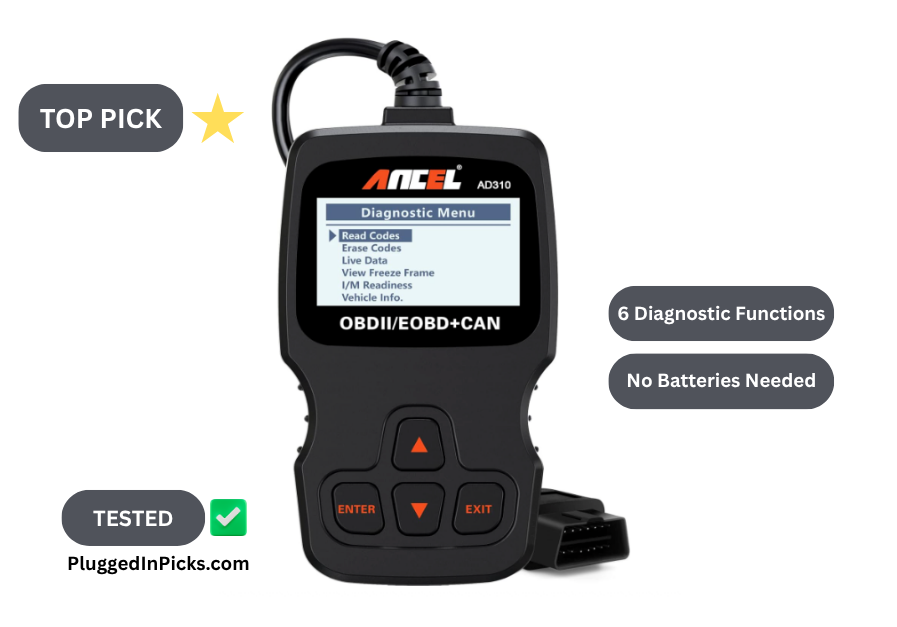
The check engine light is one of the most anxiety-inducing things a dashboard can do. It could be a loose gas cap. It could be an oxygen sensor. It could be something that needs immediate attention or something that’s been sitting dormant for two years. Without a scanner, you either drive to AutoZone and hope someone can run it, or you pay a shop diagnostic fee just to find out what you’re dealing with. The ANCEL AD310 exists to eliminate that trip entirely.
I’ve had one in the CRV for over a year. It’s come out twice for actual check engine lights — once for an evap leak code that turned out to be a loose gas cap, once for an O2 sensor flag I needed to track before deciding whether to repair or ignore — and a handful of times just to run a smog readiness check before an emissions test. Here’s the honest picture on what it does well, where it stops, and who actually needs one.
Quick Verdict
The ANCEL AD310 is the right OBD2 scanner for the vast majority of everyday drivers. It reads and clears check engine light codes quickly, requires no batteries or apps, and works on virtually any vehicle made after 1996. The #1 bestseller ranking in its category isn’t an accident — at this price point nothing comes close for basic code reading. The limitations are real and worth knowing upfront: it handles emission-related diagnostics only, it won’t touch ABS, SRS, or transmission codes, and the screen and build are entry-level. For drivers who want to know what a check engine light means before calling a mechanic, it does exactly that job reliably.
Buy this if: You want a no-fuss tool to read and clear check engine codes on any 1996 or newer vehicle without paying a shop diagnostic fee every time.
Skip it if: You need ABS, SRS, or transmission diagnostics, or want deeper live data and bidirectional controls — those require a more capable scanner at a higher price point.
How I Tested:
- Real code diagnosis: Used the AD310 on my 2017 Honda CRV during two actual check engine light events — not manufactured test conditions. The first was an evap system code (P0456 — small evap leak) that cleared after tightening the gas cap and a few drive cycles. The second was an O2 sensor flag I wanted to monitor over time before committing to a repair. Both times the scanner identified the code, displayed the definition on screen, and allowed me to clear it without any manual lookup.
- Smog readiness: Ran the I/M monitor readiness check on the CRV before an Illinois emissions test — confirmed all monitors were ready before driving to the station, which is exactly the use case it’s built for.
- Usability in real conditions: Tested in a parking garage with low ambient light and in a driveway in direct sunlight. Noted how the 2.4-inch screen reads in both conditions, how the menu navigation feels with work-worn hands, and how the 2.5-foot cable reaches the OBD port from a standing position outside the driver’s door.
- Protocol and compatibility: Verified connection and code reading on the CRV (CAN protocol). Cross-referenced owner feedback from verified buyers on a wide range of makes and models for compatibility pattern.

test I ran the I/M monitor check on the CRV first — confirmed all monitors were complete
before driving to the station. Saves a wasted trip if something isn’t ready.
Performance Breakdown: Technical Specs vs. Real-World Use
| Feature | Spec | Real-World Note |
|---|---|---|
| Compatible Vehicles | 1996+ US, 2000+ EU and Asian | Covers the overwhelming majority of vehicles on the road. Confirm compatibility for pre-2000 imports before purchasing. |
| OBD2 Protocols | KWP2000, J1850 VPW, ISO9141, J1850 PWM, CAN | Full protocol support — unlike cheaper scanners that skip protocols and fail on certain makes. |
| Screen Size | 2.4 inches, 128×64 resolution | Small but readable in low light. Direct sunlight washes it out — angle accordingly. |
| Cable Length | 2.5 feet | Long enough to reach the OBD port from outside the driver’s door on most vehicles. Not generous — don’t expect workbench flexibility. |
| Power Source | Draws from OBD port — no batteries needed | Plug in and it powers on. No charging, no batteries to replace, no app required. |
| Weight | 12 ounces | Light enough to keep in a glove box or center console without it being a burden. |
| Dimensions | 8.9″L x 6.9″W x 1.4″H | Compact and pocketable. Fits in a jacket pocket or tool bag easily. |
| Functions | Read/clear DTCs, live data, freeze frame, I/M readiness, VIN retrieval | Covers everything a basic code reader needs to do. Live data is present but basic — don’t expect graphing capability. |
| Does NOT support | ABS, SRS, transmission codes | Emission-related diagnostics only. This is the most important limitation to understand before purchasing. |
| Operating System | Linux | Runs on the device itself — no pairing, no Bluetooth, no smartphone dependency. |
✅ Who It’s For
- Everyday drivers who want to know what a check engine light means
- DIY mechanics doing basic emissions-related repairs
- Drivers preparing for smog or emissions tests
- Anyone tired of paying shop diagnostic fees for simple code reads
- Multi-vehicle households who want one scanner for all their cars
❌ Who It’s Not For
- Anyone needing ABS, SRS, or transmission diagnostics
- Professional mechanics who need full system access
- Anyone wanting Bluetooth or smartphone app integration
- Drivers of pre-1996 US vehicles or pre-2000 imports
- Anyone who wants live data graphing or bidirectional controls

number and nothing else. The P0456 evap code on my CRV read the full description right on
the display — no separate lookup. Worth noting the fine print: engine codes only. ABS, SRS,
and transmission are outside this tool’s scope by design.
Reading and Clearing Codes — What the Experience Actually Looks Like
Plug into the OBD port — located under the driver’s side dash on virtually every vehicle made after 1996 — and the AD310 powers on immediately from the vehicle’s battery. No pairing, no app, no Bluetooth. Navigate to “Read Codes” with the directional pad, wait a few seconds, and the code appears on screen with a plain-English definition alongside it.
On the CRV, the P0456 evap code came up as “Evaporative Emission Control System Leak Detected (Very Small Leak)” — no manual lookup required. That definition on-screen is one of the details that separates the AD310 from cheaper readers that display the code number only and leave you Googling the rest.
Clearing codes is equally straightforward — navigate to “Erase Codes,” confirm, and the light goes off. Important note from the listing: the erase function requires key on, engine off. Don’t try to clear codes with the engine running — it won’t work and it’ll confuse you about whether the scanner is functioning correctly.
One honest limitation in real use: if the underlying problem isn’t fixed, the code comes back after a few drive cycles. The scanner doesn’t fix anything — it tells you what’s wrong and lets you clear the flag. That’s the whole job, and it does it cleanly.
What It Doesn’t Do — The Limitations That Matter
This section matters more than any other in this review because the AD310’s limitations are where buyers get caught off guard.
It handles emission-related engine codes only. If your check engine light is triggered by an ABS fault, an SRS (airbag) issue, or a transmission problem — the AD310 won’t read it. It will connect to the vehicle, show no codes, and leave you thinking the scanner isn’t working. It is working. The fault just lives in a system the AD310 doesn’t access.
It also doesn’t support OBD-I vehicles — anything made before 1996 in the US, or before 2000 for most EU and Asian imports. An OBD-I adapter won’t help — the protocol difference is fundamental, not a connector issue.
For most everyday drivers these limitations don’t matter. A check engine light on a 2005 or newer daily driver is almost always an emission-related fault. But for anyone who drives an older vehicle, works on multiple platforms, or needs ABS and transmission visibility, the AD310 is the wrong tool. The ANCEL AD530 is the natural step up if you need broader system access.
Build and Screen — Entry Level, Honestly
The AD310 feels like what it is — a well-built entry-level tool. The housing is hard plastic with enough weight to feel solid without being bulky. The 2.5-foot cable is thick and flexible rather than the brittle kind that cracks after a few uses. The buttons are labeled clearly and have a positive click.
The 2.4-inch screen is the area where entry-level shows most clearly. In a dim garage it reads fine — the contrast is adequate and the text is large enough to navigate without squinting. In direct sunlight it washes out enough that you’ll want to angle the unit or shade it with your hand. It’s not a dealbreaker but it’s worth knowing going in, especially if you’re regularly working outdoors.
The screen size also means the live data display is functional rather than rich. You can read sensor values, but there’s no graphing, no multi-parameter overlay, no data logging. For looking up a code and clearing it, that’s irrelevant. For deeper diagnostic work, it’s the ceiling you’ll hit.
No Batteries, No Apps, No Pairing
This deserves its own section because it’s one of the AD310’s most underappreciated advantages. There’s no Bluetooth to pair, no smartphone app to download, no account to create, no subscription to manage. Plug it in, it works. That simplicity is exactly right for a tool that spends most of its life in a glove box waiting to be needed.
Bluetooth OBD scanners have their appeal — the app interfaces are richer and the data visualization is better — but they add friction at exactly the wrong moment. When a check engine light comes on during a road trip or in an unfamiliar location, the last thing you want is to troubleshoot a Bluetooth connection or remember which app you paired it with. The AD310 just works.
What Other Owners Are Saying
With over 62,000 verified reviews and a 4.6-star average, the pattern is about as clear as it gets for a product in this category. Ease of use and reliability on basic code reading come up consistently — owners across a wide range of mechanical experience levels describe the same experience: plug in, get the code, understand what it means, clear it. Several owners with multiple vehicles specifically call out that one unit covers their entire household without compatibility issues.
The honest friction point in the feedback mirrors what the listing disclaims: buyers who expected full system diagnostics — ABS, SRS, transmission — report disappointment when those codes don’t show. That’s a purchasing decision problem, not a product defect. The AD310 is exactly what it says it is. Reading the limitations before buying eliminates that frustration entirely.
A small number of owners report connection errors on specific older vehicle models. Per ANCEL’s guidance, confirming compatibility with customer service before purchasing is worthwhile if your vehicle is pre-2000 or a less common import.

interface takes about two minutes to get oriented on. The 16-pin OBD2 connector fits every
compliant port without adapters.
Final Decision:
The ANCEL AD310 earns its #1 bestseller ranking the honest way — it does a specific job reliably, costs less than a single shop diagnostic visit, and works on virtually every vehicle most people actually drive. Having one in the CRV has saved two unnecessary mechanic trips and removed the low-level anxiety that used to come with every check engine light. That alone is worth the price of admission.
The limitations are real and non-negotiable — emission codes only, no ABS or SRS access, entry-level screen and live data. None of that matters for the driver it’s built for: someone who wants to know what a check engine light means, clear it after a repair, and not need a mechanic to do either. For that use case the AD310 is the standard the category is measured against. If your needs go beyond that, it’s worth stepping up to a more capable scanner — but most drivers will never need to.
Frequently Asked Questions:
- What does the ANCEL AD310 do? The ANCEL AD310 reads and clears OBD2 diagnostic trouble codes on 1996 and newer vehicles. It displays the code and a plain-English definition on screen, allows you to clear the check engine light after a repair, runs I/M monitor readiness checks for emissions testing, and can display live sensor data and freeze frame information. It handles emission-related diagnostics only — it does not access ABS, SRS, airbag, or transmission systems.
- Does the ANCEL AD310 need batteries? No. It draws power directly from the vehicle’s OBD2 port — no batteries, no charging, no external power source required. Plug it in and it powers on immediately.
- Where do you plug in an OBD2 scanner? The OBD2 port is located under the driver’s side dashboard on virtually every vehicle made in 1996 or later. It’s typically within reach of the steering column — look for a 16-pin trapezoidal connector. On most vehicles it’s accessible without tools or removing any panels.
- Can you plug in an OBD scanner while the car is running? Yes — you can connect and read codes with the engine running. However, the erase/clear codes function requires key on, engine off. Do not attempt to clear codes with the engine running.
- Will the ANCEL AD310 read ABS or airbag codes? No. The AD310 is limited to emission-related engine diagnostics. ABS, SRS, airbag, and transmission fault codes require a more advanced scanner that supports full system access. If your warning light is ABS or airbag related, the AD310 will not retrieve those codes.
- What vehicles is the ANCEL AD310 compatible with? All 1996 and newer US-based vehicles, and 2000 and newer EU and Asian vehicles that use the OBD2 protocol. It supports all five OBD2 protocols — CAN, KWP2000, J1850 VPW, J1850 PWM, and ISO9141. OBD-I vehicles are not supported. If you’re unsure about your specific vehicle, ANCEL recommends confirming with their customer service before purchasing.
- How do you use an OBD2 scanner? Locate the OBD2 port under your driver’s side dash, plug in the scanner, and turn the key to the “on” position without starting the engine. Navigate to “Read Codes” using the directional pad. The scanner will communicate with the vehicle’s computer and display any stored fault codes with definitions. To clear a code after repairing the issue, navigate to “Erase Codes” with the key on and engine off.
- What’s the difference between the ANCEL AD310 and AD530? The AD310 is a dedicated code reader — emission-related engine diagnostics, read and clear codes, live data, freeze frame, I/M readiness. The AD530 is an upgraded scanner that adds battery testing and broader system coverage. If the AD310’s emission-only scope covers your needs, it’s the better value. If you need ABS, SRS, or battery diagnostics, the AD530 is the appropriate step up.
Related Reading
- Michelin CrossClimate 2 Review — knowing what your check engine light means is one layer of road confidence; having tires that handle whatever the road throws at you is another
- Noco GB40 Jump Starter Review — the AD310 pairs naturally with a jump starter in the glove box; our GB40 review covers the best compact unit for emergency starts
- Airmoto Tire Inflator Review — rounding out the roadside preparedness kit; our Airmoto review covers the best portable inflator for staying ahead of pressure drops